What Everyone Is Saying
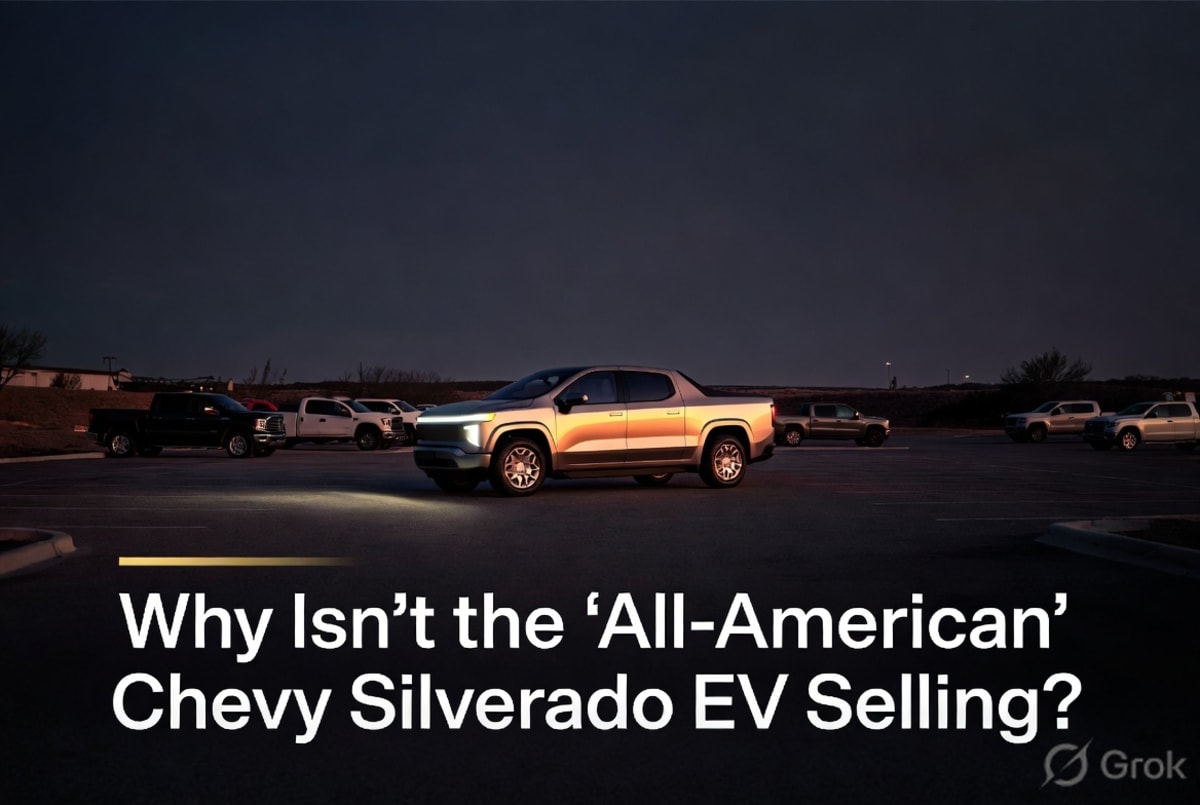
The dominant narrative surrounding the Chevrolet Silverado EV is one of perplexing underperformance. Mainstream reports often highlight its impressive specifications – substantial range, powerful towing capacity, and advanced technology – and frame it as a quintessential American product, built for the hardworking consumer. The expectation, therefore, is strong sales. Yet, the reality on the ground appears to be a stark contrast. Many observers are puzzled, asking why a vehicle seemingly designed to capture the lucrative pickup truck market, particularly one with a strong 'Made in America' appeal, is not flying off dealership lots. The prevailing sentiment is that something is fundamentally amiss, a missed opportunity for General Motors to capitalize on the burgeoning EV trend with a product that should, by all accounts, be a hit. This narrative often stops short of offering a definitive answer, leaving a void that suggests a disconnect between the product and its intended audience.
What The Evidence Actually Shows
The stark reality is that sales figures for the Silverado EV have been notably sluggish since its launch. While specific monthly sales data can be proprietary, industry analyses and dealership reports consistently point to lower-than-expected demand. This isn't a simple case of a bad product; the Silverado EV boasts a GM-estimated range of up to 450 miles on certain trims and offers features like four-wheel steering for enhanced maneuverability. However, the average transaction price for new EVs, including trucks, remains significantly higher than their internal combustion engine counterparts. Data from Cox Automotive, for instance, has shown that while EV sales are growing, the pace has slowed, and inventory levels have increased, indicating a market that is becoming more discerning. Furthermore, the 'all-American' branding, while a potent marketing tool, doesn't fully insulate the vehicle from broader economic pressures and consumer hesitations regarding EV adoption, such as charging infrastructure concerns and upfront cost. Reports from automotive news outlets have detailed how dealerships are struggling to move inventory, with some Silverado EVs sitting on lots for extended periods.
The Layer Most Coverage Is Missing
What is largely being overlooked is the intricate interplay of structural economic factors and specific market segmentation that are suffocating the Silverado EV's potential. Firstly, the sheer price point of these advanced electric trucks places them out of reach for a significant portion of traditional pickup truck buyers, who are often more price-sensitive and utility-focused than early EV adopters. The target demographic for an EV truck is not necessarily the same as the traditional Silverado buyer. Secondly, the charging infrastructure, while improving, is still a significant hurdle, especially for those in rural areas or without dedicated home charging solutions – precisely the environments where heavy-duty trucks are often utilized. The 'built in America' angle also faces a complex reality: while assembly may occur in the US, the global supply chain for EV components, particularly batteries, means a truly 'all-American' EV is a nuanced claim. Consumers are increasingly aware of these complexities, and the marketing message might not be resonating as strongly as General Motors intended, especially when compared to the established familiarity and lower entry cost of gasoline-powered trucks. The current EV market is also becoming saturated with choices, making it harder for any single model to dominate without a clear, compelling value proposition beyond its powertrain.
What This Means For India
For India, the Silverado EV's lukewarm reception offers a critical cautionary tale. India's automotive market is overwhelmingly dominated by price-conscious consumers, where the upfront cost of electric vehicles remains a significant barrier, even for smaller passenger cars, let alone large trucks. The concept of an 'all-American' EV truck has little direct resonance; the focus here is on affordability, practicality for Indian road conditions, and increasingly, local manufacturing and cost-effectiveness. While the demand for commercial vehicles, including trucks, is immense, the transition to electric is being driven by operational cost savings and government incentives, not necessarily by a desire for cutting-edge, premium-priced EVs. The infrastructure challenges in India, particularly charging availability in less urbanized areas, are even more pronounced than in the US. Therefore, any Indian EV truck strategy must prioritize accessible pricing, robust charging solutions tailored to local needs, and a clear demonstration of total cost of ownership benefits, rather than relying on nationalistic branding or high-spec, high-cost propositions. The Silverado EV's struggle underscores that 'impressive specs' alone do not guarantee market success; deep local market understanding is paramount.
Let us be honest: the Chevy Silverado EV is a victim of its own ambition and a market that is far more pragmatic than automakers often assume. General Motors has built a technologically advanced EV truck, but it has failed to align its product and pricing strategy with the realities of the vast majority of potential pickup truck buyers. The 'all-American' narrative is a smokescreen for a vehicle that is too expensive, too niche, and too reliant on an EV infrastructure that is still developing. The data clearly indicates that while there is a segment for premium EVs, the core pickup truck market remains anchored to value, utility, and familiarity. The Silverado EV, in its current form, appeals more to the early adopter EV enthusiast than the seasoned truck owner. Its struggles are not a sign that the EV truck market is dead, but rather that it requires a different approach – one that prioritizes affordability, realistic infrastructure integration, and a value proposition that directly addresses the pain points of the average truck buyer. The true 'all-American' truck buyer in the 21st century is looking for a workhorse that makes economic sense, not just a technological statement. This failure to connect the dots between advanced EV technology and the economic calculus of the common consumer is the fundamental flaw, a lesson that will likely echo across the global EV market.
- EV truck pricing remains a major barrier for mainstream adoption.
- Charging infrastructure is a more significant concern for practical truck users than often acknowledged.
- 'Made in America' branding alone cannot overcome economic realities and consumer priorities.
- The success of EV trucks hinges on bridging the gap between advanced tech and affordability.
The Silverado EV's sales figures will continue to be a closely watched indicator of the broader EV truck market's health. What happens next will depend on whether GM and other manufacturers can adapt their strategies to meet consumer needs or if they will continue to chase a market that isn't yet ready for their vision. The ultimate test will be whether they can deliver an electric truck that is not just technically capable, but also economically viable for the working person.