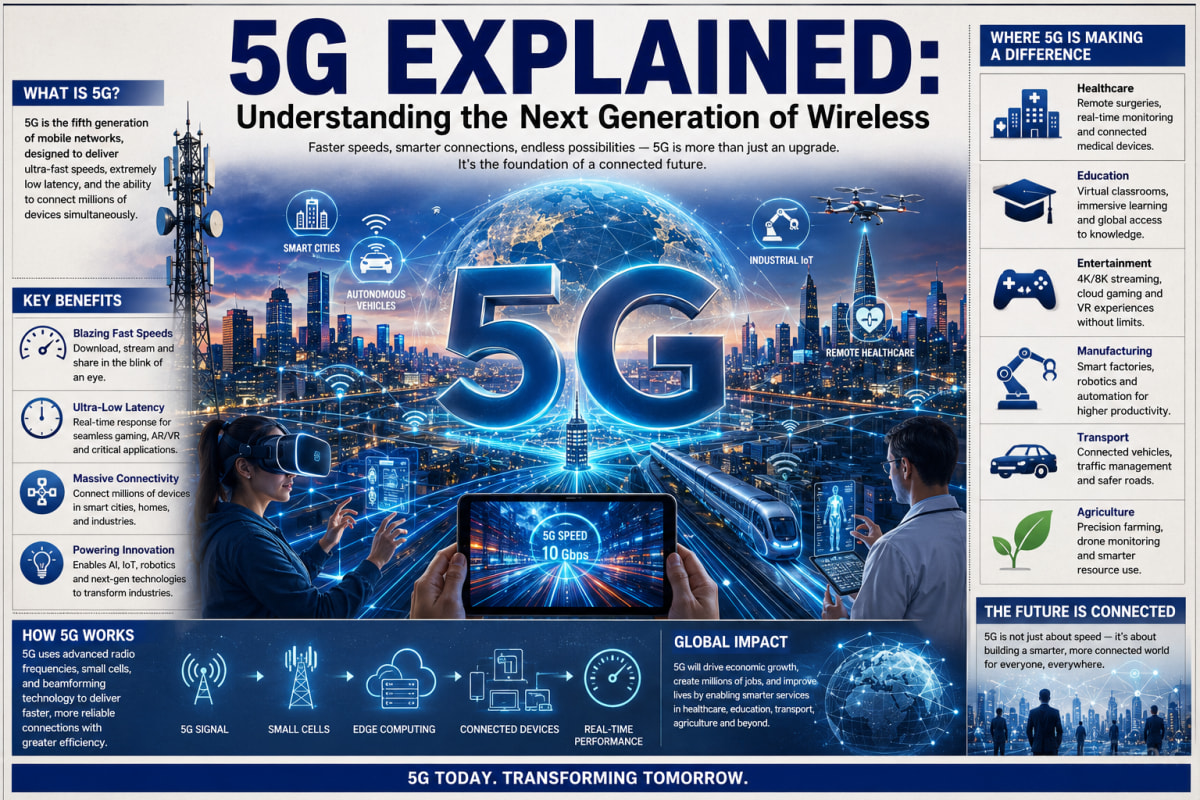
The fifth generation of cellular network technology, commonly known as 5G, represents a significant leap forward from its predecessors. It’s not just about faster phone downloads; it’s a foundational technology designed to connect virtually everything, enabling new applications and services that were previously impossible. Think of it as a hyper-connected nervous system for our increasingly digital world, promising lower latency, higher capacity, and greater reliability than 4G LTE.
Many consumers experienced 5G as a buzzword accompanying new smartphone releases, often associated with faster speeds. However, the true potential of 5G extends far beyond mobile broadband. It’s engineered to support the massive influx of data from the Internet of Things (IoT) devices, enable real-time control for autonomous vehicles and remote surgery, and power immersive experiences like augmented and virtual reality. The transition to 5G is a complex, multi-year process involving significant infrastructure upgrades and spectrum allocation by governments worldwide. Its rollout has been uneven, with some regions experiencing widespread availability while others are still in the early stages of deployment.
What Exactly Is 5g
At its core, 5G is the latest iteration of cellular network technology, designed to offer a dramatic improvement in speed, latency, and connectivity compared to 4G. It’s not merely an upgrade to your phone's internet connection; it’s a fundamental reimagining of wireless communication. Imagine 4G as a busy highway, capable of handling a good amount of traffic, but prone to congestion during peak hours. 5G, on the other hand, is like a multi-lane superhighway with dedicated express lanes, optimized for vastly more vehicles and instantaneous travel. This enhanced capacity means 5G can support a much larger number of connected devices simultaneously, a crucial factor for the exploding Internet of Things (IoT). Furthermore, its significantly lower latency—the delay between sending and receiving data—opens doors for real-time applications that require immediate responses, such as autonomous driving, advanced robotics, and remote medical procedures. The technology also utilizes a broader range of radio frequencies, including millimeter waves (mmWave), which offer extremely high bandwidth but have a shorter range, necessitating a denser network of smaller cell sites.
How It Actually Works
5G operates by employing a combination of advanced technologies that work in concert to achieve its superior performance. One key component is the use of higher frequency bands, particularly millimeter waves (mmWave), which range from 24 GHz to 100 GHz. These frequencies can carry enormous amounts of data, offering speeds potentially exceeding 10 gigabits per second (Gbps), far surpassing 4G's peak speeds of around 1 Gbps. However, mmWave signals have a very short range and are easily blocked by obstacles like walls and even rain. To overcome this, 5G networks utilize Massive MIMO (Multiple Input, Multiple Output) technology, which employs a large number of antennas at cell sites to simultaneously transmit and receive data to multiple users, improving efficiency and coverage. Beamforming is another critical technique, allowing base stations to direct wireless signals precisely towards user devices, rather than broadcasting them in all directions. This focused transmission conserves energy and reduces interference. Additionally, 5G networks are designed with a more flexible and software-defined architecture, utilizing network slicing. This allows operators to create multiple virtual networks on top of a single physical infrastructure, each tailored to specific service requirements—for example, one slice for enhanced mobile broadband, another for ultra-reliable low-latency communications for industrial applications. This intricate interplay of new spectrum, advanced antenna systems, and intelligent network management underpins 5G's transformative capabilities.
Why Is This Trending Right Now
The ongoing global expansion and refinement of 5G infrastructure are keeping the technology in the spotlight. As of July 2026, major telecommunications companies worldwide continue to invest billions in upgrading their networks, with a particular focus on expanding mid-band 5G coverage, which offers a good balance of speed and range. For instance, recent reports indicate that Verizon in the United States is accelerating its deployment of C-band spectrum 5G, aiming to cover millions more potential users by the end of the year. Similarly, in India, operators like Jio and Airtel are actively expanding their 5G footprints, with coverage now extending to numerous Tier 2 and Tier 3 cities, driving adoption rates. The increasing availability of 5G-enabled devices, from smartphones to industrial sensors, also fuels consumer and enterprise interest. Furthermore, the recent advancements in 5G-Advanced (5.5G) standards, which promise even greater speeds and lower latency, are generating discussions about the next wave of innovation that will be powered by this technology. These continuous developments in deployment, device compatibility, and future-proofing standards ensure 5G remains a persistent topic of interest and a driver of technological advancement.
The Global Impact
The global impact of 5G is profound and multifaceted, touching economies, industries, and daily life across continents. In North America, the rollout has enabled significant advancements in areas like smart cities, with initiatives in cities like Toronto exploring 5G for enhanced public safety and traffic management systems. South Korea, an early adopter, has seen widespread 5G penetration, leading to a surge in demand for immersive entertainment and advanced mobile gaming experiences. In Europe, industrial sectors are beginning to leverage 5G for factory automation and the Industrial Internet of Things (IIoT). For example, Germany's manufacturing hubs are integrating 5G for real-time monitoring and control of production lines, boosting efficiency. Asia, particularly China, has been a leader in 5G infrastructure deployment, with over 3 million 5G base stations operational as of early 2026. This extensive network is supporting everything from remote healthcare services in rural areas to advanced logistics and autonomous vehicle testing. The economic implications are substantial, with projections indicating that 5G could contribute trillions of dollars to the global economy in the coming decade by enabling new business models and driving innovation across sectors like healthcare, automotive, and entertainment. The sheer scale of connectivity that 5G facilitates is poised to reshape global commerce and societal interaction.
What Most People Get Wrong
A common misconception about 5G is that it's solely about faster internet speeds for smartphones. While enhanced mobile broadband is a significant benefit, it represents only a fraction of 5G's true potential. Many fail to grasp that 5G is a foundational technology designed to be a universal communication fabric. The real game-changers lie in its ultra-low latency and massive capacity, which are critical for the Internet of Things (IoT), autonomous systems, and mission-critical applications. For instance, the ability for a self-driving car to communicate with other vehicles and infrastructure in milliseconds, or for a surgeon to remotely operate robotic instruments with near-instantaneous feedback, are capabilities that 4G simply cannot support. Another oversimplification is viewing 5G as a single, monolithic technology. In reality, 5G networks are deployed across different frequency bands (low, mid, and high/mmWave), each offering distinct characteristics in terms of speed, range, and penetration. The