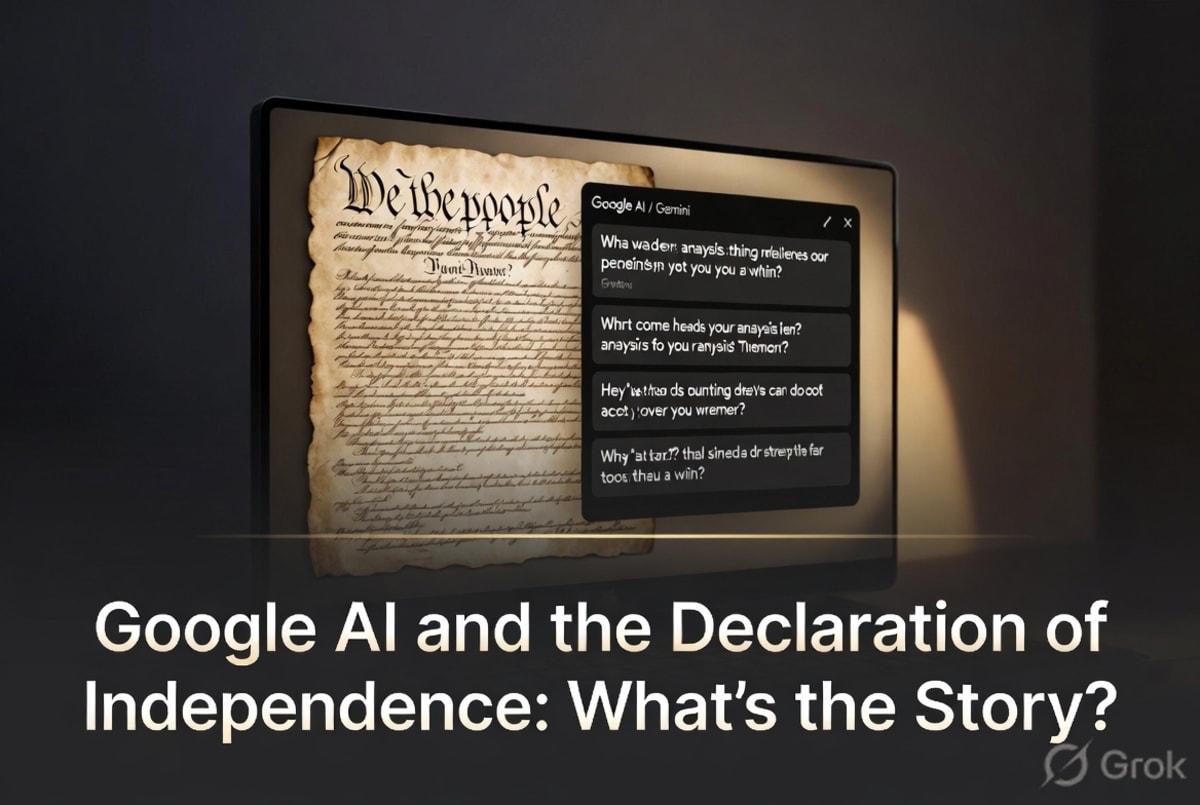
Google's recent advertisement has ignited a unique discussion by envisioning a hypothetical scenario: what if the Declaration of Independence was drafted with the assistance of Artificial Intelligence? The commercial presents a thought-provoking narrative, suggesting that AI could have served as a powerful tool for historical figures, aiding in the articulation of foundational democratic principles. This imaginative leap is not just about a clever ad campaign; it's a prompt to consider the evolving relationship between human creativity and artificial intelligence, particularly in contexts that shape our understanding of history and governance.
What Exactly Is New Google commercial imagines
The core of Google's commercial is a speculative 'what if' scenario. It doesn't claim AI *did* help write the Declaration of Independence, but rather uses this premise to explore AI's potential as a creative and intellectual partner. Imagine a tool that could instantaneously access and synthesize vast historical texts, philosophical treatises, and legal precedents. This AI, as envisioned in the ad, could have helped Thomas Jefferson and the other Founding Fathers refine their arguments, explore different phrasings for critical concepts like liberty and equality, and even fact-check historical claims relevant to their grievances against the British Crown. The commercial suggests that AI could have streamlined the arduous process of drafting such a monumental document, potentially leading to a more robust, comprehensive, or even differently articulated statement of ideals. It’s about showcasing AI's capacity to assist in high-level cognitive tasks, moving beyond simple automation to collaborative ideation and refinement.
How It Actually Works
While the commercial is fictional, the underlying technology it alludes to is very real and rapidly advancing. Modern AI, particularly large language models (LLMs) like Google's own Gemini, operate by processing enormous datasets of text and code. When prompted, these models can generate human-like text, translate languages, write different kinds of creative content, and answer your questions in an informative way. In the context of the ad's premise, an AI could function as an advanced research assistant and writing aide. A user, like a hypothetical Jefferson, might input a core idea, such as 'unalienable rights,' and the AI could generate various definitions, historical examples of their assertion or denial, and even suggest eloquent phrasing drawing from classical rhetoric or Enlightenment philosophy. For instance, if Jefferson was struggling to articulate the concept of consent of the governed, an AI could present different formulations used by thinkers like Locke or Rousseau, alongside potential counterarguments and ways to address them. The AI could also help identify potential logical inconsistencies or areas where the document might be misinterpreted, providing a layer of critical review. The process would involve iterative prompting and refinement, with the human user guiding the AI's output to align with their intent and vision. The AI essentially acts as an incredibly sophisticated brainstorming partner and editor, capable of accessing and processing information at scales far beyond human capacity. For example, an LLM could analyze millions of historical documents in seconds to find the most compelling precedents for a particular argument.
Why Is This Trending Right Now
This Google commercial is tapping into a zeitgeist where AI's capabilities are rapidly expanding and becoming more accessible. The ad, released recently, coincides with a period of intense public and professional interest in generative AI. Major tech companies, including Google, are in a race to develop and deploy increasingly sophisticated AI models, leading to frequent news cycles about their advancements and potential impacts. Discussions about AI's role in creative fields, from art and music to writing, are at an all-time high. Furthermore, the specific use of the Declaration of Independence brings a historical and philosophical weight to the conversation, prompting reflection on how AI might intersect with foundational human endeavors and societal structures. The ad's release strategically leverages this current fascination, positioning AI as a tool that can even aid in crafting documents of profound historical significance, thereby amplifying its perceived importance and potential. It’s a timely narrative as AI moves from a niche technological concept to a mainstream tool impacting daily life and future possibilities.
The Global Impact
The implications of AI as a collaborative partner, as suggested by the Google ad, extend far beyond historical hypotheticals. Globally, AI is already transforming industries by enhancing productivity and innovation. In education, AI tutors can provide personalized learning experiences, adapting to individual student needs in real-time. In scientific research, AI is accelerating discovery by analyzing complex datasets, leading to breakthroughs in medicine and material science. For instance, AI has been instrumental in developing new drug candidates and understanding intricate biological processes. Economically, countries are investing heavily in AI research and development, aiming to boost their competitiveness. Nations like China and the United States are leading in AI investment, with billions of dollars poured into AI startups and infrastructure. However, this also raises concerns about job displacement and the ethical use of AI, prompting governments worldwide to develop regulatory frameworks. The potential for AI to assist in complex communication, like drafting legislation or international treaties, could also foster greater understanding and efficiency in global diplomacy, though it simultaneously raises questions about accountability and bias in decision-making processes. The impact is multifaceted, promising unprecedented advancements while demanding careful consideration of its societal and ethical ramifications across diverse geopolitical landscapes.
What Most People Get Wrong
One of the most common misconceptions is that the ad implies AI is capable of independent thought or original historical contribution in the way humans are. People often conflate AI's ability to generate coherent and contextually relevant text with genuine consciousness or subjective experience. The commercial, while imaginative, uses AI as a sophisticated tool, an amplifier of human intent, rather than a sentient co-author. The AI doesn't *understand* liberty or *believe* in equality; it processes patterns and probabilities from its training data to construct language that reflects these concepts as understood by humans. Another oversimplification is viewing AI solely through the lens of automation, expecting it to replace human roles entirely. In reality, the more profound impact, and the one hinted at by the ad, is AI's potential to augment human capabilities, enabling us to tackle more complex problems and engage in higher-order thinking. The ad's vision is one of partnership, not replacement, a nuanced distinction often lost in broader public discourse. The idea that AI could have 'written' the Declaration suggests a level of agency it does not possess; it's a tool that assists the writer, not one that writes by itself.
Google's commercial is a masterful piece of speculative marketing, brilliantly framing AI not as a cold, calculating machine, but as a potential muse for historical and modern innovation. While the ad is a fictional exploration, it underscores a critical truth: AI's most transformative power lies in its ability to collaborate with human intellect. The notion of AI assisting in drafting foundational documents like the Declaration of Independence is a powerful metaphor for how AI can help us articulate complex ideas, refine arguments, and push the boundaries of human creativity. We should embrace AI as an intellectual amplifier, a tool that can help us overcome cognitive limitations and explore new frontiers of thought. The real 'next step' isn't just about building more powerful AI, but about developing the wisdom and frameworks to integrate these tools ethically and effectively into every facet of human endeavor, from historical reflection to future-building. The ad correctly identifies that AI's true value is in its synergy with human ingenuity.
- AI as a creative partner in historical contexts
- The mechanics of modern large language models
- Current trends driving AI interest
- Global economic and societal impacts of AI
- Distinguishing AI assistance from independent thought
- Google's framing of AI as an intellectual amplifier
This imaginative commercial serves as a compelling starting point for a broader conversation about AI's role in shaping not just our future, but also our understanding of the past. As AI continues to evolve, its potential to serve as a partner in human endeavors, from artistic creation to the articulation of fundamental societal values, is becoming increasingly evident. The ongoing dialogue will be crucial in determining how we harness this technology responsibly and effectively.
Google AI Blog, "Gemini: A new era of AI models," December 2023.
The Verge, "Google's new AI ad imagines the Declaration of Independence written with AI," July 2, 2026.
UNESCO, "AI and education: Guidance for policy-makers," 2021.
McKinsey Global Institute, "The state of AI in 2025," November 2025.
MIT Technology Review, "AI doesn't think, it predicts," April 15, 2026.