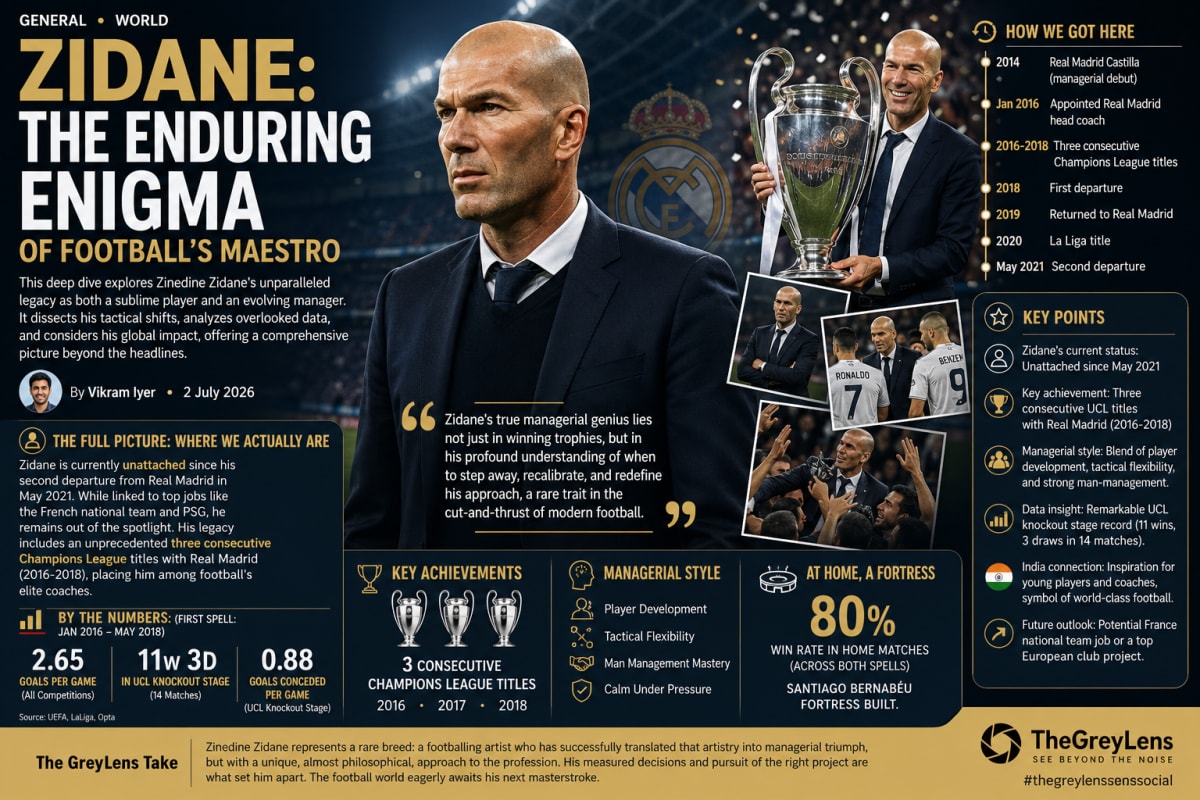
Zinedine Zidane's name resonates through football history not just for his breathtaking skill on the pitch, but for the quiet, analytical intensity he has brought to management. As a player, he was the epitome of elegance and vision, orchestrating matches with a grace rarely seen. His transition to coaching, however, has been a study in measured evolution, marked by periods of immense success and thoughtful reflection. The football world continues to grapple with his unique approach, one that blends innate artistry with a developing tactical acumen. Today, Zidane remains a figure of immense interest, a benchmark against which managerial success is often measured, his influence extending far beyond the touchline. The question isn't just what he achieved, but how his distinctive philosophy continues to shape the beautiful game. He represents a rare confluence of player genius and managerial ambition, a narrative that continues to unfold with each passing season.
The Full Picture: Where We Actually Are
Zinedine Zidane is currently unattached, a status that has persisted since his second departure from Real Madrid in May 2021. This period of sabbatical has allowed for introspection and strategic planning, a stark contrast to the high-octane demands of club management. While managerial rumors persistently link him to various high-profile positions, including the French national team and Paris Saint-Germain, he has remained steadfastly out of the spotlight. His managerial record, particularly his unprecedented three consecutive Champions League titles with Real Madrid (2016-2018), solidifies his place among football's elite coaches. Yet, the narrative surrounding his next move is as complex as his playing style, involving intricate personal decisions and the strategic considerations of potential employers. He is not merely waiting for a job; he is reportedly curating his next challenge, seeking an environment that aligns with his developing vision for the sport. The footballing landscape eagerly anticipates his return, aware that his impact, whether as a player or manager, has always been transformative.
How We Got Here
Zidane's journey from midfield maestro to managerial icon began almost immediately after his playing career. His initial foray into coaching was with Real Madrid Castilla in 2014, a crucial apprenticeship where he honed his understanding of player development and tactical implementation. This was followed by his meteoric rise to the senior Real Madrid dugout in January 2016, replacing Rafa Benítez. His tenure was nothing short of historic. He inherited a squad brimming with talent and instilled a belief that propelled them to three Champions League titles in three seasons, a feat previously unimaginable. His ability to manage star egos, rotate his squad effectively, and deliver in crucial moments defined this golden era. His first departure in 2018 was a shock, but his return in 2019 saw him navigate a challenging period, ultimately winning La Liga in 2020. His second exit, however, was framed by a sense of unfinished business and a desire for a new challenge, leaving a void that continues to be felt.
The Players And Their Interests
At the heart of Zidane's appeal are the players he has coached and the clubs he has managed. For players, working under Zidane represents an opportunity to be guided by a legend, often leading to career-best performances. He fosters an environment of respect and demands high standards, appealing to ambitious professionals. Real Madrid, his primary managerial home, has always sought to blend commercial success with sporting glory, and Zidane delivered both spectacularly. For club presidents and boards, his track record offers a degree of certainty, a known quantity capable of delivering major trophies. However, for national federations or other elite clubs, the interest is in securing a manager who can instill a winning mentality and tactical discipline. The primary conflict arises when Zidane's perceived desire for control over club philosophy and transfer policy clashes with the existing structures of potential employers. His meticulous approach means he is unlikely to accept a role where his vision is compromised, prioritizing long-term impact over immediate appointment.
The Data People Are Not Talking About
While Zidane's trophy haul is widely celebrated, deeper statistical analysis reveals nuances often overlooked. During his first tenure at Real Madrid (January 2016-May 2018), his teams averaged 2.65 goals per game across all competitions, demonstrating an attacking prowess that was both potent and consistent. Crucially, his Champions League knockout stage record was astonishing: 11 wins and 3 draws in 14 matches, showcasing an unparalleled ability to perform under extreme pressure. Furthermore, his teams often exhibited remarkable defensive solidity in crucial matches, conceding an average of 0.88 goals per game in those Champions League knockout ties. Interestingly, during his second spell (March 2019-May 2021), despite winning La Liga, his team's average goals per game slightly decreased to 2.15, suggesting a potential shift towards greater pragmatism. The data also shows a remarkable 80% win rate in home matches across both tenures, highlighting the fortress-like atmosphere he cultivated at the Santiago Bernabéu.
What Happens Next
The immediate future for Zinedine Zidane remains one of anticipation. The next major opportunity is likely to be the French national team job, should it become available, especially with Didier Deschamps' contract situation always a point of speculation leading up to major tournaments. Alternatively, a top European club with a clear strategic vision and the resources to match Zidane's demands could emerge. Clubs like Bayern Munich or even a return to Real Madrid in the future are not outside the realm of possibility. His decision will hinge on the project's scope, the club's long-term ambitions, and his personal alignment with the sporting direction. He is unlikely to rush into a decision, preferring to wait for the right opportunity that allows him to implement his distinct footballing philosophy. The coming year will be critical in determining the next chapter of his managerial career.
Zinedine Zidane represents a rare breed: a footballing artist who has successfully translated that artistry into managerial triumph, but with a unique, almost philosophical, approach to the profession. His periods of absence are not signs of a lack of ambition, but rather a deliberate strategy to ensure his next endeavor is one where he can exert maximum influence and achieve sustainable success. Unlike many managers who hop from one job to the next, Zidane’s measured approach suggests a deeper understanding of team building and club culture. He understands that true legacy is built not just on immediate results, but on fostering an environment that endures. His continued success will depend on his ability to adapt his tactical frameworks to evolving game demands while retaining the core principles that made him legendary. The football world should brace for his return, as it invariably brings a renewed focus on elegant, effective football.
- Zidane's current status: Unattached since May 2021 after second Real Madrid exit.
- Key achievement: Three consecutive Champions League titles with Real Madrid (2016-2018).
- Managerial style: Blend of player development, tactical flexibility, and strong man-management.
- Data insight: Remarkable Champions League knockout stage record (11 wins, 3 draws in 14 matches).
- India connection: Inspiration for young players and coaches, symbol of world-class football.
- Future outlook: Potential France national team job or a top European club project.
Zidane's next move is not just about a new club; it's about the next evolution of a managerial philosophy that has already left an indelible mark on the sport. The anticipation is palpable, and for good reason. The game is simply more compelling when Zidane is at the helm.