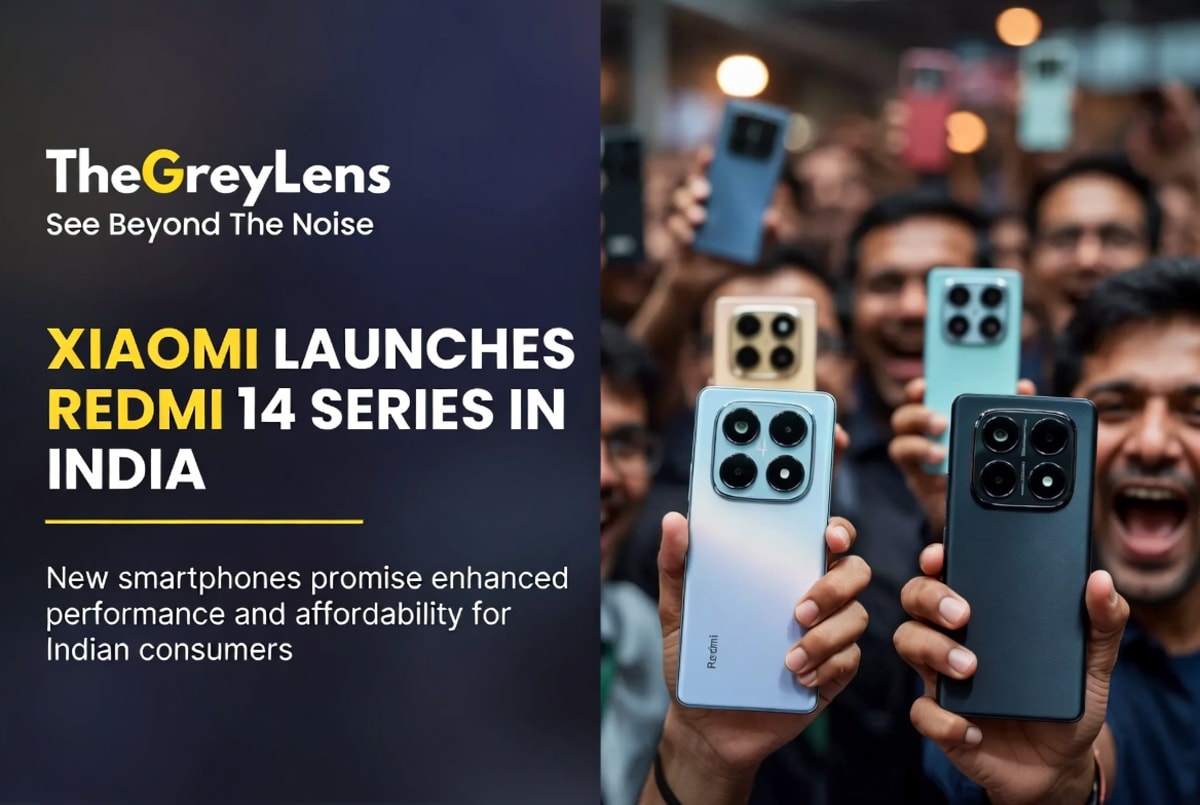
New Delhi – Xiaomi has once again set its sights on the lucrative Indian budget smartphone market with the unveiling of its Redmi 14 series. The launch, which took place today, introduces two new models: the Redmi 14 and the Redmi 14A. This move by the Chinese technology giant underscores its commitment to catering to the price-sensitive Indian consumer base, a segment where it has historically enjoyed significant success.
The Redmi 14 series is positioned to compete directly with other major players in the sub-₹15,000 category, a segment that continues to drive smartphone sales in India. The company has emphasized improvements in key areas such as camera performance, battery longevity, and display quality, aiming to provide an all-around better user experience without a substantial price hike. Both devices are expected to be available for purchase starting June 3rd on major e-commerce platforms and through offline retail channels across the country.
Redmi 14: A Feature-Rich Challenger
The Redmi 14, the more premium of the two new offerings, boasts a 50-megapixel primary camera sensor, a significant upgrade for its price bracket. This is complemented by an 8-megapixel ultrawide lens and a 2-megapixel macro sensor, offering users versatility for various photographic scenarios. On the front, a 13-megapixel selfie camera is housed within a subtle notch. The device is powered by the MediaTek Helio G99 processor, a capable chipset known for its balance of performance and power efficiency, making it suitable for everyday tasks and moderate gaming. It comes with 6GB of RAM and 128GB of internal storage, with an option to expand storage via a microSD card. The display is a 6.7-inch AMOLED panel with a 120Hz refresh rate, promising vibrant colors and smooth scrolling. Powering the Redmi 14 is a substantial 5,000mAh battery, supported by 33W fast charging. Xiaomi claims this battery can comfortably last over a day of typical usage. The device runs on MIUI 14 based on Android 13, offering a feature-rich software experience, though users may encounter pre-installed apps, a common characteristic of Xiaomi's software.
Redmi 14A: Value Proposition for the Masses
The Redmi 14A is designed to offer an even more accessible entry point into the Redmi ecosystem. It features a 50-megapixel main camera, paired with a 2-megapixel depth sensor for portrait shots. The front camera is an 8-megapixel unit. Under the hood, the Redmi 14A is equipped with the Qualcomm Snapdragon 680 processor, another efficient chipset well-suited for daily operations. This model is offered in configurations of 4GB RAM with 64GB storage and 6GB RAM with 128GB storage, both expandable. The display is a slightly smaller 6.6-inch IPS LCD panel with a 90Hz refresh rate. To keep costs down, the Redmi 14A houses a 5,000mAh battery but supports only 18W fast charging. This suggests a longer charging time compared to its sibling, but the battery capacity remains a strong selling point for users prioritizing endurance. Like the Redmi 14, the 14A also runs MIUI 14 based on Android 13.
Strategic Pricing and Market Impact
The pricing strategy for the Redmi 14 series is crucial to its success in India. The Redmi 14 is slated to be priced starting at ₹14,999 for the base 6GB+128GB variant, while the Redmi 14A will begin at ₹11,999 for the 4GB+64GB model. These price points place both devices squarely in the highly competitive budget segment, where brands like Samsung, Oppo, and Realme also have a strong presence. Xiaomi's aggressive pricing, coupled with its established brand recognition and extensive distribution network, gives it a significant advantage. The company's strategy often involves offering specifications that are slightly superior to competitors at similar price points, a tactic that has resonated well with Indian consumers. Industry analysts predict that the Redmi 14 series could further consolidate Xiaomi's position in the budget segment, potentially impacting sales of rival devices that may not offer the same level of features for the price. The focus on camera and battery life aligns with consumer preferences in India, where these features are often prioritized. The launch also comes at a time when smartphone upgrade cycles are shortening, with consumers looking for compelling value propositions to justify their purchases. The availability of attractive financing options and exchange offers through online and offline partners will also play a role in driving sales.
Xiaomi has also highlighted its commitment to local manufacturing and assembly in India, a move that aligns with the government's 'Make in India' initiative. This not only helps in managing costs but also contributes to the local economy. The company has consistently been one of the top smartphone vendors in India for several years, and the Redmi series has been instrumental in building its market share, particularly in the entry-level and mid-range segments. The introduction of the Redmi 14 and 14A is expected to continue this trend, offering consumers compelling choices that balance features, performance, and affordability. The company is anticipating strong demand, especially during the upcoming festive season, when consumer spending on electronics typically surges. The marketing campaigns are expected to focus on the camera capabilities of the Redmi 14 and the all-day battery life of both devices, aiming to appeal to a broad demographic of users. The company’s ongoing efforts to expand its retail footprint beyond Tier 1 and Tier 2 cities are also expected to support the sales of these new budget offerings, reaching a wider audience across rural and semi-urban areas.
The launch of the Redmi 14 series is a clear indication that Xiaomi is not resting on its laurels in the Indian market. The company continues to innovate and adapt its product strategy to meet the evolving demands of consumers. The competitive pricing and feature set of these new devices suggest that the budget smartphone segment in India is likely to witness intensified competition in the coming months. Consumers stand to benefit from this rivalry, as it often leads to better products and more attractive deals. Xiaomi’s performance in the coming quarters will be closely watched as it aims to defend and potentially expand its market share with these latest additions to its popular Redmi lineup.