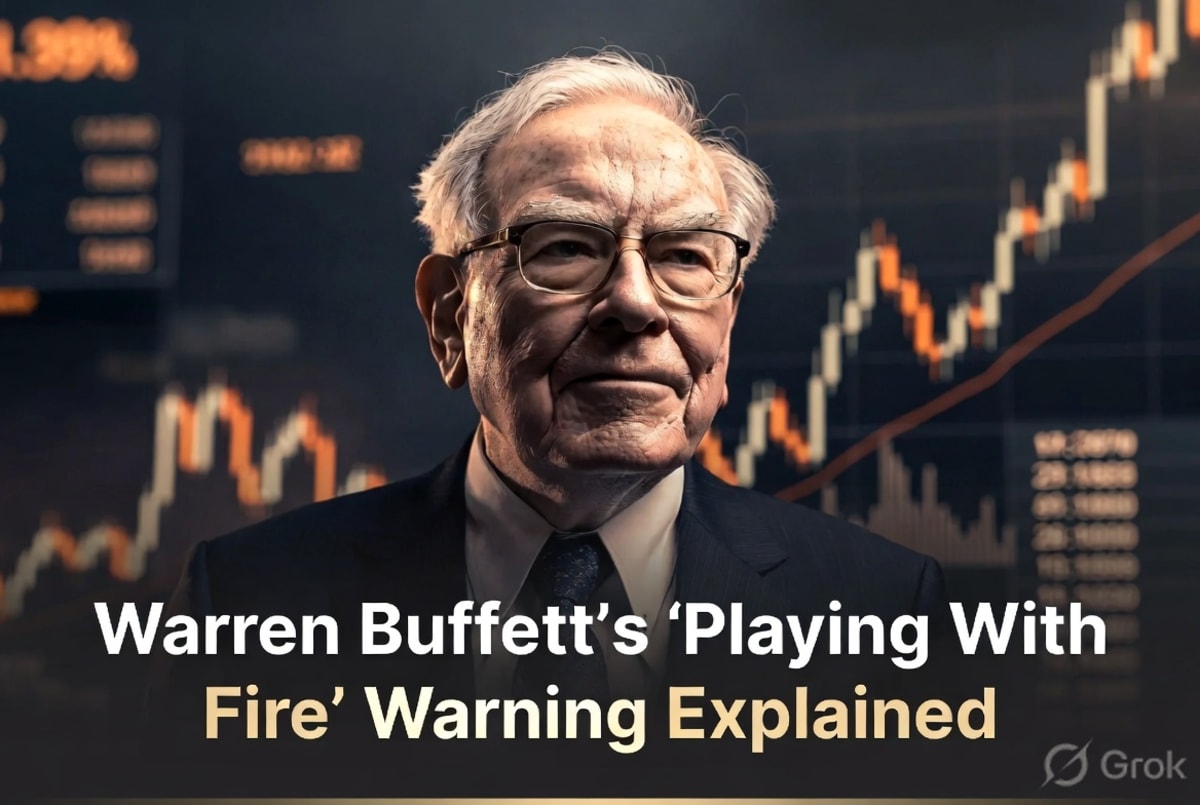
Warren Buffett, the Oracle of Omaha, is not one for casual pronouncements. When he issues a stark warning, particularly one as vivid as 'playing with fire' regarding the stock market, it demands attention. This phrase, however, is not a technical financial term but a potent metaphor. It signifies a market environment where speculative fervor and irrational exuberance have pushed asset prices to unsustainable levels, detached from underlying economic fundamentals. Buffett's concern is that investors, caught up in the excitement of rapid gains, are ignoring inherent risks, much like someone carelessly handling a flame. This isn't about a specific stock or sector, but a broad sentiment that can infect the entire market, leading to a dangerous complacency about potential downturns. His use of such strong language suggests a deep unease about the current market's trajectory and the behavior of its participants.
What Exactly Is Warren Buffett's Stock Market Warning
Warren Buffett's 'playing with fire' warning isn't a formal economic indicator or a quantifiable metric. Instead, it's a qualitative assessment of investor psychology and market conditions. He uses it to describe a market characterized by excessive speculation, where asset prices are driven up by optimism and the fear of missing out (FOMO) rather than by genuine value or earnings potential. It implies that investors are taking on undue risk, betting on continued rapid appreciation without adequate consideration for potential downsides. This often occurs during bull markets when prices have been steadily rising, leading to a sense of invincibility. Buffett, a value investor, prioritizes long-term fundamentals and intrinsic value. When he sees prices soaring far beyond what these fundamentals justify, and when speculative trading becomes rampant, he likens it to playing with fire – an activity that might offer short-term thrills but carries the significant risk of severe burns. His warning is a call for caution, urging investors to remember that markets can be volatile and that unsustainable gains often lead to sharp corrections.
How It Actually Works
Buffett's 'playing with fire' warning is rooted in observing market behavior that deviates from rational investment principles. When investors are 'playing with fire,' it often manifests in several ways. Firstly, there's a surge in speculative trading, where individuals buy assets not for their long-term utility or income-generating potential, but with the sole expectation of selling them quickly at a higher price. This can be seen in the proliferation of meme stocks, where social media hype drives valuations, or in the excessive trading volumes seen in certain high-flying tech stocks. Secondly, it involves a disregard for traditional valuation metrics. Investors might overlook high price-to-earnings (P/E) ratios, negative earnings, or unsustainable debt levels because they believe the market will continue to rise indefinitely. For example, during the dot-com bubble, many internet companies with no revenue were valued in the billions. Thirdly, a 'playing with fire' market often sees a significant increase in leverage, with investors borrowing money to amplify their bets. This magnifies both potential gains and losses. Buffett's concern is that when these speculative bubbles inevitably burst, the unwinding can be swift and devastating, leading to significant wealth destruction for those who were overexposed. His historical perspective, such as the dot-com crash of 2000 or the 2008 financial crisis, informs his caution against such excesses.
Why Is This Trending Right Now
Warren Buffett's 'playing with fire' warning has resurfaced and gained traction in mid-2026 due to a confluence of factors creating a sense of heightened market risk. Persistent inflation, though showing signs of moderating, continues to influence central bank policies, leading to an unpredictable interest rate environment. This uncertainty makes long-term investment planning more challenging and can exacerbate market volatility. Compounding this, several high-profile tech companies have seen their valuations skyrocket in the past year, driven by advancements in artificial intelligence and a speculative rush into related stocks, pushing some P/E ratios to levels not seen since the dot-com era. Furthermore, a significant influx of retail investors, many of whom entered the market during the pandemic-induced rally, are actively participating in options and day trading, often chasing short-term gains. This heightened speculative activity, coupled with a backdrop of geopolitical tensions and ongoing supply chain adjustments, has led many seasoned investors, including Buffett's Berkshire Hathaway team, to express caution. The sheer speed and magnitude of some recent market gains are prompting a re-evaluation of risk, making Buffett's timeless warning about speculative excess particularly relevant today.
The Global Impact
When Warren Buffett issues a warning about 'playing with fire' in the stock market, its implications ripple globally, affecting economies, investment strategies, and even government policies. A market overheating, driven by speculation, can lead to asset bubbles. If these bubbles burst, as they historically have, it can trigger widespread financial instability. For instance, a significant market downturn in the United States, the world's largest economy, can lead to reduced consumer spending, decreased business investment, and job losses, impacting global trade and demand. This can disproportionately affect emerging markets that rely on exports to developed nations. Central banks worldwide monitor such conditions closely. If excessive speculation is detected, they might consider tightening monetary policy, raising interest rates to cool down the economy and asset prices, which can slow global growth. For individual investors across continents, from Mumbai to London, a market correction can erode savings and retirement funds. In countries like India, where household savings are increasingly channelled into equity markets, a sharp downturn can have significant social and economic consequences, potentially leading to reduced consumption and increased financial anxiety. Governments might face pressure to implement stricter regulations on financial markets to prevent systemic risks.
What Most People Get Wrong
The most common misconception about Buffett's 'playing with fire' warning is that it refers to a specific, imminent market crash. People often interpret it as a direct prediction of a sell-off in the next few weeks or months. However, Buffett's pronouncements are typically more nuanced. He's not trying to time the market; he's commenting on the *prevailing sentiment* and *behavior* within the market. The 'fire' he refers to is the inherent danger of speculative excess, which *increases the probability* of a painful correction over an unspecified future period. It's a cautionary note about the *risk* being taken, not a precise forecast of *when* the risk will materialize. Another oversimplification is assuming that any market rise is automatically 'playing with fire.' Buffett distinguishes between sustainable growth driven by economic fundamentals and speculative frenzies. His concern is with the latter – when optimism becomes detached from reality, and risk-taking becomes reckless. The warning is about the *quality* of the market's momentum, not its mere existence.
Buffett's 'playing with fire' adage, while seemingly simple, serves as a vital heuristic in today's hyper-connected, algorithm-driven market. The current environment, characterized by rapid AI-fueled rallies in select tech stocks and persistent retail investor engagement, strongly echoes the speculative excesses he warns against. While the market's resilience has surprised many, the underlying risks of overvaluation and speculative fervor remain. The real danger isn't a single crash, but a prolonged period of stagnation or sharp reversals that can derail economic progress and individual financial security. Therefore, investors must heed this warning not as a signal to exit the market entirely, but as a prompt to re-evaluate their portfolios with a critical eye. Prioritizing companies with strong fundamentals, sustainable earnings, and reasonable valuations over those driven purely by hype is paramount. The 'fire' is indeed burning brightly in certain market segments; prudence dictates keeping a safe distance and focusing on long-term, tangible value rather than chasing ephemeral speculative gains. This is not a time for blind optimism, but for disciplined, value-oriented investing.
- Investor sentiment driven by euphoria and FOMO
- Speculative trading and disregard for valuation metrics are key indicators
- Market downturns can have global economic and social repercussions
- The warning signals elevated risk, not an exact crash prediction
- Focus on fundamentals and value over speculative hype is advised