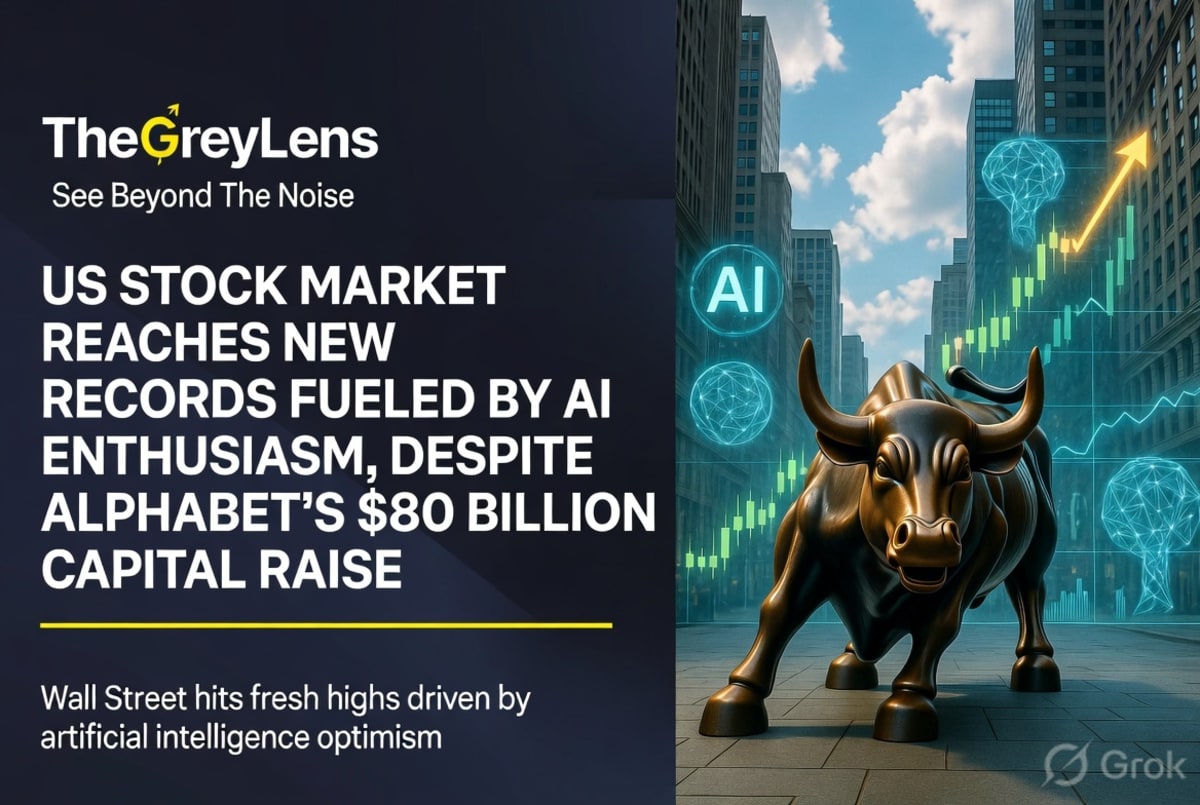
The U.S. stock market continued its upward trajectory on Tuesday, June 2, 2026, with major indexes like the S&P 500, Dow Jones Industrial Average, and Nasdaq Composite all closing at new record highs. This sustained rally, largely propelled by the ongoing artificial intelligence boom, saw the S&P 500 cross the significant milestone of 7,600 points for the first time.
AI Chipmakers Lead the Charge to New Highs
The driving force behind this market surge was the robust performance of companies heavily invested in artificial intelligence infrastructure and chip manufacturing. Marvell Technology experienced a dramatic leap, soaring over 30% after Nvidia CEO Jensen Huang suggested it could be the "next trillion-dollar company." Huang's comments, made at the Computex conference, underscored Marvell's crucial role in data center connectivity, a key component of AI development. Similarly, Hewlett Packard Enterprise (HPE) saw its stock surge by approximately 19% following strong quarterly earnings and an optimistic full-year guidance, which the company attributed to high demand from customers building their AI capabilities. The broader semiconductor sector also benefited, with the Philadelphia SE Semiconductor Index advancing significantly.
Despite the overall market optimism, certain tech giants faced headwinds. Alphabet, the parent company of Google, saw its stock decline as it announced plans to raise $80 billion through a combination of equity offerings, including a substantial $10 billion private placement from Berkshire Hathaway. This move, intended to fund its extensive AI investments and infrastructure buildout, raised concerns among investors about potential dilution and the sheer scale of capital expenditure required for AI initiatives. While the company expects to spend up to $190 billion on equipment and other investments this year, this has renewed questions about the profitability and productivity gains from such massive AI spending, fueling ongoing debates about a potential AI bubble.
Market Indices and Year-to-Date Performance
On Tuesday, June 2, 2026, the S&P 500 index closed up 0.13% at 7,609.78, marking its 24th record high of the year. The Dow Jones Industrial Average displayed strong performance, gaining 0.45% to reach 51,307.79, also hitting new all-time highs. The Nasdaq Composite eked out a modest gain of 0.03%, closing at 27,093.90, and setting its own record. The Russell 2000 index, representing smaller companies, outperformed its larger counterparts, rising 0.9% to 2,931.96.
Looking at year-to-date performance, the S&P 500 has climbed 11.2%, the Dow Jones Industrial Average has seen a 6.8% increase, and the Nasdaq Composite has surged by 16.6%. The Russell 2000 has shown significant growth, up 18.1%. This broad market strength, particularly in growth-oriented sectors like technology and semiconductors, has been a hallmark of 2026, with the S&P 500 having experienced a remarkable nine consecutive winning weeks, its longest streak since 2023.
Economic Undercurrents and Investor Sentiment
While the AI-driven rally dominated headlines, other economic factors played a role in shaping market sentiment. Investors monitored geopolitical developments, including ongoing talks between the U.S. and Iran regarding the reopening of the Strait of Hormuz, which could ease global oil supply pressures. In the commodities market, oil prices showed some volatility, with Brent crude trading around $93.41 per barrel.
Additionally, the release of the Job Openings and Labor Turnover Survey (JOLTS) data for April indicated a slight increase in job openings, suggesting labor market stability despite AI-related layoffs. However, this data also contributes to the ongoing discussion about the Federal Reserve's potential interest rate decisions later in the month, as a strong labor market can influence inflation concerns.
Despite the record highs, some analysts expressed caution, noting that the market's advance has been concentrated in a narrow set of technology stocks. The forward price-to-earnings (P/E) ratio for the S&P 500 sits at approximately 23x, well above its long-run historical average of 18x, signaling potentially lower expected future returns. This concentration risk, coupled with Alphabet's substantial equity raise, has led to discussions about portfolio rebalancing and managing exposure to the dominant technology players.
Looking ahead, market participants will be closely watching upcoming economic data, including the May employment report, and listening for further commentary from Federal Reserve officials. The sustained momentum in AI and technology stocks will likely continue to be a key focus, alongside broader economic trends and geopolitical developments.