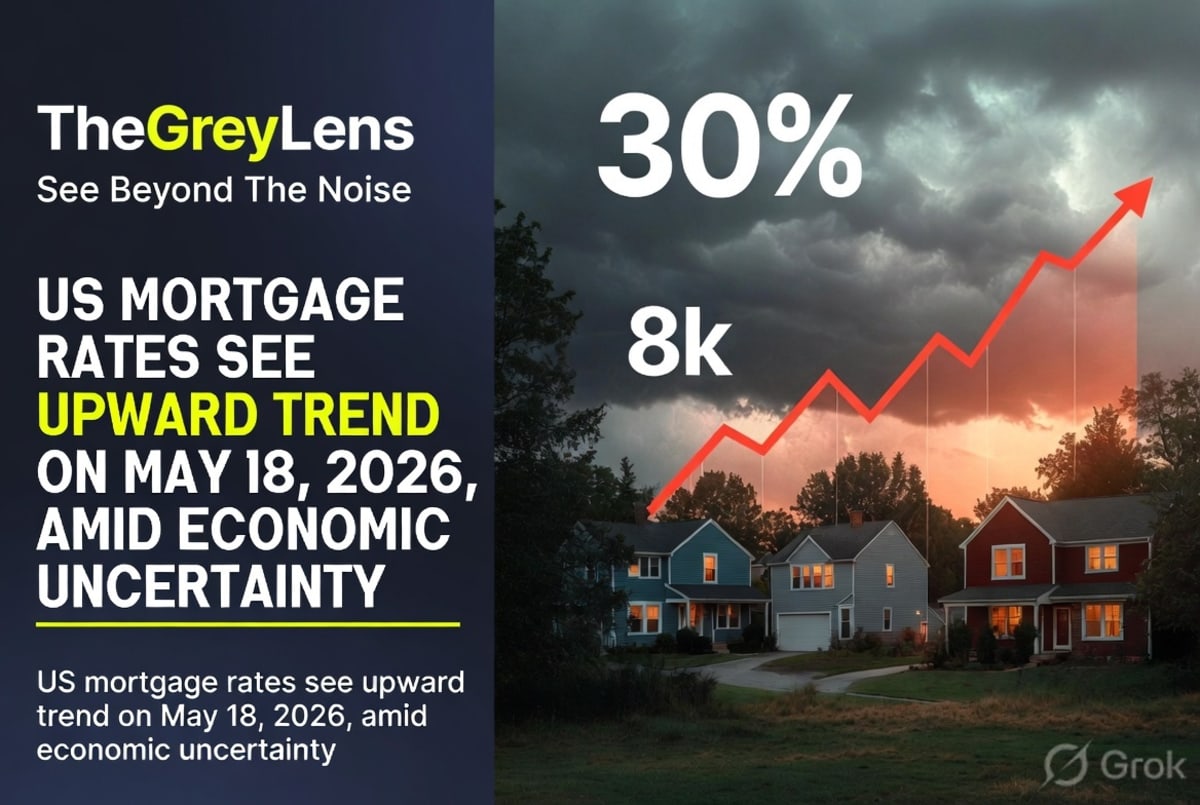
Mortgage rates in the United States have seen a noticeable uptick as of Sunday, May 18, 2026, with various loan terms reflecting higher average interest rates than observed in the preceding week. This shift occurs against a backdrop of the Federal Reserve holding its benchmark federal funds rate steady, a decision influenced by a complex interplay of global geopolitical events and domestic inflation concerns.
Rates Climb Across Fixed-Rate Mortgages
For borrowers seeking traditional financing, the 30-year fixed-rate mortgage has climbed approximately 0.24 percentage points over the past week, now averaging around 6.61%. This increase means that a $100,000 loan at this rate would result in monthly principal and interest payments of about $639, accumulating an estimated $130,917 in total interest over the loan's lifespan. Similarly, the 15-year fixed-rate mortgage has also seen an upward adjustment, rising by about 0.22 percentage points to an average of 5.77%. For a $100,000 loan on a 15-year term, this translates to monthly payments of roughly $831, with total interest reaching approximately $50,178.
Jumbo mortgages, which apply to loan amounts exceeding the conforming limit (currently $832,750 in most areas for 2026), have also experienced rate increases. The average rate for a 30-year fixed-rate jumbo mortgage is now 6.79%, up from 6.68% last week. This rise impacts borrowers seeking higher loan amounts, with monthly payments on a $100,000 loan potentially reaching $651 and total interest amounting to about $134,789.
Federal Reserve's Stance and Economic Influences
The Federal Reserve's Federal Open Market Committee (FOMC) has maintained its target federal funds rate between 3.50% and 3.75%. This pause in rate adjustments follows a series of cuts in late 2025, as the central bank now monitors economic data to assess the impact of its previous actions. Policymakers are reportedly cautious due to persistently high inflation figures, which remain above the Fed's 2% target.
External factors are also contributing to market uncertainty. Ongoing global conflicts, particularly in the Middle East, have led to fluctuations in oil prices, which in turn can fuel inflation expectations. These geopolitical developments add a layer of complexity to the economic outlook, influencing Treasury yields and, consequently, mortgage rates. Despite some speculation for rate cuts, the Fed's recent decisions indicate a strategy of holding steady, with some policymakers even expressing concerns about potential inflationary pressures that could necessitate rate hikes, though the market is largely expecting rates to remain unchanged in the near term.
Refinance Market Shows Similar Trends
The mortgage refinance market mirrors the trends seen in purchase mortgages. The average interest rate for a 30-year fixed-rate refinance has risen to 6.67%, an increase from the previous week. Similarly, 15-year fixed-rate refinance mortgages are now averaging 5.75%, up from 5.52% a week ago. Even 20-year fixed refinance rates have climbed to 6.53% from 6.29%. Jumbo refinance rates have also seen modest increases, with the 30-year fixed-rate jumbo refinance averaging 6.77%.
Looking ahead, the mortgage market will likely continue to be influenced by upcoming inflation reports and any new developments in international affairs. Borrowers are advised to closely monitor economic indicators and compare offers from multiple lenders to secure the most favorable rates available in this dynamic environment. The Federal Reserve's next meeting will be closely watched for any signals of future policy adjustments.