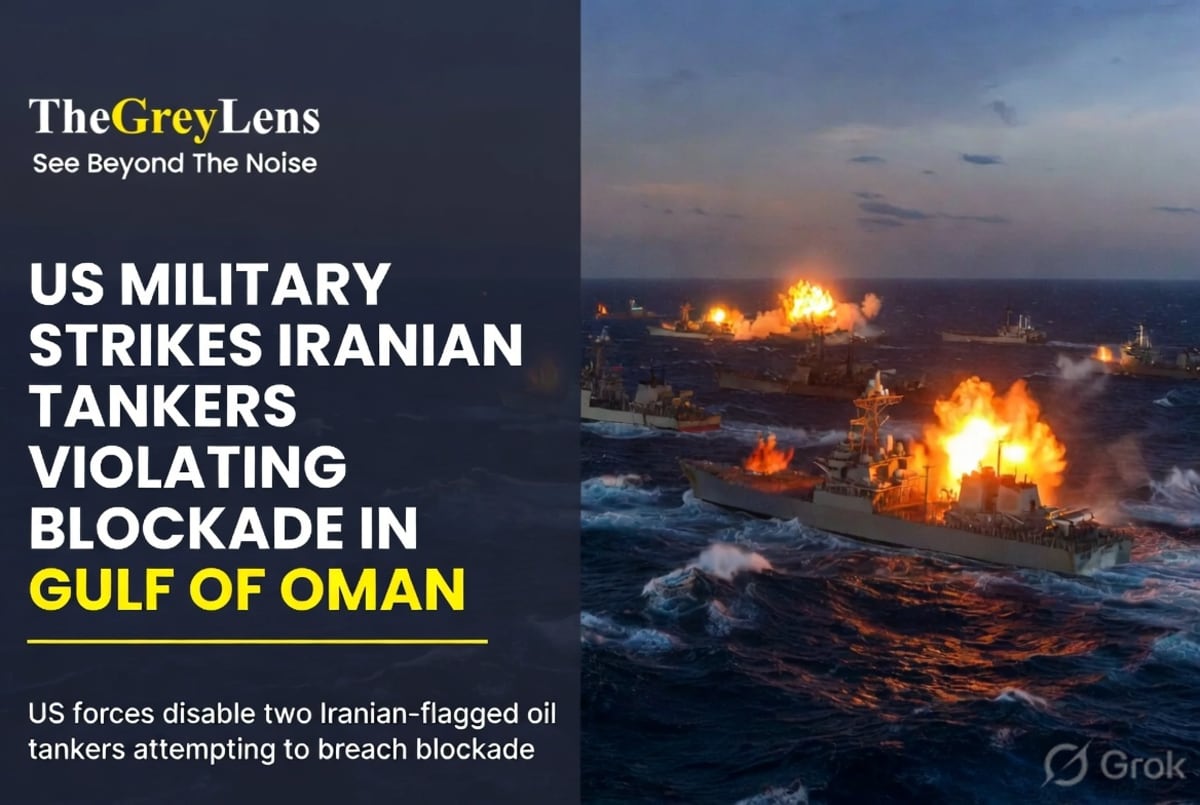
In a significant escalation of maritime tensions, U.S. forces on Friday, May 8, 2026, disabled two Iranian-flagged oil tankers, the M/T Sea Star III and M/T Sevda, as they attempted to enter an Iranian port in the Gulf of Oman. This action was taken to enforce an ongoing U.S. blockade in the strategic waterway, according to statements from U.S. Central Command (CENTCOM).
Enforcing the Blockade in the Gulf of Oman
The U.S. Navy utilized an F/A-18 Super Hornet, operating from the USS George H.W. Bush (CVN 77), to fire precision munitions into the smokestacks of both tankers. This targeted strike effectively disabled the vessels, preventing them from reaching their intended destination. CENTCOM emphasized that these actions were part of enforcement measures against vessels violating the blockade. This incident follows a similar event on May 6, when U.S. forces disabled another Iranian-flagged tanker, the M/T Hasna, using a 20mm cannon fired from an F/A-18 Super Hornet launched from the USS Abraham Lincoln (CVN 72). The M/T Hasna was also an unladen oil tanker attempting to sail to an Iranian port.
Broader Geopolitical Context Amidst Ceasefire Talks
The military actions come at a critical juncture, as diplomatic efforts are underway to de-escalate the broader conflict involving Iran. President Donald Trump announced on Friday that Russia and Ukraine have agreed to a temporary three-day ceasefire and a significant prisoner exchange, indicating that talks to end that conflict are progressing. Simultaneously, the United States is awaiting a response from Iran regarding renewed negotiation proposals, with Secretary of State Marco Rubio stating that Washington expects to know more about the possibility of serious negotiations on Saturday, May 9. Despite the ongoing military actions, President Trump described previous U.S. strikes on Iranian targets as a "love tap," asserting that a fragile ceasefire with Iran remains in effect. However, Iran's Foreign Minister Abbas Araghchi has criticized U.S. actions, stating that "Every time a diplomatic solution is on the table, the U.S. opts for a reckless military adventure."
Economic Sanctions and Maritime Security
In parallel with the maritime operations, the U.S. Department of the Treasury announced new sanctions on May 8 against 10 individuals and companies across the Middle East, Asia, and Eastern Europe. These entities are accused of enabling Iran's military to acquire weapons and raw materials for its drone and ballistic missile programs, particularly for its Shahed-series UAVs. This move, part of an initiative dubbed "Economic Fury," aims to disrupt networks supporting Iran's proliferation efforts. The Treasury Department reiterated its commitment to "maximum pressure" on Iran and warned of potential secondary sanctions on foreign financial institutions facilitating Iran's illicit activities. The ongoing tensions in the Strait of Hormuz, a vital oil transit route, remain a significant concern, with Secretary Rubio warning against any Iranian attempts to control the passage, deeming such actions "problematic and unacceptable."
The U.S. military's assertive stance in enforcing the blockade in the Gulf of Oman, coupled with ongoing diplomatic maneuvers and economic sanctions, underscores the complex and volatile geopolitical landscape. The coming days will be crucial in determining whether the fragile ceasefire holds and if diplomatic channels can be effectively utilized to address the broader conflict with Iran.