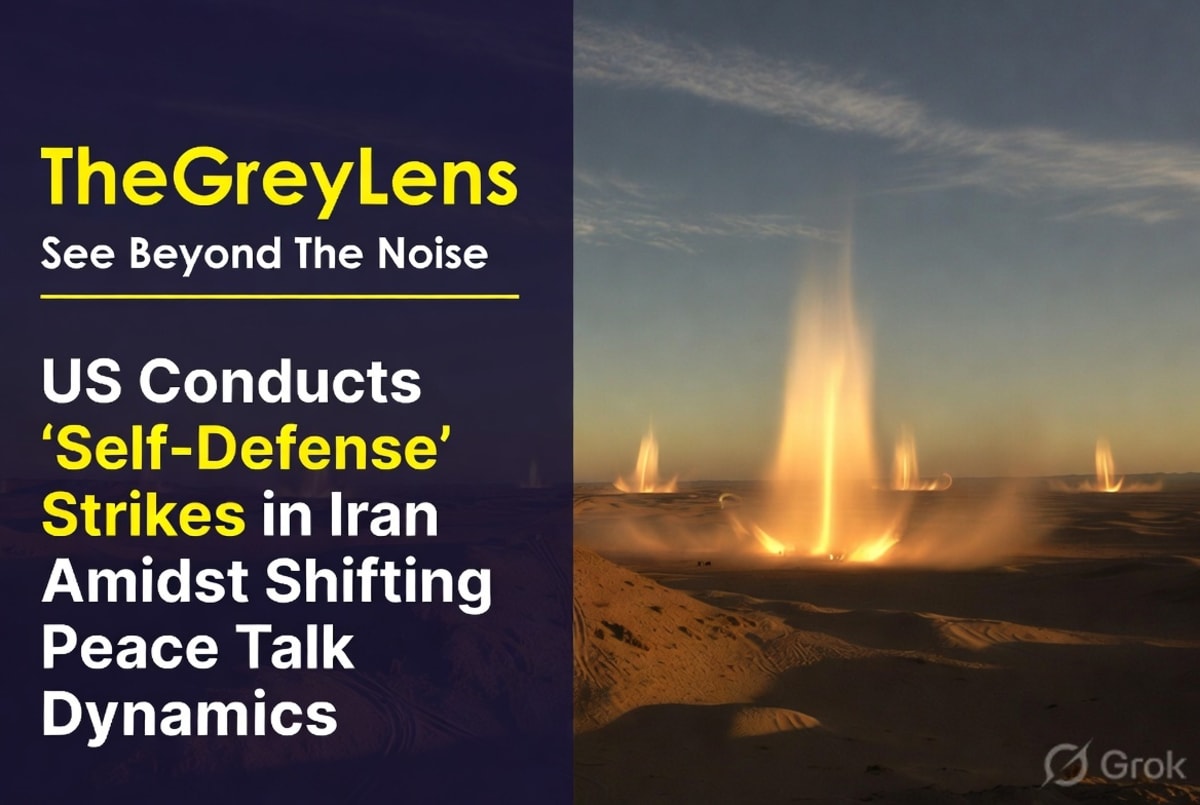
Early Tuesday, U.S. forces conducted "self-defense" strikes in southern Iran, with U.S. Central Command (CENTCOM) stating the military action was necessary to "protect our troops from threats posed by Iranian forces."
Escalation Amidst Diplomatic Signals
CENTCOM spokesman Tim Hawkins confirmed that targets included missile launch sites and Iranian boats attempting to emplace mines. Hawkins added that "U.S. Central Command continues to defend our forces while using restraint during the ongoing ceasefire." The strikes come at a delicate moment, as President Donald Trump simultaneously posted on social media that negotiations aimed at ending the war were "proceeding nicely." This juxtaposition of military action and optimistic diplomatic statements highlights the intricate and potentially volatile nature of the current geopolitical situation.
Market Reactions and Economic Undercurrents
Global markets reacted with a mixed response to the news. In early European trading, Germany's DAX saw a loss of 0.7%, and France's CAC 40 shed 0.9%. Conversely, Britain's FTSE 100 gained 0.7%. Futures for the S&P 500 and the Dow Jones Industrial Average showed a 0.5% increase. Oil prices presented a divided picture, with Brent crude rising but remaining below $100 a barrel, while U.S. benchmark crude oil experienced a decline. This mixed market performance reflects investor uncertainty as they weigh the implications of the strikes against the backdrop of ongoing, albeit complex, peace talks. The ongoing conflict and its impact on energy markets continue to be a significant factor, with oil prices having seen substantial increases since the conflict began in late February. Gas prices have risen sharply, impacting consumers and contributing to broader inflationary pressures. The annual inflation rate in the U.S. accelerated to 3.8% in April 2026, a figure that has put pressure on the Federal Reserve. Despite these economic headwinds, U.S. equities have recently reached all-time highs, driven in part by strong corporate earnings, particularly in the technology sector, though concerns about sustained inflation and potential interest rate hikes persist. Federal Reserve officials have indicated that rate increases may be considered if inflation remains above target levels, a point underscored by the recent minutes from the Federal Open Market Committee's April meeting. The nomination of Kevin Warsh to chair the Federal Reserve has also added a layer of anticipation regarding future monetary policy decisions.
Global Tensions and Diplomatic Uncertainty
Beyond the immediate Iran conflict, broader global tensions are evident. Reports indicate that Chinese President Xi Jinping and Russian President Vladimir Putin have condemned President Trump's nuclear policies. Concurrently, the U.S. military's actions in Iran occur even as regional officials in the Middle East had suggested that the United States was nearing an agreement with Iran to end the war, reopen the Strait of Hormuz, and secure Iran's stockpile of enriched uranium. The lack of an official response from Iran to the recent strikes leaves the situation further open to interpretation. Analysts note that markets are reacting to perceived progress in peace talks, even as significant challenges remain. The differing signals from Washington and Tehran—optimism from the U.S. and insistence from Iran that no agreement is imminent—contribute to the prevailing market volatility. Looking ahead, the focus will remain on the de-escalation of tensions in the Middle East, the progress of peace negotiations, and the potential impact on global energy markets and economic stability.