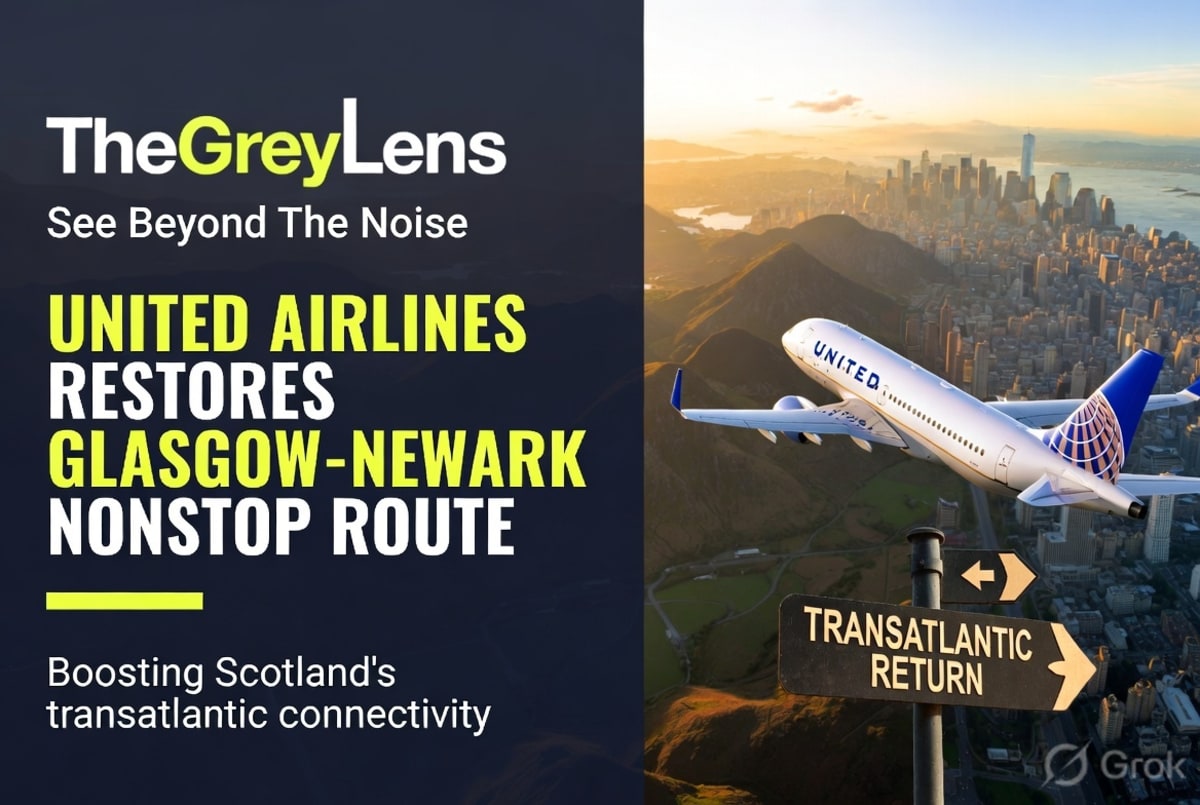
United Airlines has re-established a crucial nonstop air link between Scotland and the United States with the relaunch of its service between Glasgow Airport (GLA) and Newark Liberty International Airport (EWR) on May 9, 2026. This development is particularly significant for Glasgow, which has seen a decline in long-haul routes over the past decade as airlines increasingly concentrated on Edinburgh. The new route, operated by the fuel-efficient Boeing 737 MAX 8, signifies a strategic shift by United, with the airline reallocating some capacity from its Newark-Edinburgh service to support the Glasgow offering.
A Strategic Rebalancing of Scotland's Transatlantic Market
Historically, Glasgow Airport played a more prominent role in Scotland's transatlantic market, especially in the 1990s and 2000s when multiple US and Canadian carriers operated from the airport. However, a decade-long trend saw a concentration of long-haul operations at Edinburgh Airport, driven by perceived stronger premium demand, tourism growth, and a broader catchment appeal. This led to Glasgow losing key routes, including services to Philadelphia and Toronto. United's decision to reinstate the Newark-Glasgow route is a testament to the evolving capabilities of modern narrowbody aircraft like the Boeing 737 MAX 8. These aircraft are now economically viable for operating 'long and thin' routes—those with lower demand that might not sustain larger widebody jets year-round. This aligns with a broader industry trend where airlines are leveraging aircraft such as the Airbus A321LR and XLR for similar market development.
Enhanced Connectivity and Economic Implications
Karolien De Hertogh, Director Sales UK and Ireland for United Airlines, expressed enthusiasm for the return to Glasgow, stating, “We are excited to return to Glasgow with the launch of our service to Newark/New York, further underlining the importance of Scotland within United's global route network.” The restored nonstop service not only provides a direct link for travelers between Scotland and the New York metropolitan area but also reintroduces a direct Star Alliance presence at Glasgow Airport. This improves connectivity for passengers and potentially stimulates business and tourism in the region. The route is scheduled to operate daily using the Boeing 737 MAX 8, configured with 166 seats, including various classes of service such as United Premium Plus, Economy Plus, and standard economy.
The economic implications for Scotland, and by extension Great Britain, are multifaceted. Improved air connectivity can facilitate trade, attract foreign investment, and boost tourism. For Glasgow, the return of a direct US flight is a significant win, potentially revitalizing its position as a key international gateway. While the article focuses on the aviation aspect, broader economic discussions in Scotland reveal a challenging fiscal landscape. Economists have warned that the incoming Scottish government faces significant budgetary constraints, with public spending growth outpacing income. This fiscal pressure, exacerbated by global economic instability, underscores the importance of sectors like aviation in driving economic activity and providing essential links to international markets. The renewed air service from Glasgow offers a positive development amidst these broader economic concerns, providing a vital artery for both business and leisure travel.