In the quiet suburbs of Britain, millions of retirees wake each month to the reassurance of a state pension that has steadily grown in value. For many, this income forms the bedrock of their financial security in later life. At the heart of this protection lies the Triple Lock — a policy that has become both a political promise and a fiscal headache for successive governments.
Introduced in 2010 by the Conservative-Liberal Democrat coalition, the Triple Lock guarantees that the basic state pension rises each year by the highest of three measures: the rate of inflation, average earnings growth, or a guaranteed minimum of 2.5 per cent. This simple but powerful formula was designed to restore dignity to retirement after years when pensions had sometimes lagged behind the rising cost of living.
How the Triple Lock Works in Practice
The mechanism operates with elegant clarity. Each spring, statisticians examine three key figures from the previous year. First comes the Consumer Prices Index (CPI) inflation rate, which tracks the changing cost of everyday goods and services. Second is the growth in average earnings, reflecting how wages are moving across the economy. The third is that reassuring floor of 2.5 per cent — a safety net ensuring pensions never stagnate even in times of low inflation or wage growth.
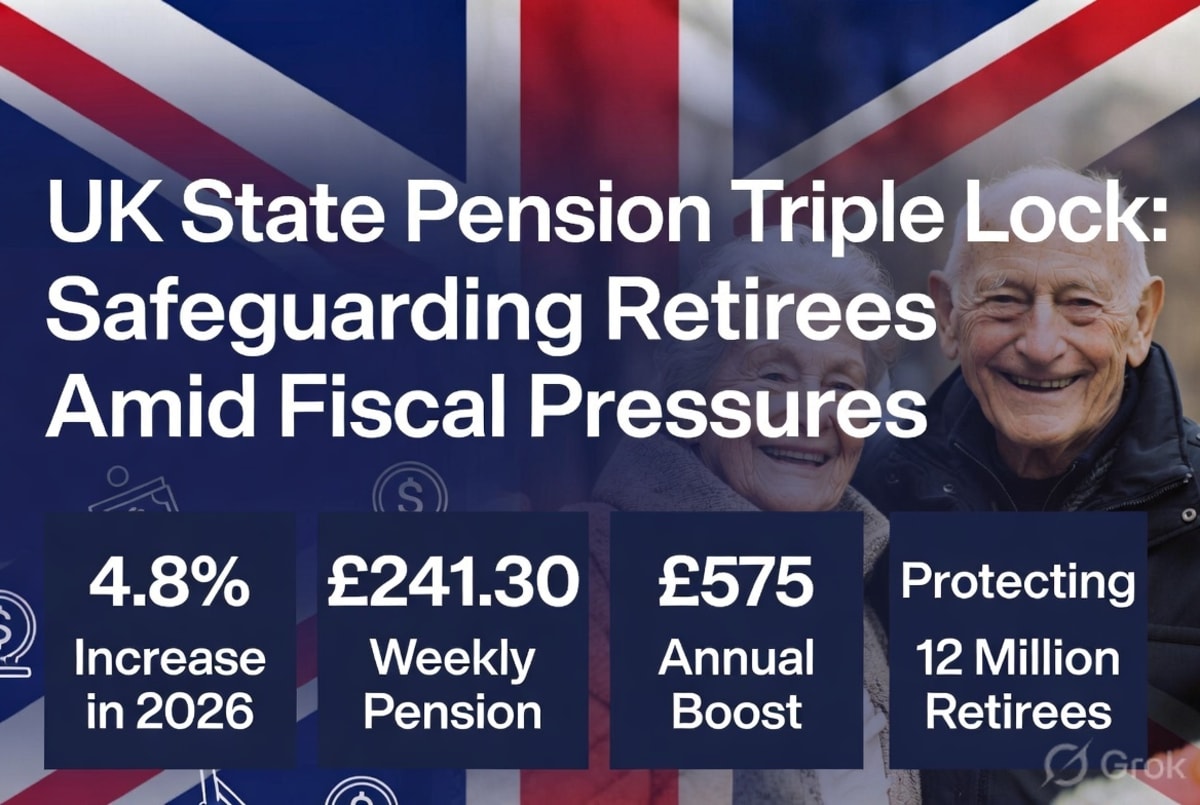
This April, the Triple Lock delivered a 4.8 per cent increase, driven primarily by strong earnings growth. The full new state pension rose to approximately £241.30 per week, providing an annual boost of around £575 for those receiving the maximum amount. Over the course of a single year, this represents tangible help against the pressures of energy bills, food costs, and housing expenses that continue to challenge fixed-income households.
For a couple both receiving the full pension, the combined annual income now exceeds £25,000 before any other savings or benefits. In an era where private pensions vary dramatically in generosity and many older workers missed out on generous final-salary schemes, the state pension remains the most reliable source of income for the majority of retirees.
The Human Impact: Dignity in Retirement
Beyond the statistics lies a more profound story. Walk through any market town in Britain and you will meet pensioners who speak gratefully of the Triple Lock's protection. Margaret Thompson, a 78-year-old widow from Yorkshire, explains how the annual increases have allowed her to maintain her independence. “Without these rises, I would have had to choose between heating my home and eating properly,” she says.
Research consistently shows that pensioner poverty has fallen significantly since the Triple Lock's introduction. The policy has helped millions avoid the harsh choices that defined retirement for earlier generations. It recognises the contributions made by those who worked through post-war reconstruction, the challenges of the 1970s, and the transformations of the 1980s and 90s.
By linking pensions to earnings growth, the Triple Lock also ensures that retirees share — at least to some extent — in the country's economic progress. This intergenerational solidarity matters. Today's workers are, after all, tomorrow's pensioners. A system that fails to provide dignity in old age risks eroding public confidence in the entire social contract.
The Mounting Fiscal Challenge
Yet this commitment comes at a substantial and growing cost. With more people living longer and drawing pensions for extended periods, the Triple Lock amplifies these demographic realities. The number of people over state pension age continues to rise steadily, placing increasing pressure on public finances.
Critics argue that the policy creates budgetary unpredictability. When earnings growth surges, as it has in recent years following the pandemic recovery, pension spending accelerates rapidly. The Triple Lock has delivered pension increases worth billions more than would have occurred under simpler inflation-linking alone.
Younger generations, grappling with high housing costs, student debt, and squeezed wages, increasingly voice concerns about fairness. They question whether current spending priorities adequately balance the needs of working families with those of retirees. The NHS, education, housing, and infrastructure also compete for limited resources, creating difficult choices for Chancellors and future governments.
Political Consensus and Future Prospects
Remarkably, the Triple Lock has enjoyed broad political support. Both major parties have committed to maintaining it through the current parliamentary term. This consensus reflects an understanding that undermining pensioner incomes would be electorally damaging, particularly given the high turnout rates among older voters.
Nevertheless, behind closed doors, senior officials acknowledge the need for longer-term thinking. The proportion of the population over 65 is projected to rise significantly in coming decades. Combined with advances in medical technology that extend lifespans further, this demographic shift demands creative policy responses.
Potential solutions extend beyond the Triple Lock itself. Strengthening auto-enrolment into workplace pensions, encouraging later working lives where appropriate, and reforming tax relief on pensions could all help ease future pressures. Some experts advocate for a more comprehensive review of the entire pension system, including the interaction between state and private provision.
The challenge lies in achieving reform without breaking the fundamental promise of security in old age. Any changes must be implemented gradually and with clear communication to maintain public trust. Abrupt shifts could damage confidence not only in pensions but in government more broadly.
Balancing Compassion with Responsibility
As Britain navigates an era of tight public finances, the Triple Lock embodies the tension between compassion and fiscal responsibility. It represents a deliberate choice to prioritise dignity for those who have contributed throughout their working lives. Yet it also highlights the need for honest conversations about what the country can sustainably afford.
The policy's success should not blind us to its limitations. Many pensioners still face hardship, particularly those with minimal private savings or health issues. Meanwhile, younger workers need assurance that the system will remain viable when their turn comes to retire.
Looking ahead, the Triple Lock may evolve, but its core principle — protecting retirees from economic uncertainty — is likely to endure. The real test will be whether policymakers can pair this protection with broader reforms that secure the pension system's future for generations to come.
In an uncertain world, the Triple Lock stands as a rare constant: a commitment that says society values its elders and will not allow them to fall behind. As fiscal pressures mount, maintaining this promise while adapting to new realities will define the quality of British public policy for years ahead.