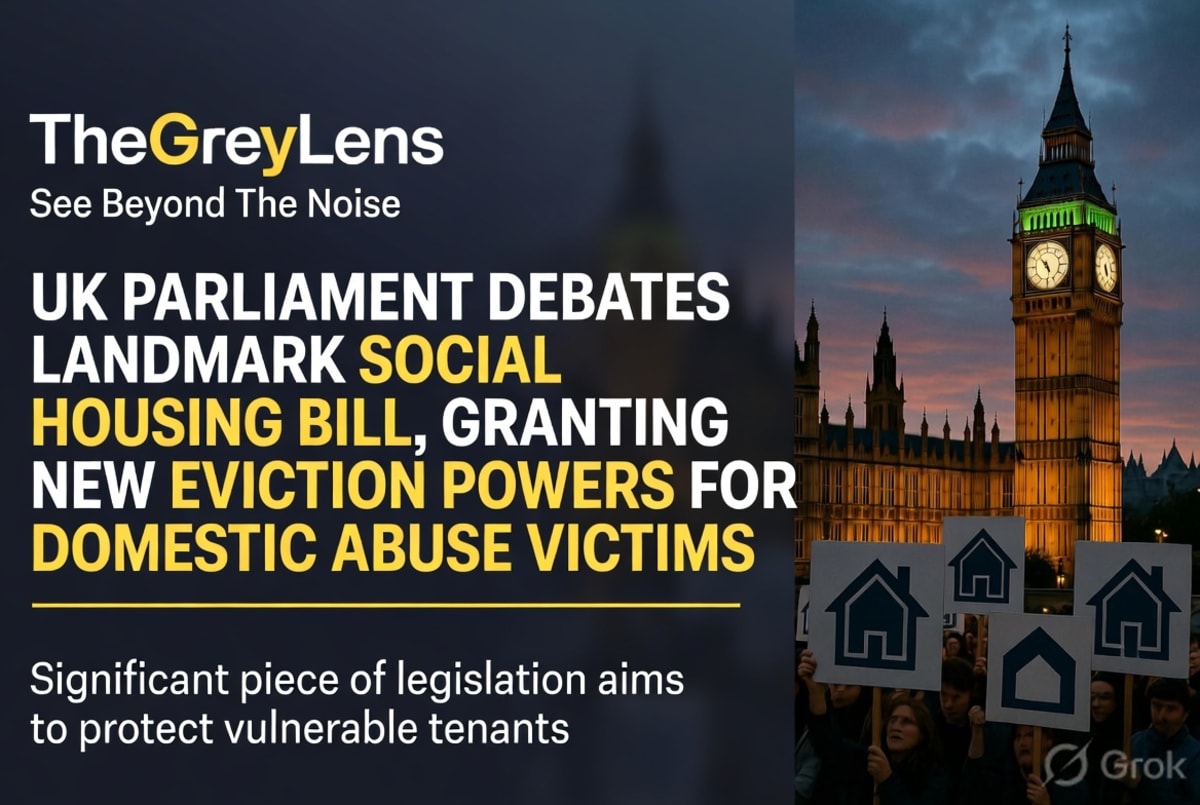
The United Kingdom Parliament is convening this week to deliberate on the crucial Social Housing Bill, a legislative proposal designed to fundamentally alter the landscape of social housing and bolster protections for its tenants. The bill, which returns for its Second Reading in the House of Lords on Monday, June 1, 2026, introduces a series of significant reforms, most notably empowering social housing landlords with new measures to evict perpetrators of domestic abuse, thereby safeguarding victims from displacement.
Empowering Victims and Reforming Tenancy Laws
A core tenet of the Social Housing Bill is the rectification of a critical loophole that has historically left victims of domestic abuse in a precarious position. Under current regulations, social housing landlords can generally only initiate eviction proceedings against an abuser after the victim has already vacated the property. In instances of joint tenancies, this often compels the victim to end the tenancy altogether, potentially leading to homelessness. The proposed legislation seeks to dismantle this barrier by allowing courts to transfer a joint tenancy into the victim's sole name. Furthermore, it introduces provisions for landlords and courts to seek the eviction of abusers without requiring the victim to leave their home first. In situations where remaining in the property is not feasible for the victim, the bill also mandates that landlords may be required to provide suitable alternative accommodation, where available.
Last year alone, an estimated 15,000 households in England were forced to seek new social housing due to domestic abuse, underscoring the urgent need for these reforms. Housing Secretary, Steve Reed, stated that victims have often faced an “impossible choice, stay in danger or make themselves homeless,” a situation the government aims to rectify with this bill. The bill also addresses the tactic of abusers serving a 'Notice to Quit' to make victims homeless, by ensuring such notices will not automatically end a joint tenancy while court proceedings are active.
Overhauling the Right to Buy Scheme
Beyond domestic abuse protections, the Social Housing Bill introduces the most substantial overhaul of the Right to Buy scheme in a generation, a policy that has been a cornerstone of Conservative housing policy since the 1980s. The reforms aim to mitigate the long-term decline in social housing stock by making it more difficult for tenants to purchase their homes. Under the proposed changes, the minimum qualifying period for the Right to Buy scheme will be extended from three years to 10 years. Additionally, newly built social and affordable homes will be exempt from the scheme for 35 years, and certain hard-to-replace rural homes will also be excluded.
Furthermore, the bill revises the discount structure for Right to Buy. Discounts will now start at 5% of a property's value and increase by one percentage point annually, capped at a maximum of 15%, subject to revised cash caps. Tenants who have previously benefited from Right to Buy will generally be ineligible to use the scheme again, with exceptions made for cases involving domestic abuse or irretrievable relationship breakdown. Council homes let at market rent will also be exempt from the scheme. The Local Government Association (LGA) has welcomed these reforms, particularly the extension of the qualifying period, viewing it as a positive step towards helping local authorities rebuild their housing stock, while still allowing tenants the opportunity to purchase their homes. However, the LGA has also suggested that nationally set maximum discounts may lack the flexibility needed to align with local market conditions, advocating for the consideration of locally or regionally set discounts.
Parliamentary Scrutiny and Future Outlook
The Social Housing Bill is scheduled for its Second Reading in the House of Lords this week, following its introduction to Parliament on May 14, 2026, after being announced in the King's Speech on May 13, 2026. Peers will debate the general principles of the bill, with detailed scrutiny and potential amendments expected during the Committee Stage, provisionally scheduled for June 15 and 17, 2026.
While the bill has garnered support from domestic abuse campaigners and organizations like the Domestic Abuse Housing Alliance, who have hailed it as an “important and long overdue step forward,” some housing charities, such as Shelter, have urged the government to go further, calling for the construction of 90,000 social rent homes annually for the next decade. The ongoing housing crisis, with over 134,000 households in temporary accommodation and more than one million people on council housing waitlists, highlights the scale of the challenge the government faces. The successful passage and implementation of the Social Housing Bill will be a critical indicator of the government's commitment to addressing these pressing issues.
The Bank of England's Monetary Policy Committee is also set to convene on June 18, 2026, to decide on the base interest rate. The current rate stands at 3.75%, having been held unchanged on April 30, 2026. While recent geopolitical events, particularly the conflict in the Middle East, have introduced uncertainty and driven inflation concerns, leading to predictions of potential rate hikes, Governor Andrew Bailey has indicated a cautious approach, suggesting the bank will not rush to increase rates amidst global uncertainty and weak UK growth. The interplay between housing policy and economic stability will be a key focus in the coming months.