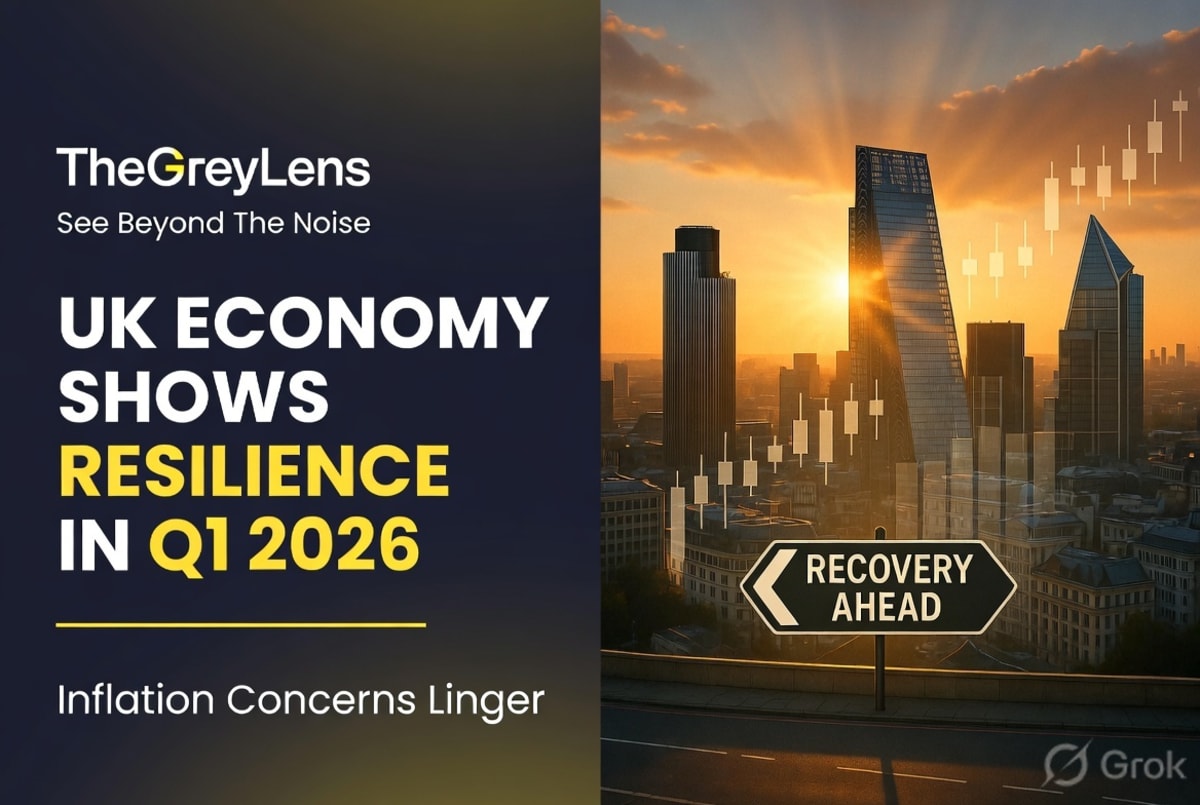
The United Kingdom's economy has shown a surprising degree of resilience in the first three months of 2026, defying earlier predictions of slower growth. Data released on May 18, 2026, from CoStar indicates that the economy expanded by 0.6% in Q1, a significant improvement from the 0.1% growth recorded in the final quarter of 2025. This upward trend continued into March, with the economy growing by 0.3% for the month. The services sector was a primary driver of this expansion, showing broad increases across various industries. Additionally, the construction sector returned to positive territory, with a 0.4% rise, largely attributed to repair and maintenance activities rather than new project development. Production output, including manufacturing, also saw a modest increase of 0.2%.
Geopolitical Tensions Fuel Inflationary Pressures
Despite the positive growth figures, concerns are mounting over persistent inflation, which is being significantly influenced by ongoing geopolitical events, particularly the war in the Middle East. The Consumer Prices Index (CPI) is forecast to have eased to 3% year-on-year in April, down from 3.3% in March, according to FactSet consensus estimates. However, core inflation, which excludes volatile energy and food prices, is expected to fall to 2.6% from 3.1%. Prior to the escalation of the Iran conflict in late February, April's inflation print was anticipated to fall back to the Bank of England's 2% target, paving the way for potential interest rate cuts. The surge in energy prices directly linked to the conflict has rewritten these expectations.
Bank of England Considers Further Rate Hikes
The Bank of England's Monetary Policy Committee is now facing a difficult balancing act. With inflation proving more stubborn than anticipated, futures markets are implying a 32% chance of an interest rate hike at the next meeting in June. The July meeting is seen as even more likely for an increase. Raphael Olszyna-Marzys, international economist at J. Safra Sarasin Sustainable Asset Management, suggests that the Bank of England may need to raise interest rates at its next meeting to combat inflation, stating that policymakers might implement a single hike in June to signal their determination to anchor inflation expectations. However, he does not anticipate further tightening beyond that, believing that interest rates remain restrictive and second-round effects should be limited, particularly if oil prices decline in the latter half of the year.
The International Monetary Fund (IMF) has also weighed in, urging the UK to 'stay the course' on borrowing despite political uncertainty. While acknowledging the economy's resilience, the IMF projects growth to slow to 1.0% in 2026, down from an estimated 1.4% in 2025. This slowdown is attributed to higher energy prices dampening consumer spending and increasing production costs, coupled with tighter financial conditions and elevated uncertainty weighing on consumption and investment. The IMF anticipates that growth should recover in the second half of 2027 once the energy price shock dissipates.
Regulatory Adjustments and Future Outlook
In a move aimed at enhancing competitiveness and reducing costs within the financial sector, the Prudential Regulation Authority (PRA) announced plans on May 18, 2026, to consult on reforming rules around shared operational services for ring-fenced banks. This reform seeks to provide greater flexibility for firms in how they share operational resources, potentially streamlining requirements and unlocking cost savings. The PRA aims to make the ring-fencing rules more proportionate and reduce compliance costs for major British banks.
Looking ahead, the UK economy faces a period of continued uncertainty. The ongoing geopolitical instability, particularly the war in the Middle East, is a significant dampening factor on near-term prospects. Risks to growth are considered to be tilted to the downside, with a prolonged conflict posing the greatest threat through sustained higher energy and food prices and market volatility. The return of inflation to the Bank of England's target is now projected to be delayed by approximately one year.
Furthermore, the political landscape remains fluid, with discussions around potential leadership challenges and the UK's future relationship with the European Union continuing. While some political figures advocate for closer ties or even rejoining the EU, others, like Greater Manchester Mayor Andy Burnham, have ruled out an immediate return. The Bank of England's next interest rate decision in June will be closely watched as it navigates these complex economic and geopolitical currents.