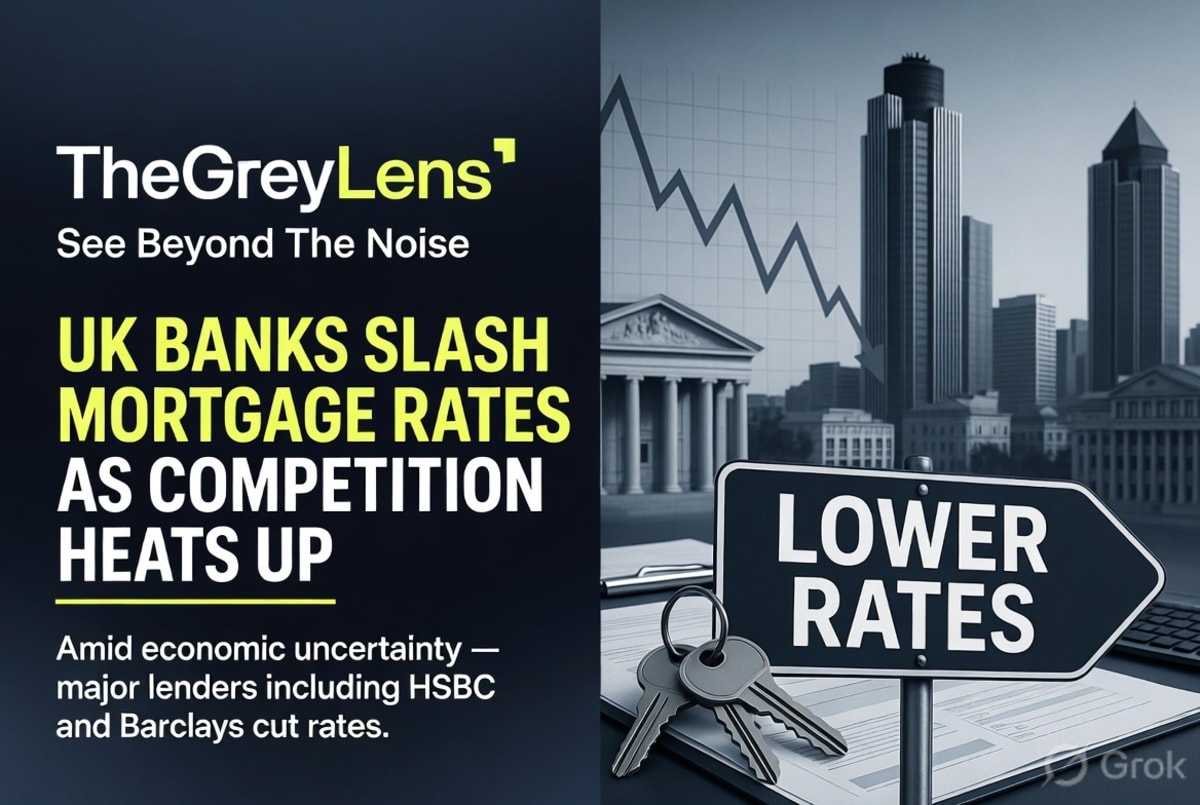
In a notable shift within the UK banking sector, several prominent lenders have aggressively cut mortgage rates over the past week, with some offers now dipping below the 4% threshold. This competitive pricing strategy is seen as a move to capture market share as economic conditions remain uncertain, influenced by global geopolitical events. Lenders such as HSBC UK and Barclays have been at the forefront of these reductions, signalling a potential end to a period of rate volatility.
Lender Rate Wars Erupt Amidst Shifting Market Dynamics
HSBC UK has implemented reductions of up to 0.30% across its mortgage product range. This includes two-year tracker rates starting from 4.09% at 60% loan-to-value (LTV) and 4.44% at 85% LTV, with various fee and cashback incentives. For purchase mortgages, five-year fixed rates now begin at 4.49% at 60% LTV. Similarly, Barclays has also introduced significant rate cuts, reducing rates on purchase and remortgage deals by up to 0.36 percentage points. Their fee-free two-year fix at 60% LTV has been reduced to 4.79%. This aggressive pricing strategy from major players like HSBC and Barclays follows a trend observed in early May, where lenders like Santander and Halifax also announced rate reductions. For instance, Santander planned to lower rates on selected residential and buy-to-let mortgage products, while Halifax implemented cuts on remortgage and home mover fixed rates. These moves suggest a concerted effort by banks to stimulate activity in the mortgage market.
The Impact of Global Events and Bank of England's Stance
The recent adjustments in mortgage rates are occurring against a backdrop of global economic uncertainty, particularly stemming from the conflict in the Middle East. This has led to fluctuations in energy prices and has influenced the Bank of England's monetary policy. Despite inflation rising to 3.3%, the Bank of England's Monetary Policy Committee (MPC) voted to hold the base rate at 3.75% on April 30th. This decision, while anticipated by many, has created a complex environment for lenders. While the Bank of England has maintained its stance, some analysts predict potential rate hikes later in the year if inflation persists. However, the recent rate cuts by lenders suggest a belief that the Bank of England might be nearing a point where rates could either be held steady or even reduced in the medium term, prompting a competitive response from the banking sector. The average cost of a two-year fixed-rate mortgage has seen a decrease, now standing at approximately 5.77%, down from 5.90% last month, according to Moneyfacts data. Similarly, the average five-year fixed rate has fallen to 5.69%. Despite these reductions, rates remain significantly higher than at the beginning of March, adding an estimated £1,700 annually to the cost of a typical mortgage.
What Lies Ahead for Borrowers and the Property Market?
The current landscape presents a mixed picture for borrowers. While the reduction in mortgage rates offers some relief, especially for those looking to remortgage or purchase a property, the overall cost of borrowing remains elevated compared to earlier in the year. The average deal lifespan in the mortgage market has also been notably short, with rates changing rapidly. Approximately 1.8 million fixed-rate mortgages are due to end in 2026, meaning many borrowers will be transitioning to potentially more expensive deals. The ongoing competition among lenders could lead to further rate reductions, but the broader economic outlook, including inflation trends and potential future Bank of England decisions, will play a crucial role. Lenders are carefully monitoring market conditions, and while aggressive rate cuts are occurring now, the expectation of potential interest rate rises could influence future pricing strategies. Borrowers are advised to act decisively when favourable deals emerge, as the market remains dynamic and subject to external economic pressures.