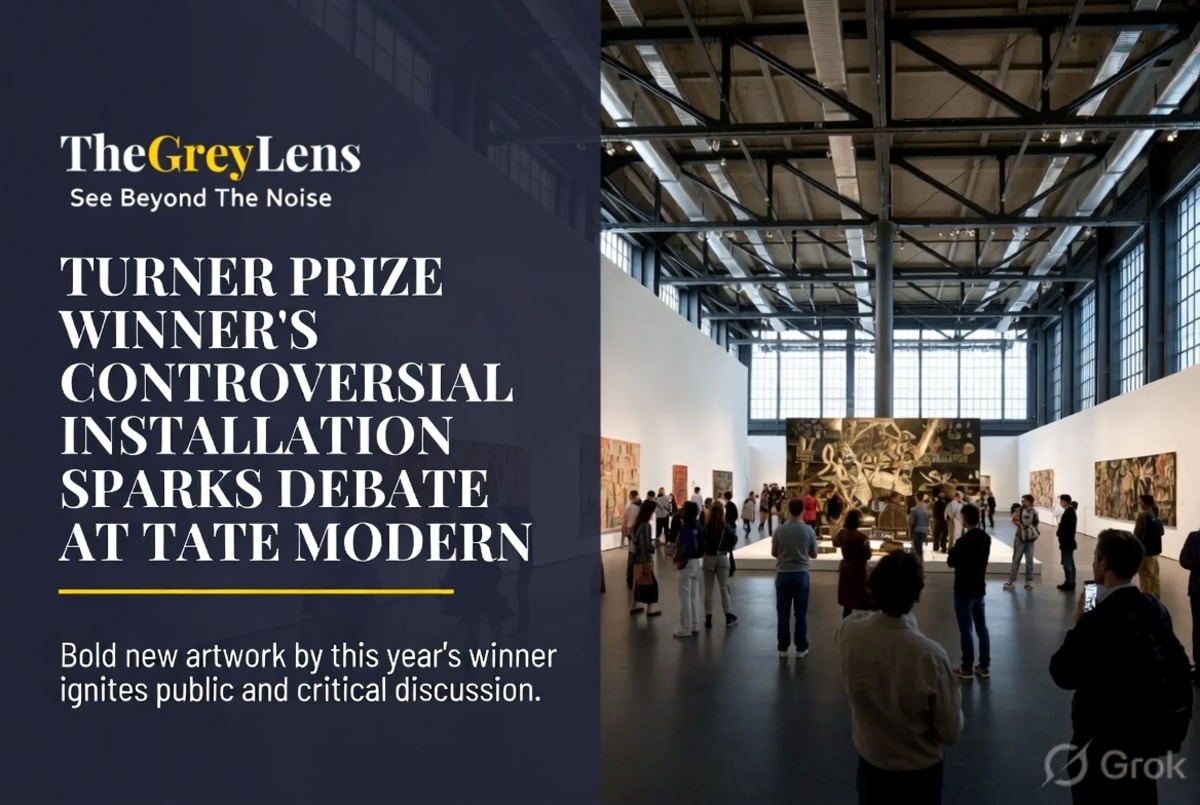
The Turbine Hall at Tate Modern is currently dominated by Jesse Darling's ambitious new installation, a sprawling and evocative work that has quickly become the focal point of London's contemporary art scene. Awarded the prestigious Turner Prize last year, Darling's work has consistently explored themes of fragility, resilience, and the detritus of modern existence, often utilizing discarded materials and industrial remnants to create pieces that are both haunting and deeply resonant.
A Landscape of Found Objects
Darling's installation, titled 'Adventures in the Anthropocene', transforms the vast expanse of the Turbine Hall into a landscape of assembled detritus. Towering structures made from salvaged scaffolding, bent metal, and decaying electronics punctuate the space, interspersed with delicate, almost skeletal forms crafted from wire, plastic, and fabric. The sheer scale of the work is immediately impactful, inviting visitors to wander through a maze of these assembled objects, each telling a silent story of obsolescence and transformation. Lighting is used sparingly, casting long shadows and highlighting the textures of rust, grime, and weathered materials, contributing to an atmosphere that is both melancholic and strangely beautiful. Visitors are encouraged to walk around and through the installation, experiencing its materiality up close and personal. The effect is one of being immersed in a post-industrial dreamscape, where the remnants of human activity have been re-contextualized into a new, albeit somber, artistic reality.
One of the most striking elements of the exhibition is the use of sound. Ambient noises, industrial hums, and fragmented spoken word recordings emanate from hidden speakers, creating a disorienting yet captivating soundscape. These auditory elements are not merely background noise; they are integral to the narrative of the piece, evoking the constant, often unnoticed, hum of machinery and the cacophony of urban life. Darling has spoken about wanting to capture the 'ghosts in the machine' – the residual energy and forgotten histories embedded within the objects they have created. The sounds contribute to a sense of unease, prompting reflection on the pervasive influence of technology and industry on our lives.
Themes of Fragility and Resilience
Central to Darling's artistic practice is an exploration of the human body and its vulnerabilities, often mirrored in the precariousness of the structures they construct. The exhibition at Tate Modern is no exception. Many of the assembled forms appear on the verge of collapse, their delicate balances held together by thin wires or improbable juxtapositions. This inherent instability serves as a powerful metaphor for the fragility of human existence in the face of overwhelming societal and environmental forces. Darling, who has spoken openly about navigating chronic illness, imbues their work with a profound understanding of physical vulnerability, translating it into a visual language that resonates with a universal sense of precariousness.
The installation also delves into themes of consumption and waste. The sheer volume of discarded materials used in 'Adventures in the Anthropocene' is a stark reminder of our throwaway culture. Darling's act of reassembling these objects, however, is not simply a critique of consumerism; it is also an act of reclamation. By giving these forgotten items new form and purpose, the artist challenges us to reconsider our relationship with the material world and to find beauty and meaning in the overlooked and discarded. The exhibition prompts questions about what we value, what we deem disposable, and the potential for renewal even in the face of decay.
Critics have been divided in their reception. Some have lauded Darling's ability to create a work that is both intellectually stimulating and emotionally resonant, praising the raw honesty and powerful social commentary. Others have found the work to be overly bleak or inaccessible, questioning whether the use of industrial debris truly constitutes art. However, the sheer volume of public engagement and the intensity of the discussions surrounding the exhibition suggest that Darling's work has struck a nerve, provoking a necessary dialogue about our contemporary condition.
Public Reaction and Future Implications
Since its opening, 'Adventures in the Anthropocene' has drawn considerable crowds, with queues often stretching out from the Turbine Hall. Visitors have been observed engaging deeply with the work, taking photographs, and discussing their interpretations amongst themselves. Social media platforms are abuzz with images and commentary, reflecting a broad public interest in Darling's distinctive artistic vision. The exhibition has become a talking point, extending beyond the usual art circles and into broader public discourse.
Gallery attendants have reported a wide range of reactions, from awe and contemplation to confusion and even discomfort. "It's overwhelming, in a way that makes you think about everything you own and everything you throw away," commented one visitor, Sarah Jenkins, a teacher from Hackney. "I found it incredibly powerful, seeing these materials that you'd normally ignore transformed into something so thought-provoking." Another visitor, Mark Chen, an architect, noted the "ingenious use of structure and form, even with such humble materials. It makes you question the very definition of monumentality."
The success of Darling's exhibition at Tate Modern underscores a growing trend in the art world towards more conceptually driven and materially experimental practices. The Turner Prize, known for its role in championing challenging and boundary-pushing art, has once again highlighted an artist whose work demands attention and provokes debate. The implications for the broader arts industry are significant, potentially encouraging further exploration of sustainable art practices and the use of unconventional materials in public installations. As the exhibition continues its run, it is poised to leave a lasting impression on the UK's cultural landscape, sparking further conversations about art's role in reflecting and shaping our understanding of the world.
The exhibition is scheduled to run for three months, and Tate Modern anticipates continued high visitor numbers. The ongoing dialogue surrounding the installation is expected to evolve as more visitors experience Darling's work and contribute their own interpretations. The lasting impact of 'Adventures in the Anthropocene' will likely be measured not only by its critical reception but also by its ability to foster a sustained public engagement with pressing contemporary issues through the powerful medium of art.