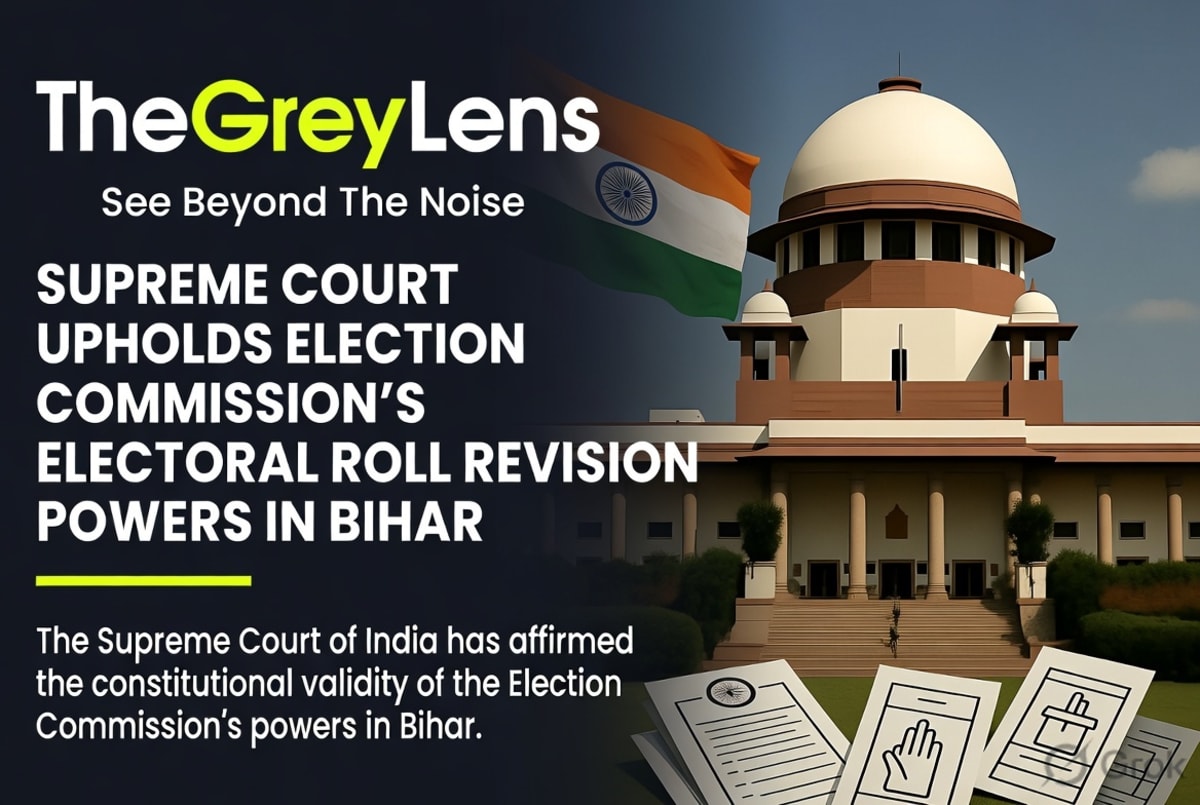
The Supreme Court on Wednesday, May 27, 2026, delivered a significant verdict upholding the Election Commission of India's (ECI) Special Intensive Revision (SIR) of electoral rolls in Bihar. A two-judge Bench, led by Chief Justice Surya Kant and including Justice Joymalya Bagchi, unanimously ruled that the SIR exercise was constitutionally valid and within the ECI's powers. This decision comes after extensive hearings that spanned nearly seven months.
Ensuring Electoral Integrity
The Court's judgment emphasized that the SIR exercise was undertaken to preserve the "integrity, accuracy and credibility" of electoral rolls, which are fundamental to the democratic process. Rejecting the challenges made against the revision, the Bench observed that the SIR is not a mechanism to subvert but rather to secure the mandate of free and fair elections. The exercise was found to pursue a legitimate and constitutionally grounded purpose: the restoration of accuracy, completeness, and integrity to the electoral rolls. The Court noted that rapid urbanization and migration necessitate such intensive revisions to remove potential errors and duplications that accumulate over decades without thorough updates.
Scope of ECI's Powers and Judicial Review
The Supreme Court clarified that the ECI possesses the power to conduct the SIR under Article 324 of the Constitution and Section 21(3) of the Representation of the People Act, 1950. The Court found that the measures adopted by the ECI were neither arbitrary nor excessively disproportionate, stating that the process, when executed with appropriate safeguards, can be constitutionally compliant. While upholding the ECI's authority, the Court also noted that the SIR is subject to judicial review. In cases where the ECI is not satisfied about a person's eligibility for inclusion in the electoral rolls, particularly concerning citizenship, the ECI is directed to refer such matters to the competent authority under the Citizenship Act for adjudication. The Court specifically directed the ECI to refer all cases where names were deleted from the 2003 electoral rolls on grounds of non-citizenship to the relevant authorities within four weeks.
Implications and Future Direction
The Supreme Court's validation of the SIR exercise in Bihar is expected to have implications for similar revision drives conducted in other states. The judgment reinforces the ECI's mandate to maintain accurate voter lists, which is a critical component of electoral fairness. The ruling provides clarity on the ECI's powers and the legal framework governing electoral roll revisions, assuring the public that efforts are being made to ensure the credibility of the electoral process. The Court's emphasis on proportionality and the availability of redressal mechanisms suggests a balanced approach to electoral integrity and individual rights. The ECI has welcomed the verdict, stating that it will continue to uphold its commitment to voters.