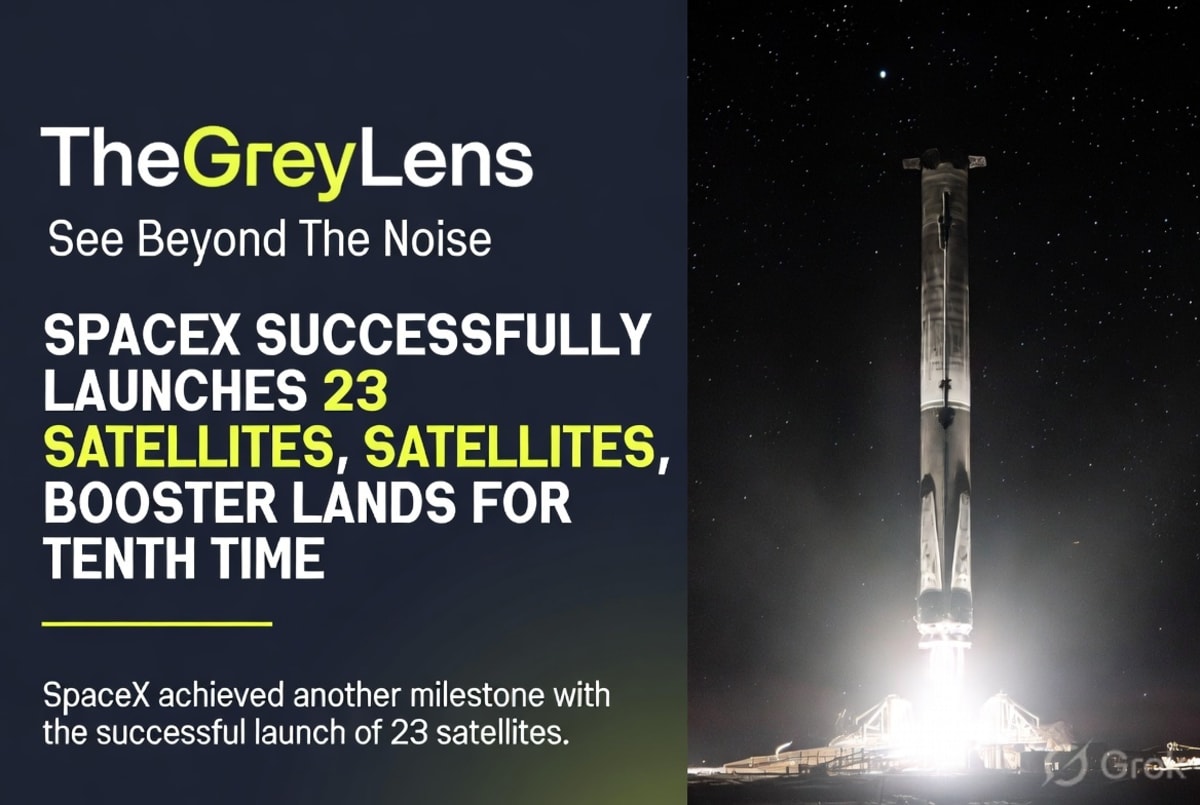
SpaceX marked another successful mission early Saturday morning, June 7, 2026, by launching 23 satellites into orbit from Vandenberg Space Force Base in California. The mission, designated Starlink Group 17-43, included 21 standard Starlink broadband satellites and two Starshield satellites, the latter being a government-oriented variant designed for national security applications. This launch further underscores SpaceX's increasing role in both commercial and defense sectors.
A Milestone for Reusability
The Falcon 9 rocket's first stage booster, identified as B1097, performed flawlessly, marking its tenth successful flight. This achievement highlights SpaceX's advanced reusability program and its ability to maintain a high cadence of launches. Approximately eight and a half minutes after liftoff, the booster executed a precise propulsive landing on the autonomous spaceport drone ship 'Of Course I Still Love You,' stationed in the Pacific Ocean. This tenth flight for booster B1097 adds to the growing fleet of SpaceX boosters that have surpassed the double-digit reuse mark, a testament to the company's engineering and operational prowess.
Expanding the Starlink and Starshield Constellations
The Starlink constellation, SpaceX's ambitious project for a space-based internet communication system, continues to expand with the addition of 21 new satellites. These satellites are crucial for providing high-speed internet access globally. Concurrently, the launch of two Starshield satellites signifies SpaceX's deepening involvement in providing dedicated satellite services for government and military clients. Starshield leverages the same core technology as Starlink but is enhanced with greater security features and inter-satellite link capabilities, catering to specific national security requirements.
The launch occurred at 9:24:45 p.m. PDT on June 6, which translated to 04:24:45 UTC on June 7. The successful recovery of the booster demonstrates the increasing reliability and cost-effectiveness of SpaceX's launch operations. This consistent performance is vital as the company prepares for future ambitious endeavors, including potential initial public offerings for its various ventures and continued expansion of its satellite networks.
The Growing Defense and Commercial Synergy
The inclusion of Starshield satellites alongside the commercial Starlink batch exemplifies a growing synergy between SpaceX's commercial and defense operations. As a defense contractor, SpaceX is increasingly being tapped for its capabilities in satellite deployment and space-based communication solutions. The Starshield variant is specifically tailored for government and military use, offering enhanced security and robust connectivity for critical national security missions. This dual-use approach allows SpaceX to leverage its technological advancements and manufacturing scale across diverse markets, strengthening its position as a key player in both the commercial and defense space industries.
Looking ahead, SpaceX is expected to maintain its high launch tempo. The company's continuous innovation in rocket technology, coupled with its expanding satellite constellations, positions it for significant growth in the coming years. The successful tenth flight of booster B1097 is not just a statistical achievement but a clear indicator of the mature and efficient operational framework SpaceX has established, paving the way for future missions and technological breakthroughs.