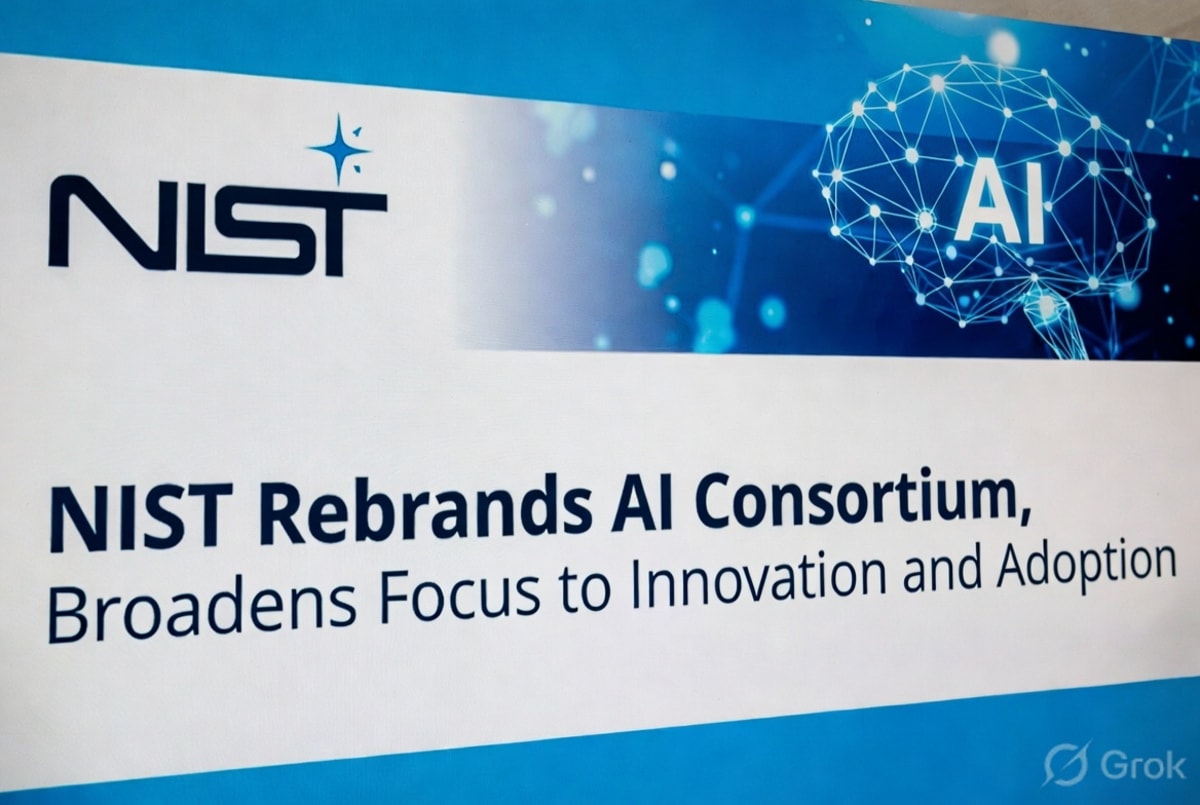
The National Institute of Standards and Technology (NIST) has officially expanded the scope and rebranded its AI Safety Institute Consortium to the NIST Artificial Intelligence Consortium, signaling a strategic pivot towards fostering AI innovation and adoption alongside its ongoing work in measurement science and evaluation. This move, announced on Friday, May 29, 2026, reflects a broader governmental strategy to accelerate the development and integration of critical and emerging technologies, with a particular emphasis on bolstering U.S. technological leadership.
A New Era for AI Collaboration
Formerly the AI Safety Institute Consortium (AISIC), the newly named NIST Artificial Intelligence Consortium will retain some of its previous focus on safety but will now concentrate on a wider array of objectives. These include building a robust AI evaluation ecosystem, investing in AI-enabled scientific research, and promoting the widespread adoption of U.S.-developed AI technologies and systems. This broadened mission is directly in line with NIST's Strategy for American Technology Leadership in the 21st Century, aiming to expedite the transition of AI from development to practical application through close collaboration with the private sector.
The consortium's work will be organized into six distinct task groups, each addressing a critical facet of AI development and deployment. These groups include the AI Testing, Evaluation, Verification and Validation (AI TEVV) Zero Draft Task Group, tasked with developing tools to ensure AI systems meet design requirements and are fit for purpose. The AI Documentation Cards Task Group will focus on creating standardized templates for documenting AI datasets, models, and systems, drawing on existing best practices. The Bias Effects and Notable Generative AI Limitations (BENGAL) Group, in partnership with IARPA, will explore solutions for issues such as misinformation, sensitive data leakage, and AI susceptibility to attacks. Furthermore, the AI Evaluation and Measurement Methods Task Group will identify gaps and challenges in AI evaluation science, while the Annotation for AI Risks & Validity Task Group will support the creation of toolkits for assessing AI risks. A restarted Chemical and Biological Security Task Group will also share insights on emerging AI measurement and evaluation approaches relevant to security concerns.
Expanding Membership for Broader Impact
In conjunction with the mission expansion, NIST is actively seeking new member organizations to join the consortium. The agency is inviting entities with relevant technical capabilities to express their interest, with selections to be made on a first-come, first-served basis. While current members are not required to reapply, they will be asked to sign an amendment to agree to the consortium's updated objectives. This call for new members underscores NIST's commitment to a collaborative approach, aiming to harness the diverse expertise and resources of the broader community to advance AI measurement, innovation, and adoption.
Deputy NIST Director Craig Burkhardt emphasized the strategic importance of this expansion, stating, “To encourage more extraordinary AI technological innovations, NIST is seeking to expand its AI measurement efforts by harnessing the broader community's interests and capabilities.” This initiative builds upon recommendations from the Trump administration's AI Action Plan, which highlighted the need for industry collaboration on AI measurement science to promote AI development. The reorganization follows a broader trend noted over the past year, with the renaming of NIST's AI Safety Institute to the Center for AI Standards and Innovation, indicating a continued emphasis on standardization and innovation within the AI landscape.
The Evolving Regulatory and Innovation Landscape
The expansion of the NIST AI Consortium comes at a critical juncture for the nation's AI ecosystem. Just yesterday, Illinois lawmakers passed a significant AI safety bill requiring public safety plans, independent testing, and incident reporting from large model developers, a move that has garnered support from major AI firms like OpenAI and Anthropic. This legislative action highlights a growing state-level focus on AI regulation, creating a baseline for practices that leading companies often claim to follow voluntarily. While proponents argue such laws set necessary standards, critics raise concerns about potential exposure of sensitive systems to auditors.
Simultaneously, the artificial intelligence sector continues to see substantial private investment and technological advancements. Reports from May 29, 2026, indicate that Anthropic is nearing a trillion-dollar valuation, potentially raising $65 billion in a Series H round. This comes as Apple reportedly explores distilling Google's Gemini models for on-device use with a new Siri, and Microsoft rolls out a redesigned, faster Microsoft 365 Copilot. Waymo is also preparing to launch its autonomous taxi service to the public in California and Arizona within weeks.
In the realm of scientific AI, a breakthrough at Stanford University involves a room-temperature quantum device that uses twisted light to entangle photons and electrons, potentially paving the way for smaller, more affordable quantum systems applicable to secure communications and future AI platforms. This development addresses a major hurdle in quantum technology, which typically requires near-absolute-zero temperatures. Meanwhile, in the pharmaceutical industry, Eli Lilly inaugurated LillyPod, its AI supercomputer, aiming to halve drug development timelines. These diverse advancements underscore the rapid pace of AI development across various sectors, from foundational research to practical applications in healthcare and transportation.
The expanded role of the NIST AI Consortium is poised to play a crucial part in navigating this complex and rapidly evolving landscape. By fostering collaboration and developing standardized measurement science, the consortium aims to ensure that the United States remains at the forefront of AI innovation while addressing the multifaceted challenges and opportunities presented by this transformative technology. The consortium's renewed focus on innovation and adoption, supported by a diverse membership, signals a proactive approach to shaping the future of AI in the U.S.
Looking ahead, the consortium's success will likely hinge on its ability to effectively integrate industry insights, drive the development of practical AI evaluation tools, and promote the responsible advancement of AI technologies. The coming months will be critical as new members are onboarded and the six task groups begin their work, setting the stage for a more coordinated and impactful approach to AI development and deployment across the nation. The ongoing dialogue between regulatory initiatives, such as Illinois's new AI safety bill, and the NIST consortium's focus on measurement and adoption, will be crucial in shaping a balanced and productive AI future.