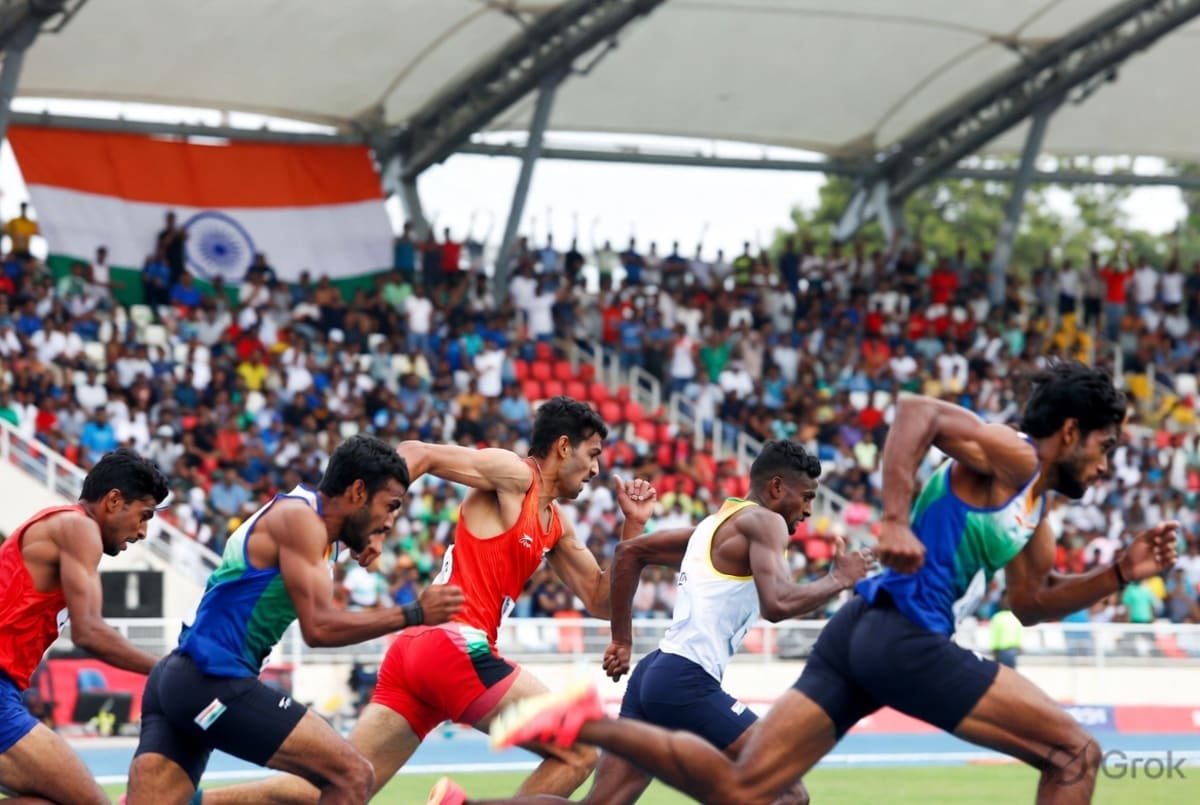
Athletes Chase Commonwealth Dreams Amidst Stiff Qualification Norms
The National Senior Athletics Federation Competition 2026, held at the Birsa Munda Stadium in Ranchi, has been a pivotal event for Indian athletes aiming to secure their places in the Commonwealth Games 2026 in Glasgow. The Athletics Federation of India (AFI) has set stringent qualification standards for many events, pushing athletes to achieve personal bests and even national records to earn a spot. In a significant number of disciplines, Indian athletes must surpass existing national records to meet the qualifying benchmarks, underscoring the heightened level of competition and the AFI's commitment to fielding a highly competitive squad. This approach aims to ensure that only the most prepared and capable athletes represent India on the international stage.
Several prominent athletes are participating, including Olympians Murali Sreeshankar, Annu Rani, Tajinderpal Singh Toor, Sarvesh Kushare, and Tejaswin Shankar. Their presence underscores the significance of the Federation Cup as a premier domestic athletics meet. For instance, in the men's javelin throw, athletes like Sachin Yadav, Rohit Yadav, and Kishore Jena are competing for a qualification mark of 82.61 meters. Sachin Yadav boasts a personal best of 86.27 meters, while Rohit Yadav has thrown 83.65 meters. Olympian and Asian Games silver medallist Kishore Jena, with a personal best of 87.54 meters, is also looking to regain his top form after a period of injury. Similarly, in the women's javelin throw, Annu Rani is competing after an uncharacteristic loss in a domestic event earlier in May. The competition is not just about achieving a standard but also about demonstrating consistent form and readiness for international competition.
Intense Duels and Emerging Talent in Focus
Beyond the headline events, the Federation Cup has showcased numerous compelling duels across various disciplines, highlighting both established stars and emerging talents. In the men's long jump, national record holder Murali Sreeshankar is facing stiff competition from Jeswin Aldrin, who also holds a national record. The women's long jump features a contest between Shaili Singh and Ancy Sojan. The men's triple jump is set to witness a clash between Commonwealth Games silver medallist Abdulla Aboobacker and national record holder Praveen Chithravel.
In the throwing events, the men's shot put is expected to be a closely fought contest, with Tajinderpal Singh Toor facing Samardeep Singh Gill, who recently defeated him at the National Open. The sprints will see national record holder Animesh Kujur competing in the men's 100m and 200m, potentially facing challenges from Gurindervir Singh, the former national record holder in the 100m. The qualifying mark for the men's 100 meters is 10.16 seconds, a mark very close to the Indian national record of 10.18 seconds, indicating the high level of performance expected.
The decathlon will feature Tejaswin Shankar, who is aiming to surpass the 8000-meter mark. In the quarter-mile (400m) race, Rajesh Ramesh and Vishal TK are set to provide a thrilling spectacle, with Vishal TK having a personal best of 45.12 seconds. The women's 400m will see Vithya Ramraj in action. Athletes recovering from injuries, such as steeplechase runner Avinash Sable and hurdler Jyothi Yarraji, are notable absentees, while middle-distance runners Gulveer Singh and Parul Chaudhary have opted out of the competition.
Strategic Importance and Future Implications
The National Senior Athletics Federation Competition 2026 is more than just a national championship; it is a critical selection trial for the Commonwealth Games 2026. The Athletics Federation of India (AFI) has emphasized that while the meet is the primary selection event, exemptions may be granted for athletes who cannot compete due to exceptional circumstances, provided they have prior written approval from the AFI. This policy highlights the federation's commitment to fairness while ensuring the strongest possible team is assembled.
The AFI has also implemented new regulations concerning athlete eligibility for major events. Athletes must have participated in at least two competitions to be eligible for the National Senior Athletics Federation Championships. For the 65th National Inter State Senior Athletics Championships, a minimum of three events is required. These measures are designed to encourage consistent participation and development throughout the season.
Furthermore, the AFI is introducing a 16-part regional series, the Indian Athletics Series, running from April to September. This series aims to boost grassroots participation and provide more competitive opportunities across various states, fostering a wider talent pool. The overall expansion of India's athletics calendar for 2026, from 32 to 40 events, reflects a strategic focus on maximizing athlete preparation and building momentum towards major international competitions like the Commonwealth Games and the Asian Games. The successful staging of this Federation Cup and the performances within it will undoubtedly influence India's medal aspirations and overall standing in global athletics for the foreseeable future. The outcomes from Ranchi will directly shape the narrative of Indian athletics as it heads into a crucial period of international competition.