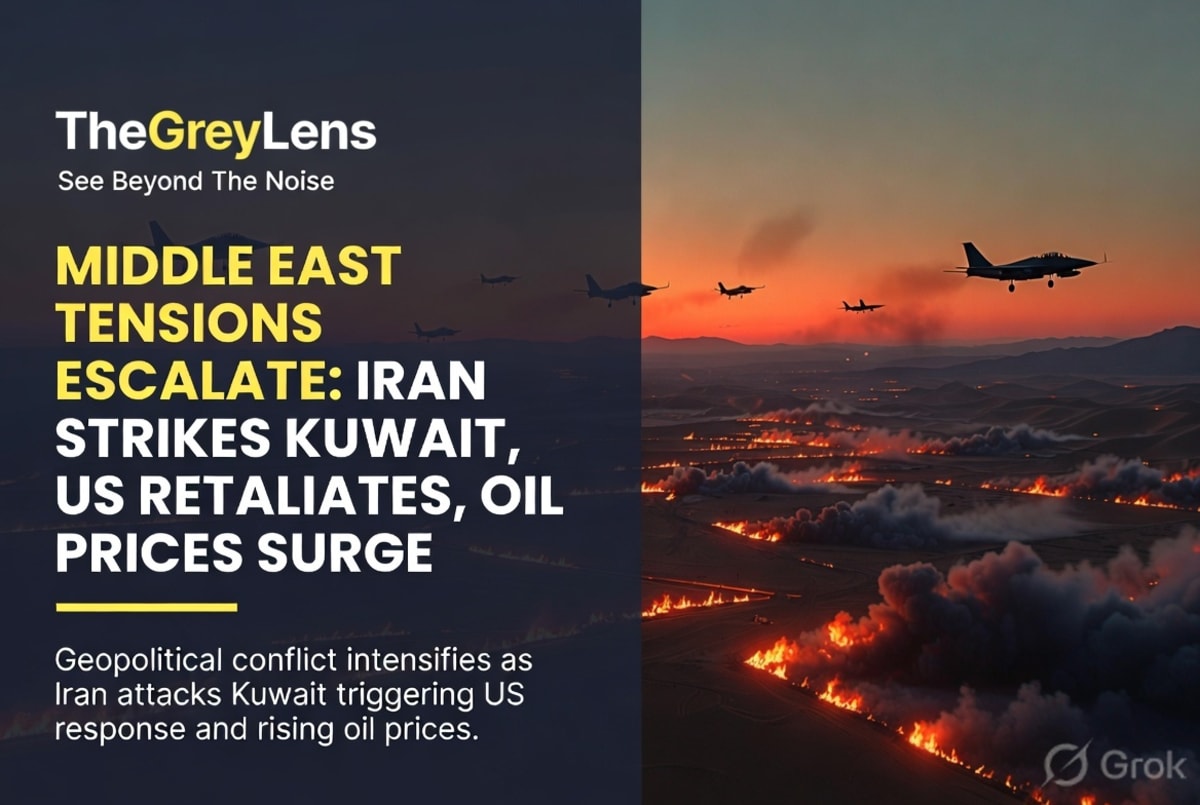
The Middle East is once again at the epicenter of escalating global conflict as Iran launched missile attacks on Kuwait and Bahrain on Wednesday, June 3, 2026. The strikes resulted in one confirmed fatality in Kuwait and left dozens wounded, according to Kuwait's foreign ministry. In response, the U.S. military conducted retaliatory strikes on Qeshm Island and an oil tanker reportedly heading for an Iranian port, further inflaming the volatile situation. The attacks have sent shockwaves through international markets, with oil prices surging significantly.
Escalating Hostilities and Global Ramifications
The series of attacks marks a dramatic escalation in the ongoing tensions between Iran and the United States, which have been further complicated by regional conflicts. The missile strikes on Kuwait, a key oil-producing nation, and Bahrain, home to a significant U.S. naval base, underscore the widening scope of the conflict. The fatality in Kuwait, identified as an Indian national, highlights the international impact of the regional instability. Iranian news agencies have reported that Tehran has ceased communication with mediators regarding a ceasefire extension with the U.S. and Israel, though President Donald Trump insists negotiations are ongoing. This breakdown in diplomatic channels, coupled with direct military actions, has created a climate of extreme uncertainty.
The repercussions of these events are already being felt globally, particularly in energy markets. West Texas Intermediate crude rose 3.2% to $96.73 a barrel, while Brent crude increased 2.9% to $98.80 a barrel. Analysts have warned that the market may be underpricing the risks associated with the ongoing conflict, which has now entered its third month. The continued disruption of oil supplies, particularly if the Strait of Hormuz remains blocked, poses a significant threat to global fuel prices and economic stability. This situation is exacerbated by the fact that gold has recently surpassed U.S. Treasury securities as the largest reserve asset held by central banks worldwide, indicating a broader shift in financial markets driven by geopolitical instability and inflation concerns.
Economic Ripples and Policy Responses
The surge in oil prices and the broader geopolitical instability are having a tangible impact on the U.S. economy. Economic analyses point to a fragile economic outlook for 2026, characterized by slower-than-expected GDP growth and persistent inflationary pressures. While AI investment and consumer spending among high earners have provided some support, falling real household incomes and a weakening labor market present significant challenges. Tariffs and energy prices remain key inflationary concerns, with the latter being directly impacted by the current Middle East crisis.
In response to these economic pressures, the Federal Reserve has maintained a cautious stance on interest rates, with projections indicating a potential for continued holding patterns amidst fiscal policy concerns. The economic landscape is further complicated by ongoing debates surrounding trade policy, with the administration signaling its intent to maintain tariffs through various mechanisms, regardless of potential Supreme Court rulings. Economic analysis highlights that while overall GDP growth has shown some resilience, driven by AI and some policy changes, manufacturing employment has stagnated, and trade uncertainty remains a top concern for businesses. The concentration of consumer spending among the top 10 percent of earners, who now account for a record 49 percent of all consumer spending, also points to an uneven economic recovery.
The White House, under President Trump, has continued to promote advanced Artificial Intelligence innovation and security, issuing executive orders aimed at strengthening cybersecurity and fostering AI development. However, these efforts are being undertaken against a backdrop of significant geopolitical and economic challenges. The administration's focus on tariffs has led to pass-through costs for consumers, potentially raising inflation. The economic outlook remains contingent on the resolution of the conflict in the Middle East and the subsequent impact on energy markets and global supply chains.
Supreme Court's Pending Decisions and Their Potential Impact
Adding to the complex landscape of U.S. policy and national discourse, the Supreme Court is poised to deliver rulings on several high-profile cases before its summer recess. These decisions, expected in the coming weeks, could have significant implications across various sectors. Among the most closely watched cases are those concerning birthright citizenship, gun rights, transgender athletes in sports, and the extent of presidential power over independent agencies.
In the realm of immigration, a case challenging the interpretation of birthright citizenship under the 14th Amendment could redefine citizenship laws. President Trump's executive order to deny citizenship to newborns of parents unlawfully present in the U.S. has faced judicial blocks, and the Supreme Court's decision will be pivotal. Separately, cases addressing transgender athletes in sports and state bans on their participation could reshape Title IX and equal protection laws. The court is also deliberating on cases that could expand or restrict campaign finance regulations and alter mail-in ballot counting laws, with potential impacts on future election administration.
Furthermore, the Supreme Court's ruling in cases concerning the president's authority to remove heads of independent agencies, such as the Federal Trade Commission, could significantly alter the balance of power between the executive branch and regulatory bodies. President Trump has sought to expand his executive authority, and the court's decision on these matters will set important precedents. The outcomes of these cases, alongside ongoing geopolitical events and economic pressures, will shape the policy environment and societal discourse in the United States throughout the remainder of 2026 and beyond. The nation watches as these critical decisions unfold against a backdrop of global instability and domestic economic challenges.
This unfolding situation demands close observation as diplomatic efforts, economic policies, and judicial decisions intersect, shaping the trajectory of both domestic and international affairs. The coming weeks and months will be critical in determining the stability of global energy markets, the resilience of the U.S. economy, and the future direction of key legal and policy frameworks within the United States.