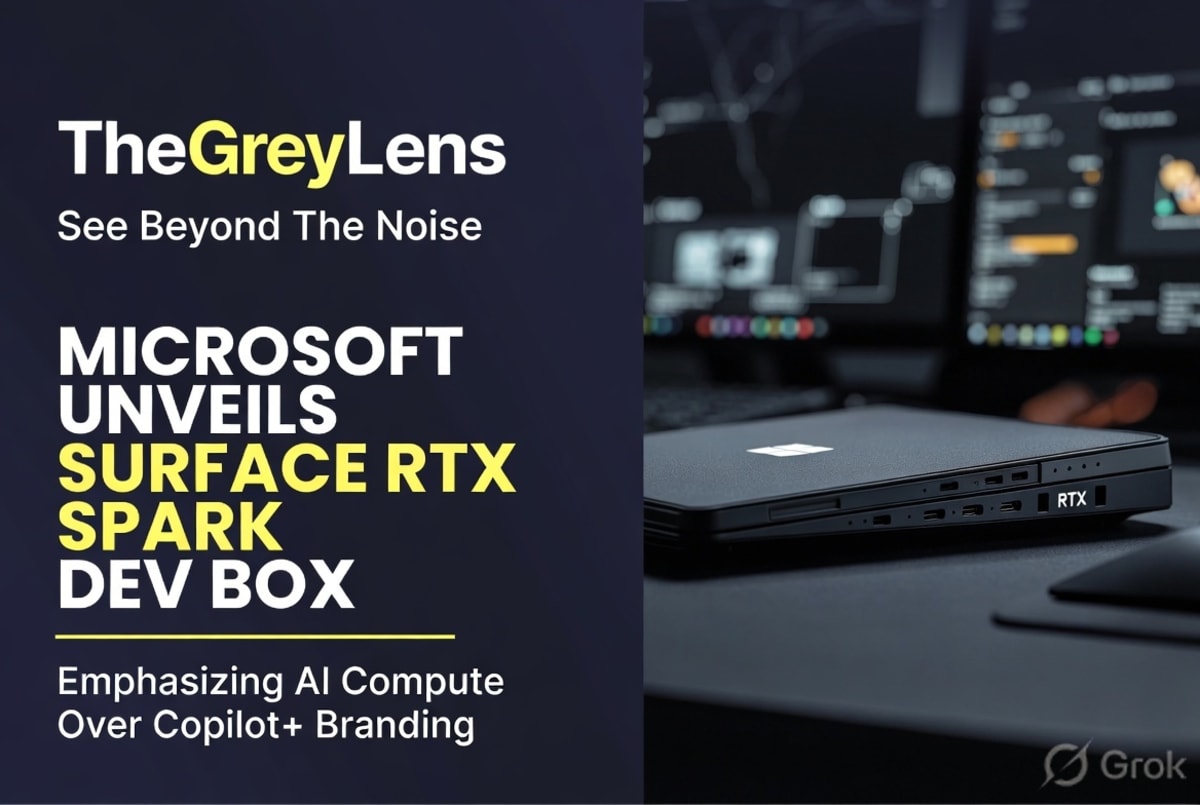
Microsoft has officially entered the AI development hardware market with the launch of its new Surface RTX Spark Dev Box. This compact, powerful machine, revealed during Microsoft's Build 2026 conference, is built around NVIDIA's RTX Spark SoC and is designed to accelerate local AI development and complex computational tasks. However, a significant observation from the launch is Microsoft's decision to forego the "Copilot+ PC" branding that has become synonymous with AI-focused Windows machines. Instead, the company is emphasizing the device's raw AI compute power and its deep integration with NVIDIA's technology.
A New Frontier in AI Development Hardware
The Surface RTX Spark Dev Box represents Microsoft's direct response to the growing demand for specialized hardware capable of handling demanding AI workloads. Unlike traditional laptops or desktops, this dev box is engineered from the ground up for developers and power users who require significant local processing power for machine learning models, generative AI applications, and other computationally intensive tasks. The device boasts an all-aluminum chassis with a distinctive layered design, featuring extensive ventilation to manage heat. Microsoft has stated that the dev box is designed to operate within a 100-watt thermal envelope, offering a glimpse into the power efficiency of the RTX Spark chip.
Internally, the Surface RTX Spark Dev Box is configured to support up to 128GB of RAM, ensuring ample memory for large datasets and complex AI models. This specification, combined with the capabilities of the NVIDIA RTX Spark SoC, positions the device as a formidable tool for AI professionals. The choice to focus on NVIDIA's hardware also underscores the deepening partnership between the two tech giants in the AI space. NVIDIA's entry into the Windows ecosystem with its Arm-based RTX Spark SoC has been a significant development, and Microsoft is clearly leveraging this to offer a compelling new platform for developers.
The Omission of "Copilot+ PC" Branding
The most intriguing aspect of the Surface RTX Spark Dev Box's unveiling is the conspicuous absence of the "Copilot+ PC" branding. Microsoft had previously defined Copilot+ PCs as the "fastest, most intelligent Windows PCs ever built," requiring specific hardware like a dedicated NPU of 40 TOPS and substantial RAM. The initial wave of Copilot+ PCs in 2024 was largely powered by Qualcomm's Snapdragon X Elite processors. However, the Surface RTX Spark Dev Box, with its RTX Spark chip capable of delivering up to 1 petaflop of AI compute in its highest configuration, far surpasses the typical NPU performance of standard Copilot+ devices. For context, Qualcomm's Snapdragon X2 Extreme tops out at around 80 TOPS.
Industry observers suggest that the decision to omit the Copilot+ branding may stem from a desire to avoid misleading consumers. Branding a device with such immense AI capabilities alongside more mainstream Copilot+ PCs, which have significantly lower AI processing power, could create confusion about performance expectations. WindowsLatest reported that the Surface Laptop Ultra, also unveiled recently and emphasizing RTX Spark and local AI compute powered by NVIDIA, was similarly presented without the Copilot+ badge. This suggests a broader strategic consideration by Microsoft regarding how it communicates the power and capabilities of its AI-focused hardware to different market segments.
A Developer-First Approach and Future Implications
Microsoft's Build 2026 conference has underscored a commitment to developers, with a strong focus on enhancing the Windows development experience. The introduction of features like native WSL containers, Homebrew, ZSH, and over 75 Unix utilities aims to reduce friction for developers who are accustomed to other operating systems. The Surface RTX Spark Dev Box and the developer-optimized Windows 11 experience that will ship on it, as highlighted by Kayla Cinnamon during the keynote, are central to this strategy. This developer-first approach, prioritizing a clean and efficient operating system environment, is seen as a move that will ultimately benefit all Windows users.
The implications of this branding decision are yet to be fully understood. It could signal a strategic pivot for Microsoft, differentiating its high-performance AI hardware from its broader range of AI-enabled consumer devices. As the AI landscape continues to evolve rapidly, companies are increasingly focusing on clear communication of specialized capabilities. The Surface RTX Spark Dev Box, with its emphasis on raw AI power and NVIDIA's cutting-edge silicon, appears to be Microsoft's play to capture the high-end AI development market, potentially setting a new benchmark for what developers can expect from Windows-based workstations. The company's continued collaboration with NVIDIA on silicon for Windows on Arm devices also suggests a long-term strategy to bolster the platform's competitiveness in the burgeoning AI hardware sector.