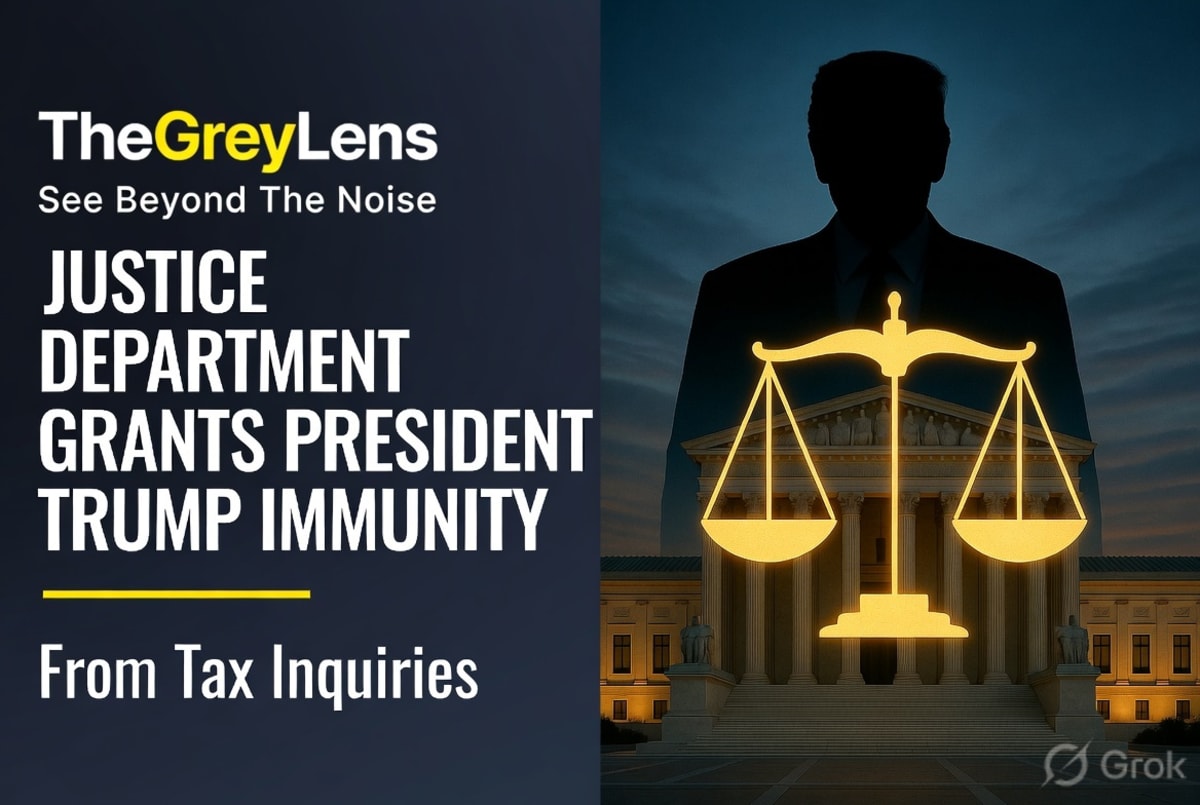
WASHINGTON D.C. – The U.S. Justice Department has issued a sweeping grant of immunity to President Donald Trump, his immediate family, and his associated businesses, shielding them from current and future inquiries into their tax affairs. This potentially landmark decision, which could avert significant financial and legal entanglements for the President, was reportedly appended to a larger agreement that also includes a substantial compensation fund for Trump allies.
The provision, detailed in documents signed by the acting attorney general, Todd Blanche, effectively bars the government from prosecuting or pursuing pending tax claims against the Trump entities. The immunity is described as "FOREVER BARRED and PRECLUDED," indicating a permanent cessation of governmental action on these specific tax matters. This development comes as the nation grapples with a complex geopolitical landscape and ongoing economic shifts.
Political Landscape Shifts Amidst Immunity Deal
The immunity grant is not the only significant political news of the past 24 hours. In Kentucky, a closely watched primary saw Ed Gallrein, endorsed by President Trump, defeat Representative Thomas Massie in the 4th Congressional District. This victory is seen as a further consolidation of Trump's influence within the Republican Party, occurring even as the President's overall approval ratings have reportedly seen a decline. Massie's defeat is attributed by some to his obstructionist stance on key Trump initiatives and his role in efforts to release documents related to Jeffrey Epstein.
In parallel, the Senate advanced a resolution aimed at limiting President Trump's war powers concerning Iran. The measure passed by a vote of 50-47, with three Republican senators joining most Democrats. However, the resolution is expected to face a presidential veto, even if it successfully navigates both chambers of Congress. This vote occurred amidst reports of Israeli airstrikes in southern Lebanon and ongoing tensions in the Middle East, with two Chinese tankers reportedly exiting the Strait of Hormuz carrying Iraqi crude oil, signaling a potential de-escalation in shipping disruptions.
Economic Indicators and Regulatory Adjustments
On the economic front, the U.S. economy has shown resilience, with GDP growing at an annualized rate of 2.0 percent in the first quarter of 2026, bolstered by the reopening of the federal government and strong private domestic demand, particularly in technology sectors. Investment in intellectual property and information processing equipment has been a key driver, though imports have played a significant role in fueling this growth. However, inflation remains a concern, with headline CPI jumping to 3.8 percent year-over-year in April, largely due to rising gasoline prices and an unusual shelter inflation calculation. Core PCE inflation has also reaccelerated, prompting the Federal Reserve to maintain a cautious stance on interest rate cuts.
Adding to the regulatory landscape, U.S. Immigration and Customs Enforcement (ICE) has updated its Form I-9 inspection guidance. These changes are expected to increase employer exposure to penalties for paperwork violations, as more errors are now classified as "substantive." This heightened scrutiny affects areas such as employee information, document details, and the use of remote verification procedures. Employers are advised to conduct thorough audits of their existing I-9 forms and retrain HR personnel to mitigate increased risks.
The Broader Political and Economic Context
These events unfold against a backdrop of broader political and economic considerations. The U.S. is navigating complex international relations, including discussions surrounding Iran and its implications for global trade and energy markets. Domestically, affordability has emerged as a central campaign issue ahead of the upcoming midterm elections, with political analysts suggesting that Republican control of Congress may be vulnerable. The administration's policies, including tax cuts and regulatory adjustments, continue to shape the economic environment, with ongoing debates about federalism, artificial intelligence, and healthcare affordability.
Looking ahead, the focus remains on how these various developments will impact the nation's political trajectory, economic stability, and international standing. The effectiveness of regulatory adjustments, the outcomes of ongoing geopolitical negotiations, and the President's continuing influence on domestic politics will be key factors to monitor in the coming months.