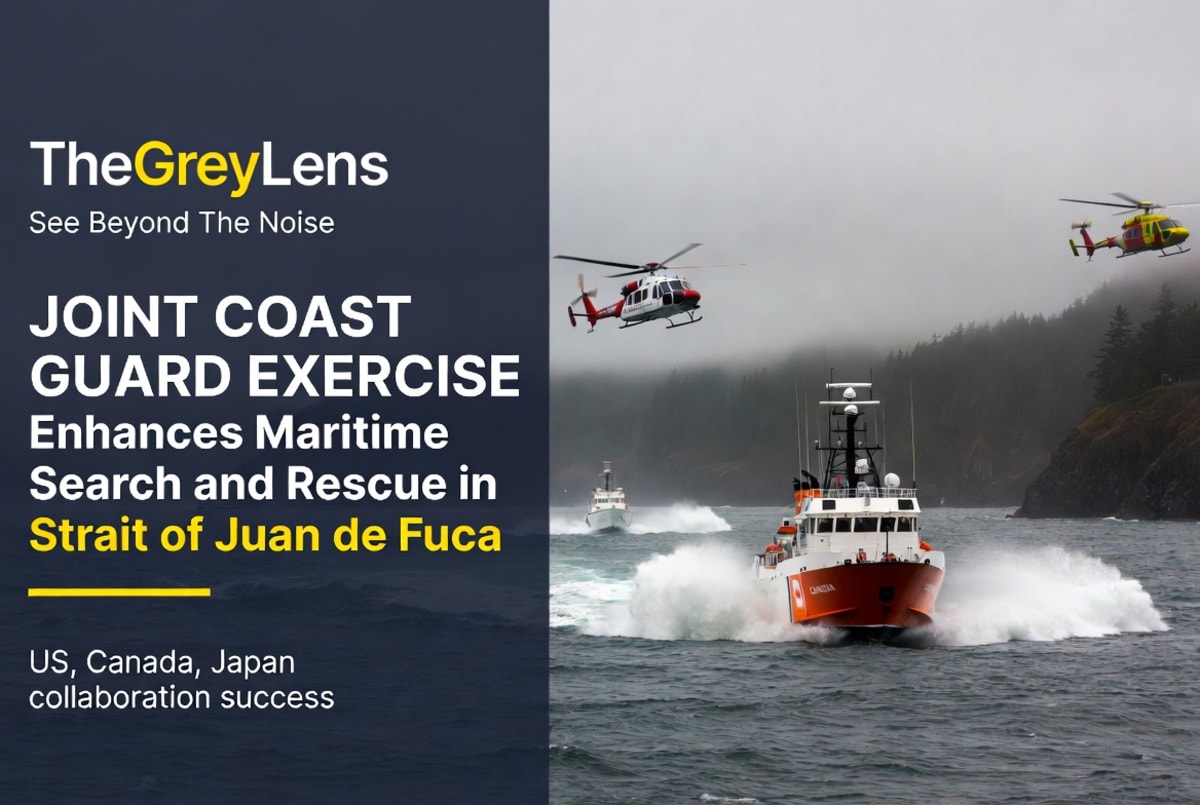
The waters of the Strait of Juan de Fuca served as the backdrop for a critical joint search and rescue (SAR) exercise conducted on May 21, 2026, involving the U.S. Coast Guard, Canadian Coast Guard, and Japan Coast Guard. This trilateral operation was designed to sharpen the collaborative capabilities of the three maritime nations in addressing diverse and challenging emergency scenarios at sea.
Interoperability Tested in Simulated Distress Scenario
The exercise centered on a simulated distress call involving a sailing vessel. Responding crews meticulously practiced locating the distressed vessel, recovering mock casualties, and safely transferring personnel between vessels from different nations. This scenario provided a realistic testbed for joint communication protocols, the execution of coordinated search patterns, and the seamless transfer of individuals, all vital components of effective maritime SAR operations. The participation of the Japan Coast Guard's training vessel Itsukushima, noted as their largest and most technologically advanced, offered a unique opportunity for personnel exchange and the sharing of best practices among future maritime professionals.
Strengthening Pacific Maritime Partnerships
This collaborative effort underscored the enduring maritime partnership between the three Pacific Rim countries. Officials emphasized the importance of such exercises in demanding environments like the Pacific Northwest. According to Douglas Samp, Coast Guard Pacific Area Search and Rescue Program Manager, "Search and rescue is a universal language. By working deck-to-deck and in the air with our partners from Canada and Japan, we ensure that when a real emergency occurs, our combined response is swift, seamless, and effective". The exercise involved assets such as the U.S. Coast Guard Cutter Osprey, an MH-65 Dolphin helicopter, and a 45-foot response boat-medium, alongside Canadian contributions including the Joint Rescue Coordination Centre Victoria, motor lifeboat Cape Calvert, and ships Tanu and Legacy.
While this exercise focused on preparedness and collaboration, other recent reports highlight ongoing SAR activities and concerns in Canada. In the Canadian Rockies, Parks Canada has noted an increase in rescue calls, urging visitors to be better prepared for the unpredictable spring mountain conditions, which can include lingering snow, ice, and avalanche hazards. Separately, a significant search and rescue training exercise involving the Canadian Coast Guard, Royal Canadian Air Force, and local emergency services took place in Parry Sound, Ontario, on May 26, 2026, preparing crews for upcoming summer deployments.
The successful completion of the Strait of Juan de Fuca exercise signifies a strengthened readiness for multinational maritime response. The lessons learned and partnerships forged are expected to enhance safety and efficiency in future real-world emergencies across the Pacific region.