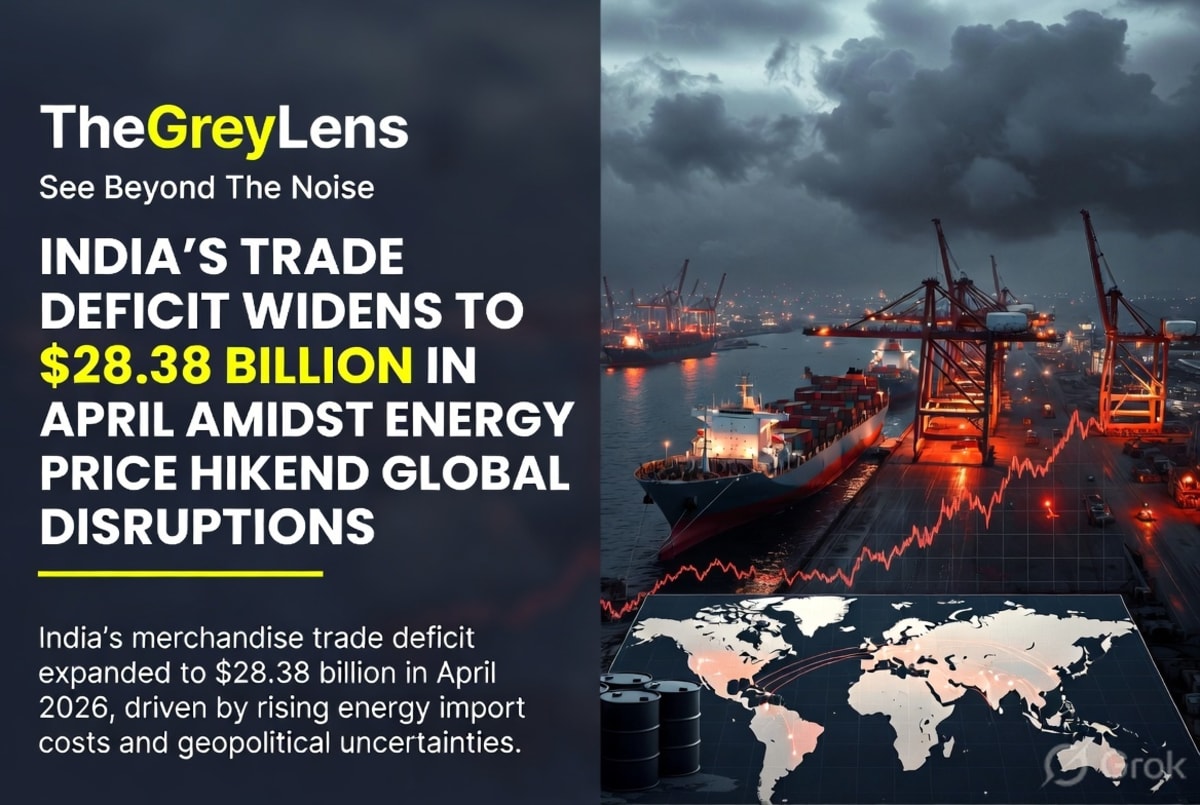
India experienced a notable widening of its merchandise trade deficit in April 2026, reaching $28.38 billion. This figure represents an increase from the $20.67 billion deficit recorded in March 2026 and surpasses economists' expectations of around $26.5 billion. The primary driver behind this expansion has been a substantial rise in imports, which climbed to $71.94 billion in April from $59.59 billion in March, while exports saw a more modest increase to $43.56 billion from $38.92 billion.
Energy Costs and Import Reliance Fuel Deficit
The persistent geopolitical tensions in the Middle East, particularly the ongoing conflict involving Iran, continue to disrupt global energy markets, making imports costlier for India. As a major importer of crude oil and liquefied natural gas, India's import bill has been significantly inflated by these price hikes. The country fulfills a substantial portion of its energy needs through imports, making it particularly vulnerable to such global price shocks. Concerns are mounting over the potential impact of these elevated energy costs on economic growth, inflation, and India's overall balance of payments.
Electronics Imports and Structural Challenges Hamper Trade Balance
Beyond energy, the electronics sector has emerged as a significant contributor to the widening trade deficit. In April 2026 alone, the deficit in electronics reached a record $7.6 billion. This indicates a continued reliance on imported components and finished electronic goods, despite efforts to bolster domestic manufacturing capabilities. Analysts point to persistent infrastructure limitations and high logistics costs, estimated at around 7.97% of GDP, as further impediments to India's export competitiveness. While merchandise exports did hit a record $441.78 billion in the fiscal year 2026, the growth rate of 0.93% lags behind that of key regional competitors such as Vietnam and China, suggesting challenges in gaining market share.
Policy Interventions and Future Outlook
Authorities have expressed concern over the expanding trade deficit's pressure on the rupee, which has become Asia's worst-performing currency this year, and the depletion of foreign exchange reserves. In response, the government has taken measures such as increasing import duties on gold and silver. Looking ahead, the trade deficit is projected to remain under pressure throughout 2026, influenced by high crude prices, supply chain disruptions, and potential downturns in global demand. The electronics sector's import growth is expected to be a key factor in maintaining this pressure. Moody's Ratings has also revised its GDP growth forecast for India in 2026 downwards to 6%, citing higher energy costs and weaker industrial activity as key concerns, although the World Bank has raised its FY27 growth forecast to 6.6% on strong domestic demand, while also flagging the West Asia conflict as a headwind.