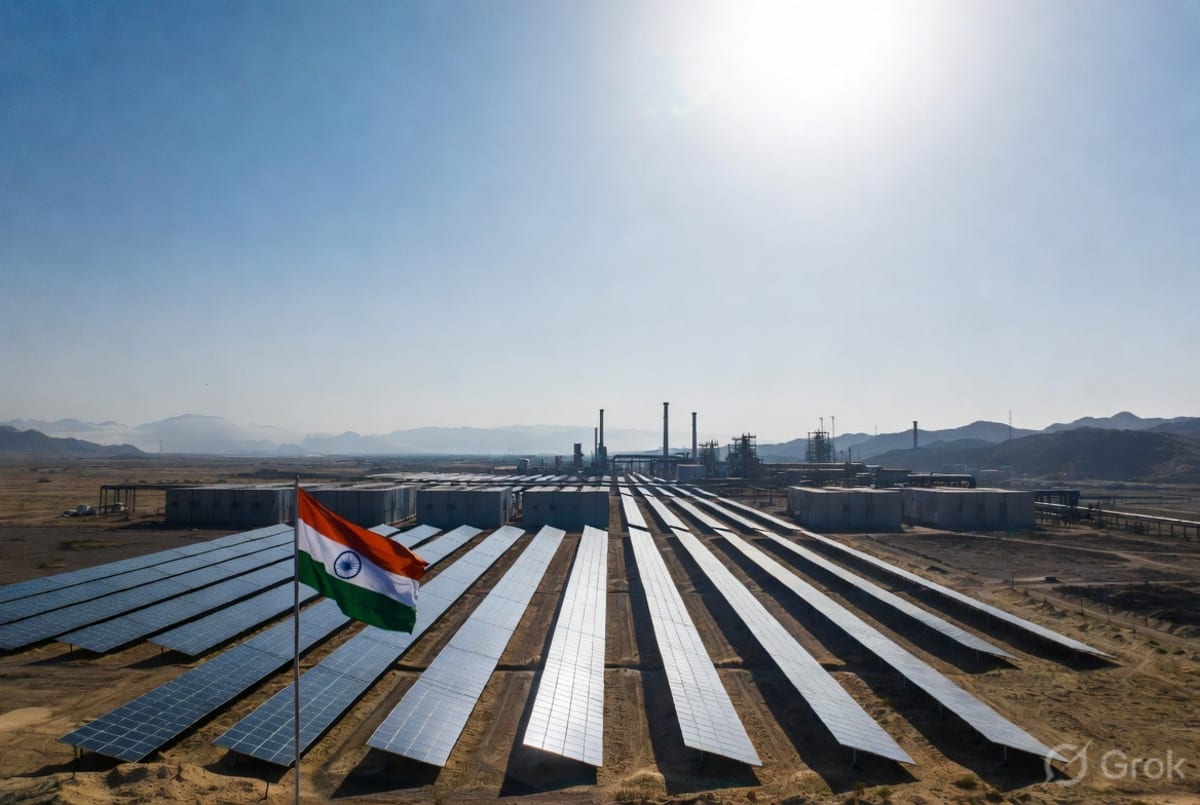
India is charting a unique course in global industrialization, increasingly powered by the sun. Analysts suggest the nation is on the verge of becoming the first major country to fuel its economic growth predominantly with solar energy, a stark departure from the fossil-fuel-heavy development paths taken by Western nations and China. This burgeoning solar revolution is most visibly demonstrated by the colossal Khavda solar park in Gujarat's Rann of Kutch. Set to be the world's largest, this park will eventually host nearly 60 million solar panels spread across 280 square miles, with a projected generating capacity of 30 gigawatts. This scale is equivalent to thirty times the output of a typical coal or nuclear power station, enough to power an entire country like Austria. This rapid expansion of solar capacity, growing at an annual rate of 40 percent, has seen India's installed solar capacity surpass 150 gigawatts as of March 2026. Projections indicate this figure will double again by 2030, underscoring the nation's aggressive push towards clean energy to meet its booming energy demands.
A New Paradigm for Developing Economies
The significance of India's solar-driven industrialization extends beyond its borders. As India's economy experiences growth rates that outpace China's, its approach to electrification is being closely watched. Energy strategist Kingsmill Bond notes that "China built on coal; India is building on sun." This shift is seen as enabling India to "develop without the long fossil-fuel detour taken by the West and China," potentially offering a blueprint for other emerging economies grappling with similar development needs and climate change imperatives. The falling costs of solar technology have made it an increasingly attractive and viable option for large-scale energy deployment. This transition is not merely about meeting domestic energy needs; it's about establishing energy independence and fostering sustainable economic growth.
Supply Chain Scrutiny and Land Use Dilemmas
Despite the optimistic outlook, India's solar ambitions face significant hurdles. A key challenge lies in its reliance on other nations, particularly China, for the supply chain of renewable energy technologies. The Indian government is actively working to boost domestic manufacturing to mitigate this dependence. However, a more persistent constraint is the issue of land. Solar farms, especially those of the scale being envisioned, require vast tracts of land, a precious commodity in a densely populated country like India. While innovative solutions like "agrivoltaics"—where solar panels are raised to allow farming underneath—are being explored in some regions, in other areas, the establishment of solar facilities has led to the displacement of farmers, sparking protests and raising social equity concerns. The expansive Khavda project, for instance, while occupying desert salt flats and avoiding human displacement, raises questions about its impact on wildlife habitats adjacent to the Rann of Kutch Wildlife Sanctuary. The sanctuary is home to several threatened species, and the proximity of such a large industrial installation could pose risks to their survival.
Geopolitical Ripples and Economic Resilience
India's energy transition is unfolding against a complex geopolitical landscape, particularly the ongoing conflict in West Asia. The Iran war has led to significant volatility in global energy markets, with warnings that oil prices could surge to $160 per barrel. This situation poses a dual challenge for India: it amplifies concerns about rising energy prices and puts downward pressure on the rupee, which has seen a depreciation of $7.51 billion in forex reserves as of May 22, 2026. The finance ministry's monthly economic review highlights the need for "policy agility" to manage these risks, cautioning that a poor monsoon could further exacerbate food inflation and impact rural demand. Despite these challenges, India's economy exhibits "cautious resilience," bolstered by strong services exports and investment. The depreciating rupee, while a concern, also makes Indian goods and services more competitively priced internationally, potentially boosting exports if global demand remains robust. The duration of disruptions in critical shipping lanes like the Strait of Hormuz, through which a significant portion of the world's energy passes, remains a consequential variable for India's economic outlook. The nation's ability to navigate these external shocks while continuing its ambitious solar-powered industrialization will be crucial for its sustained growth and global standing.
The coming months will be critical for India's energy and economic future. Watch for further developments in domestic solar manufacturing initiatives, policy responses to land use challenges, and the impact of global geopolitical events on energy security and trade balances. The success of India's solar-driven industrialization could indeed set a precedent for a cleaner, more sustainable global economic model.