What's Happening
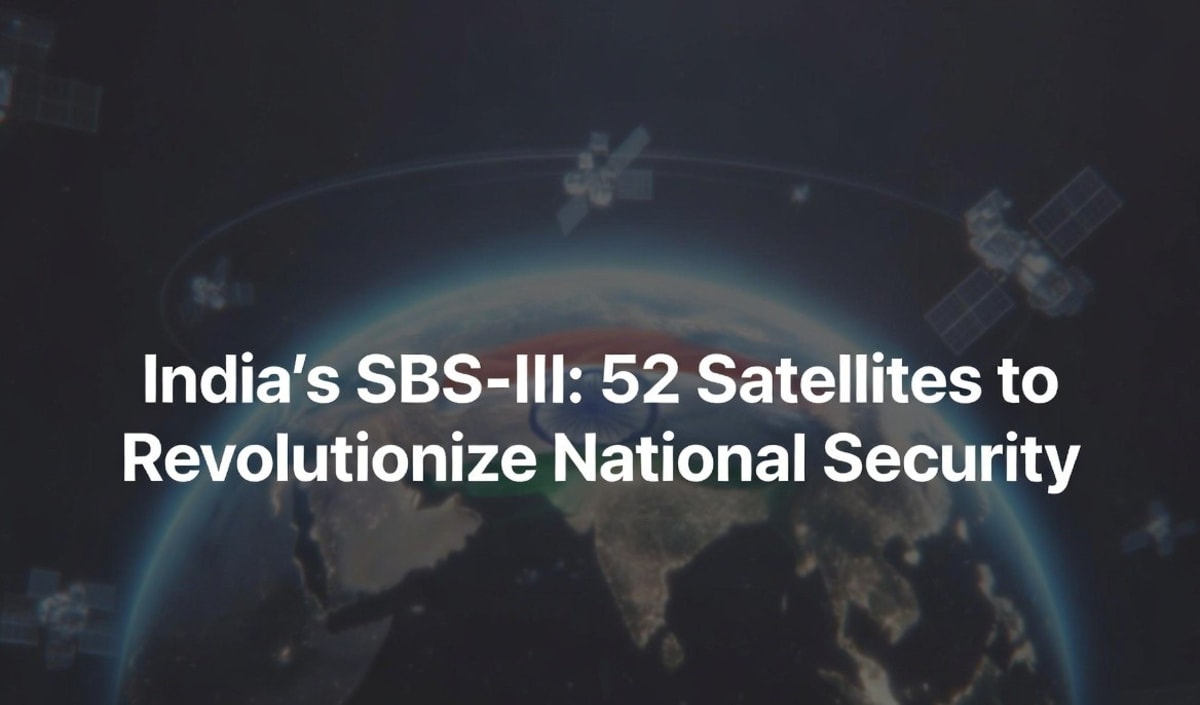
India is on the cusp of a major leap in its national security capabilities with the accelerated development of its Space-Based Surveillance (SBS)-III program. This ambitious initiative involves the deployment of a constellation of 52 advanced surveillance and communication satellites, with the full network targeted for completion by the end of 2029. The project, approved by the Cabinet Committee on Security, is valued at approximately ₹27,000 crore (around $2.8 billion to $3.3 billion). The SBS-III program is designed to provide unprecedented real-time monitoring of land, sea, and air, significantly enhancing India's intelligence, surveillance, and reconnaissance (ISR) capabilities. A key aspect of this phase is the integration of cutting-edge technologies such as Artificial Intelligence (AI) for autonomous data analysis and quantum communication for ultra-secure data transmission. The first satellites are slated for launch starting in April 2026, with ongoing production and testing. This strategic expansion aims to achieve technological parity with global space powers and ensure India's self-reliance in critical space-based intelligence gathering.
The Full Picture
The Space-Based Surveillance program represents a phased, strategic evolution of India's capabilities in orbit. SBS-I, initiated in 2001 under the Vajpayee administration, saw the launch of four satellites, including Cartosat-2A, Cartosat-2B, Eros B, and Risat-2. These early missions provided crucial imaging intelligence for border monitoring and tracking military installations, playing a role during the 2001-2002 India-Pakistan standoff. Phase II, approved in 2013, expanded this with six satellites such as Cartosat-2C, Cartosat-2D, and Risat-2A, enhancing regional monitoring with greater frequency and precision. SBS-III, the current and most ambitious phase, is not merely an expansion but a transformation, incorporating AI, quantum communication, and rapid-response launch systems. The Defence Space Agency (DSA), established in 2019, plays a pivotal role in the operational command and integration of these space assets into national defense. The program is a collaborative effort, with the Indian Space Research Organisation (ISRO) developing 21 satellites and the remaining 31 being manufactured by private Indian companies, marking a significant step towards private sector involvement in strategic space initiatives.
Why This Is Exploding Right Now
The current surge of interest in India's SBS-III program is driven by a confluence of escalating geopolitical tensions and a renewed emphasis on technological self-reliance. The recent border conflicts, particularly the 2025 confrontation with Pakistan, highlighted critical surveillance blind spots and the reliance on foreign data, prompting an urgent acceleration of the SBS-III deployment. Neighboring countries' advancements in space militarization, notably China's growing capabilities, have further underscored the strategic imperative for India to bolster its own space-based intelligence, surveillance, and reconnaissance (ISR) assets. The program's emphasis on real-time, persistent monitoring, coupled with advanced technologies like AI and quantum communication, positions it as a critical component of India's evolving national security doctrine. The integration of private sector players also signifies a broader policy shift towards leveraging domestic innovation and industrial capacity for strategic objectives, making the program a focal point of both defense and economic policy discussions.
The Real-World Impact
The SBS-III program will have a profound impact on India's national security and strategic autonomy. By providing near real-time, high-resolution imagery and data, it will significantly enhance the Indian Armed Forces' ability to monitor borders, detect troop movements, track adversary installations, and conduct maritime domain awareness operations in critical regions like the Indian Ocean. This enhanced situational awareness is crucial for preempting threats, improving response times during crises, and reducing reliance on foreign intelligence. The integration of AI-enabled satellites will allow for autonomous detection and analysis, leading to faster decision-making. Furthermore, the planned quantum communication capabilities will ensure unhackable, ultra-secure data transmission for critical command-and-control systems, providing a strategic edge against cyberattacks and electronic warfare. The program's success will also foster a robust domestic space ecosystem, boosting India's technological capabilities and creating high-skill jobs, contributing to its ambition of becoming a global leader in space. The estimated investment of ₹27,000 crore highlights the scale of this national security priority.
What Most Coverage Gets Wrong
Much of the current coverage, while acknowledging the scale of the SBS-III program, often overlooks the nuanced strategic shift it represents. While the focus is understandably on the hardware—the 52 satellites, AI, and quantum communication—the deeper implication is India's move towards strategic autonomy in the space domain. Historically, India's space policy was driven by civilian development, with security applications evolving later. SBS-III signifies a deliberate reorientation, where space is viewed not just as a support domain but as a critical battleground itself. The program is not merely about acquiring surveillance capabilities; it's about building resilience, redundancy, and rapid-response systems to counter evolving threats like ASAT weapons and electronic warfare. Furthermore, the significant role of the private sector in manufacturing a substantial portion of these strategic satellites highlights a paradigm shift in India's defense industrial complex, moving beyond traditional government-led initiatives. This public-private synergy is crucial for achieving the program's ambitious timelines and fostering a self-reliant defense-space ecosystem.
What Comes Next
The immediate next steps for the SBS-III program involve the continued development, manufacturing, and testing of the satellites by both ISRO and private partners. The first satellite launches are anticipated to commence around April 2026, with a phased deployment leading to the full constellation operational by the end of 2029. Concurrently, efforts are underway to establish overseas ground stations to enhance data relay capabilities, subject to local government approvals. The integration of SBS-III data with existing air defense assets and radar systems, such as under Mission Sudarshan Chakra, is also a key development to watch. The Defence Space Agency (DSA) will continue to lead the operational integration, ensuring these new assets are seamlessly incorporated into India's defense architecture. The development of "bodyguard satellites" to protect the surveillance constellation from threats is also a critical area of ongoing work.
India's SBS-III program is a pivotal moment, not just for its military, but for its standing as a global space power. While the technological advancements are impressive, the true significance lies in India's assertion of strategic autonomy in the increasingly contested domain of space. The move from a reactive posture to a proactive, persistent surveillance network, augmented by AI and quantum technologies, is a necessary evolution in modern warfare. The significant involvement of the private sector is a bold, forward-thinking strategy that will not only accelerate deployment but also foster a more robust and innovative domestic space industry. The program's success will depend on seamless integration with existing defense frameworks and continuous adaptation to evolving threats. We predict that SBS-III will not only deter potential adversaries but also set a new benchmark for indigenous defense technology development in the 21st century, potentially influencing similar strategic initiatives in other nations seeking to secure their interests in the space domain. The true game-changer here is the planned inter-satellite communication, enabling a truly networked and intelligent orbital observation system that can dynamically re-task assets for unprecedented detail and responsiveness, making India's "eyes in the sky" truly vigilant.
- India's SBS-III program involves 52 advanced surveillance satellites, with full deployment by 2029.
- The constellation integrates AI for autonomous analysis and quantum communication for secure data transmission.
- The program significantly enhances real-time monitoring of land, sea, and air, bolstering national security and strategic autonomy.
- Private sector participation in building 31 of the 52 satellites marks a major shift towards indigenous defense capabilities.
- SBS-III aims to achieve technological parity with global space powers and reduce reliance on foreign intelligence sources.