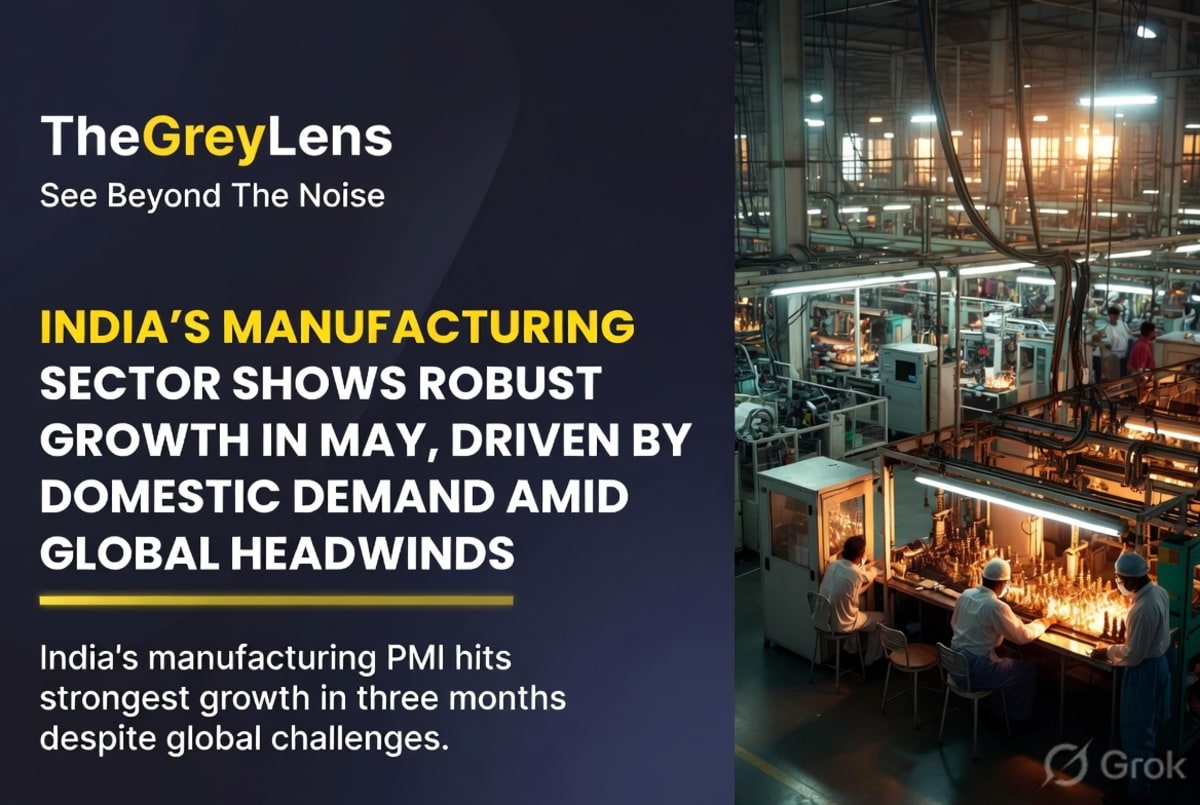
India's manufacturing sector has demonstrated significant resilience and growth, reaching a three-month high in May 2026. The HSBC India Manufacturing Purchasing Managers' Index (PMI) rose to 55.0 in May, an improvement from 54.7 in April, signaling the strongest expansion in the sector's health since February. This positive momentum was largely propelled by robust domestic demand and increased activity in infrastructure projects, underscoring the sector's ability to navigate global economic uncertainties and persistent inflationary pressures.
Domestic Demand Fuels Manufacturing Surge
The latest survey data indicates that new business orders saw a noticeable increase, supported by heightened local demand and contributions from infrastructure development. This surge in domestic consumption has been a key driver for increased output levels across the manufacturing landscape. Pranjul Bhandari, Chief India Economist at HSBC, noted, \"India's final manufacturing PMI points to another month of possible precautionary stockpiling as the Middle East conflict remains unresolved. Output growth accelerated, while purchasing activity and stocks of finished goods rose at a faster pace.\" Underlying data confirmed that the domestic market provided the primary impetus for growth, even as new export orders experienced a softer growth trajectory.
Despite the positive outlook for manufacturing, businesses are still contending with inflationary pressures. Panel members reported greater outlays on energy, fuel, materials, and transportation, largely attributed to the ongoing geopolitical tensions in the Middle East. Input cost inflation remained a concern, though it saw a slight easing. Nevertheless, companies continued to expand their workforce, with employment growth remaining solid, albeit at a slightly moderated pace compared to April. Firms also increased their purchasing activity and built up inventories to meet anticipated future demand.
RBI Policy Meeting Amid Economic Crosscurrents
Simultaneously, the Reserve Bank of India's (RBI) Monetary Policy Committee (MPC) is commencing its crucial meeting from June 3 to June 5, 2026. While a status quo on the benchmark repo rate, currently at 5.25%, is widely anticipated by market participants and analysts, the focus will be on the RBI's commentary regarding inflation and economic growth forecasts. Experts suggest that the central bank might adopt a more hawkish tone, particularly concerning inflation, due to rising crude oil prices, geopolitical uncertainties, and a depreciating rupee. SBI Research indicates no immediate relief on equated monthly installments (EMIs) for borrowers. The RBI's assessment of inflation risks, projected to remain above 5% for the next few quarters, and its stance on managing currency volatility will be closely watched. Some economists, like Abhishek Bisen from Kotak Mahindra AMC, expect the RBI to raise inflation forecasts and potentially trim growth projections, while relying on forex tools to manage currency fluctuations.
Economic Indicators Show Mixed Signals
In the broader economic context, India's GDP growth for the January-March quarter of 2026 is projected to be around 7.2% to 7.3%, a slight moderation from the previous quarter, according to various economist polls. This slowdown is attributed to factors such as weak exports, impacted by rising crude oil prices and geopolitical tensions, and a general slowdown in industrial activity. The United Nations has revised India's GDP growth forecast for 2026 downward to 6.4%, citing global uncertainties and the West Asia crisis, though it still positions India as one of the fastest-growing major economies. On the employment front, the technology sector has seen a significant decline in hiring activity, with active tech job openings falling by 14% month-on-month in June 2026, reaching a 28-month low. This is attributed to global economic uncertainty, the rapid adoption of AI, and changes in US immigration dynamics. The overall unemployment rate in India saw a slight increase to 5.20% in April 2026. The services sector, however, continues to show resilience, with the HSBC India Services PMI inching up to 58.9 in May, indicating continued solid expansion, with employment increasing at the fastest rate in nearly a year.
The upcoming days will be critical as the RBI MPC announces its policy decision on June 5. Market participants will be scrutinizing the central bank's outlook for inflation and growth, especially in light of persistent global risks and domestic economic indicators. The interplay between domestic economic strength, particularly in manufacturing, and external vulnerabilities will shape India's economic trajectory in the coming months.