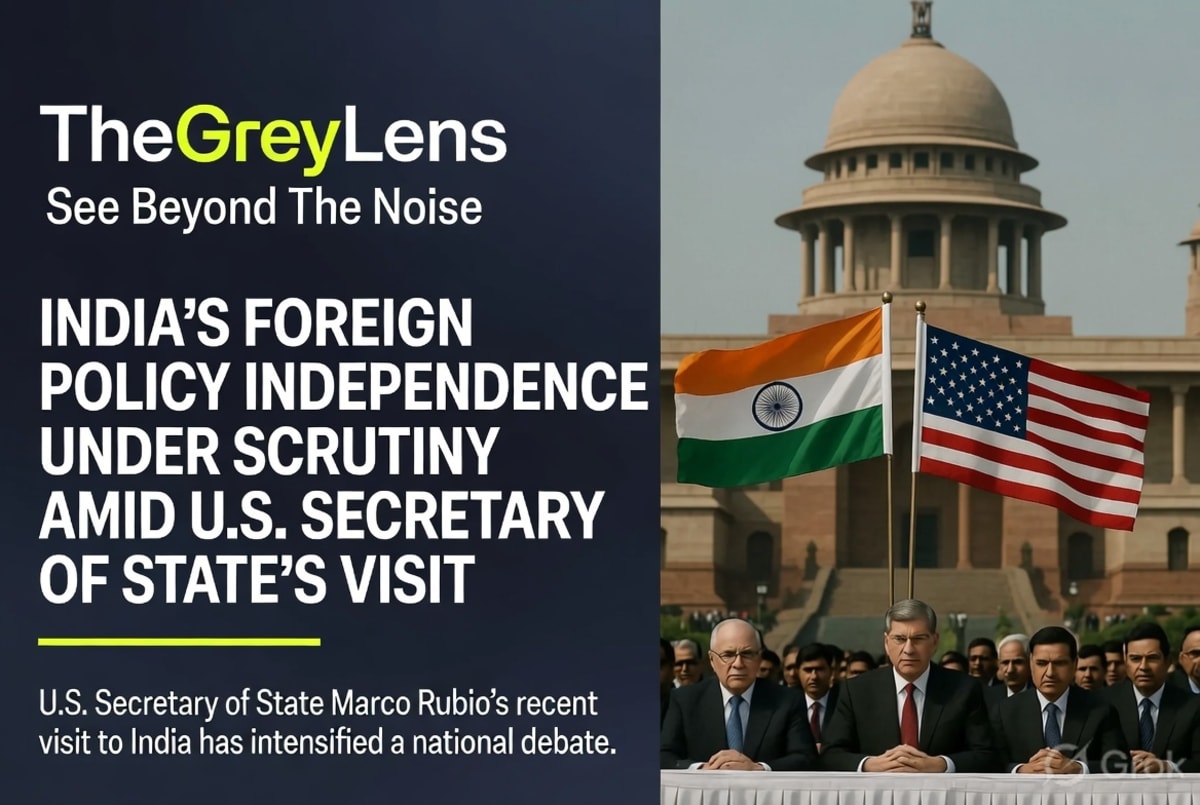
NEW DELHI – The recent visit of U.S. Secretary of State Marco Rubio to India has become a focal point for a vigorous national debate regarding the autonomy of India's foreign policy. Rubio's trip, which included attending the Quad foreign ministers' meeting, has been described by critics as exposing the Modi government's perceived inability to assert India's core interests against Washington's directives.
Trade Deal Under Fire
Opposition figures have sharply questioned the rationale behind a recently announced trade deal, which reportedly commits India to purchasing USD 500 billion worth of U.S. goods over the next five years. This figure represents a doubling of current yearly imports from the U.S., which stand at just over USD 50 billion. Critics argue this commitment is particularly questionable given Prime Minister Modi's recent calls for citizens to reduce consumption and prioritize domestic products to alleviate economic pressures. The legality and fairness of the trade deal have also been challenged, with some demanding it be declared void, citing a U.S. Supreme Court decision that reportedly invalidated a reciprocal tariff regime imposed by the previous U.S. administration, claiming the India-U.S. deal was signed under duress.
Energy Security and Strategic Autonomy Concerns
Further fueling the debate is India's stance on energy imports. The opposition has criticized the government for adhering to U.S. pressure not to purchase oil from Russia or Iran, sources offering cheaper and more accessible alternatives. This adherence is seen as a concession that compromises India's energy security and economic interests. Secretary of State Rubio's remarks prior to his visit, suggesting the U.S. has ample energy production and is ready to sell as much as India will buy, have been interpreted as a direct attempt to steer India's energy procurement away from Russian and Iranian sources, especially in the context of the ongoing war in West Asia and disruptions in the Strait of Hormuz.
The Quad Context and Geopolitical Balancing
Rubio's visit coincided with the 11th Quad foreign ministers' meeting, an alliance comprising Australia, Japan, India, and the United States. While the Quad aims to promote a free, open, and inclusive Indo-Pacific, its strategic implications for India's foreign policy have come under renewed scrutiny. Critics argue that the government's alignment within the Quad framework, particularly its responsiveness to U.S. priorities, is compromising India's ability to maintain a truly independent foreign policy. This debate highlights the delicate balancing act India performs, navigating its relationships with major global powers while striving to protect its national interests and strategic autonomy in an increasingly complex geopolitical landscape. The government has yet to issue a comprehensive statement addressing these criticisms directly, leaving the national discourse on foreign policy independence to unfold.