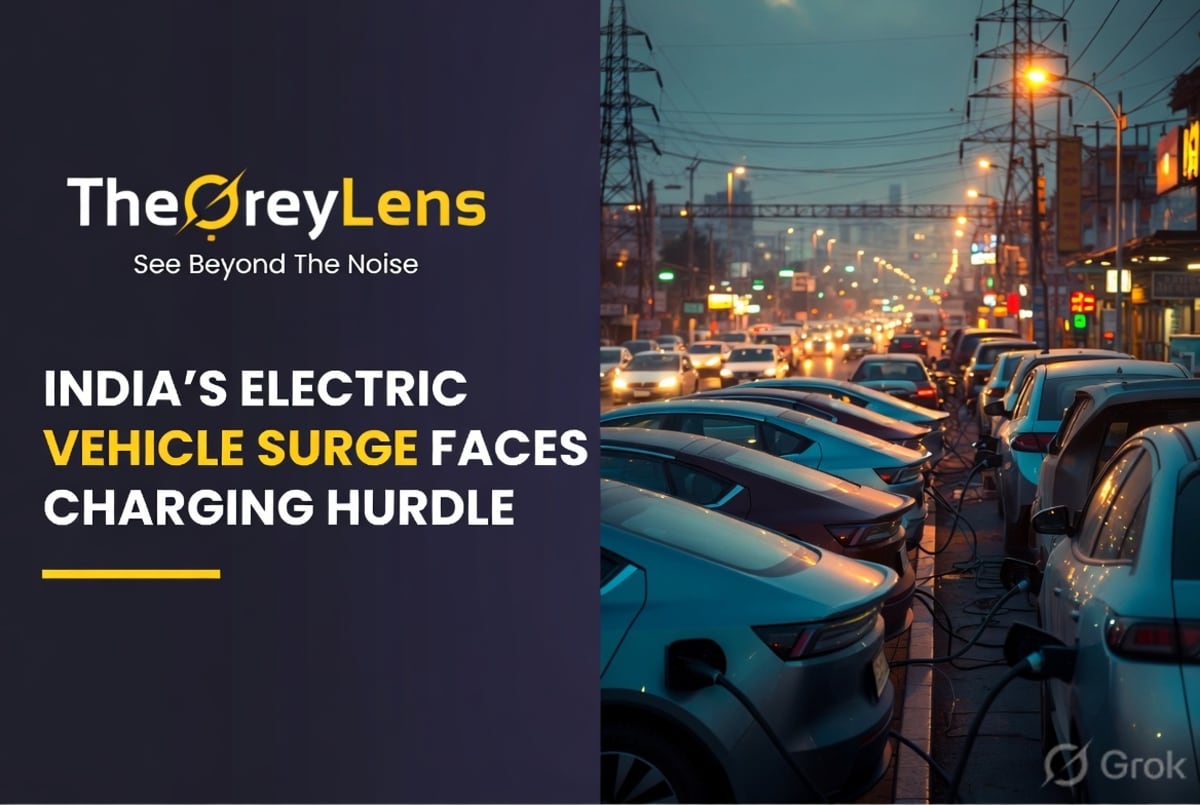
India's electric vehicle (EV) revolution is gaining unprecedented momentum, with the market witnessing a robust 25% surge in sales for electric cars in the fiscal year ending March 2026. This significant uptick has propelled EVs to cross the 5% market share milestone in India's passenger vehicle segment, a key indicator of burgeoning mass adoption. The burgeoning demand is largely attributed to the escalating costs of traditional fossil fuels and a supportive policy environment aimed at curbing vehicular emissions. Beyond cars, electric three-wheelers have captured over 30% of their segment's sales, while electric motorcycles have surpassed the 15% mark, underscoring a broad-based shift towards electric mobility across various vehicle categories.
The Roadblocks on the Path to Electrification
Despite the promising growth trajectory, India's EV ecosystem is not without its challenges. A critical area of concern remains the sparse and uneven distribution of charging infrastructure. While national public charging stations have grown to over 29,000 units, their deployment is heavily urban-centric, leading to a high EV-to-charger ratio of approximately 235:1. This scarcity is particularly acute in non-metropolitan areas and along crucial inter-city highways, contributing to 'range anxiety' among consumers. For instance, EV owners undertaking long-distance travel often face the daunting task of meticulously planning their routes around the limited availability of charging stations, with charging times often extending to an hour, significantly disrupting journeys. The upfront cost of EVs also continues to be a considerable barrier for many potential buyers. While operating costs are generally lower due to cheaper energy and reduced maintenance, the initial investment for electric cars remains substantially higher than their internal combustion engine counterparts. This price disparity is exacerbated by the significant cost of battery packs, which are heavily reliant on imported components and critical minerals, further impacting affordability.
Policy Push and Infrastructure Expansion Efforts
Recognizing these challenges, the Indian government has been actively pursuing policies to accelerate EV adoption. The Pradhan Mantri Surya Ghar: Muft Bijli Yojana (PMSGY), launched in February 2024, has provided a significant impetus to rooftop solar installations, indirectly supporting the EV ecosystem. The scheme has seen immense traction, with 6.9 million applications received and 4 million households covered as of May 31, 2026, nearly doubling the residential rooftop solar capacity built over the preceding decade. Furthermore, the PM E-DRIVE scheme earmarks ₹2,000 crore for charging infrastructure development, including fast chargers for all vehicle types. However, the success of these initiatives hinges on their swift and effective implementation. Analysts emphasize the need for policy stability and a faster rollout of charging infrastructure, including public chargers, battery swapping stations, and residential charging norms. Automakers are hesitant to make substantial investments without predictable policy frameworks and consistent implementation across different states. The Ministry of New and Renewable Energy (MNRE) is also focusing on domestic manufacturing, with no blanket extension granted for the Approved List of Models and Manufacturers (ALMM) List-II for solar PV cells beyond June 1, 2026, aiming to bolster local production and reduce import dependence. This move is expected to encourage greater domestic manufacturing of solar components, crucial for the renewable energy transition.
The Evolving Landscape of AI Governance and Clean Energy
Beyond the automotive sector, India is making significant strides in Artificial Intelligence (AI) governance and renewable energy. The India AI Governance Guidelines, released in February 2026, establish a principle-based, techno-legal approach to responsible AI deployment, balancing innovation with safeguards. These guidelines are underpinned by seven guiding principles, or 'sutras,' and institutionalize mechanisms like the AI Governance Group and the AI Safety Institute. The IT Rules, 2021, along with amendments in 2026, specifically target AI-generated and deepfake content, mandating transparency and due diligence from platforms. In the energy sector, wind power continues to be a cornerstone of India's renewable energy strategy. JSW Energy, a key private player, has significantly expanded its renewable capacity, adding 2,579 MW in FY26 alone, bringing its total renewable assets to 7,796 MW. The company's strategic manufacturing partnerships for wind turbine generators and blades are strengthening domestic capabilities and reducing import reliance. India's overall renewable energy trajectory remains robust, driven by policy stability and global climate commitments. The country is also making strides in the judiciary's adoption of AI, with the Supreme Court releasing draft regulations for AI use in case management, transcription, and legal research, while emphasizing human primacy and accountability.
Looking Ahead: The Path to Mass EV Adoption
The coming years will be crucial for India's EV transition. Experts suggest that widespread adoption, particularly for long-distance travel, hinges on the development of a dense and reliable charging network, with charging stations ideally positioned every 50 to 100 kilometers. While home charging offers a viable solution for urban commuters, the reliance on public infrastructure for highway travel necessitates a significant expansion and improvement in charger accessibility and reliability. The government's commitment to developing charging infrastructure and promoting domestic manufacturing, coupled with advancements in battery technology and more affordable EV models, are expected to drive future growth. The success of these multifaceted efforts will determine whether India can fully realize its electric mobility ambitions and achieve its clean energy targets.