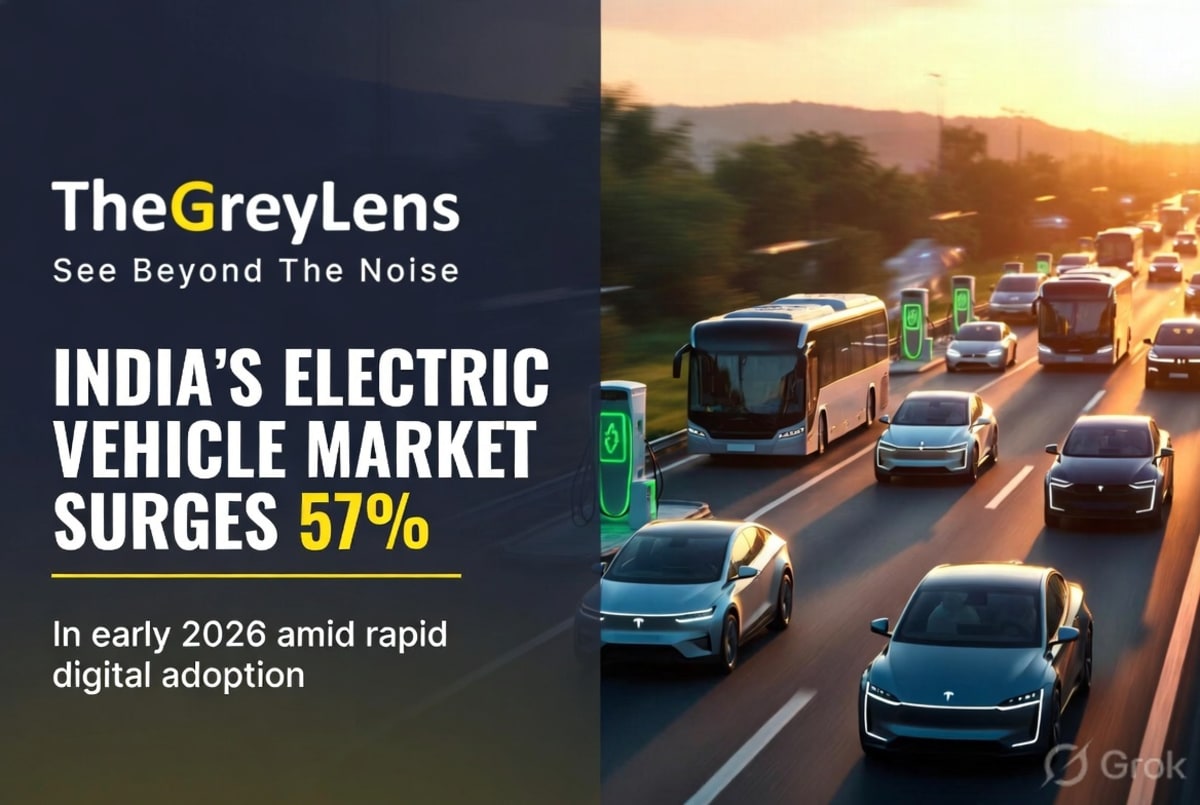
The Indian electric vehicle market has experienced a significant surge in growth during the first quarter of 2026, with a 57% year-on-year increase in its passenger vehicle segment. This expansion significantly outpaced the overall passenger vehicle market's 13% growth and indicates a rapid shift towards electric mobility in the country. The surge is attributed to a combination of factors including improved charging infrastructure, competitive pricing strategies, and a growing demand for advanced connectivity features in vehicles.
Digital Integration Accelerates EV Adoption
The integration of digital technologies within electric vehicles has become a key driver of their increasing popularity. A study revealed a 67% year-on-year rise in connected EV adoption, highlighting consumers' preference for smart and integrated automotive experiences. Furthermore, digital cluster penetration in vehicles has climbed from 35% to 48%, with overall adoption of digital clusters seeing a 55% increase. This trend positions electric vehicles as India's second most important smart device category, following smartphones, underscoring the deep integration of mobility and digital ecosystems in the daily lives of Indian consumers. Advanced driver assistance systems (ADAS) have also seen a substantial uptake, with adoption rising by 49%. Notably, Level 2 ADAS is now standard in 91% of equipped vehicles, signaling a growing emphasis on safety and convenience features. The report projects that electric vehicles will constitute 7-8% of India's passenger vehicle market by the end of 2026, with connected vehicles expected to capture 40-45% of the market share. The increasing adoption of digital cockpits, which saw a 49% rise, further emphasizes the consumer demand for immersive in-car experiences.
Policy Support and Future Outlook for Electric Mobility
The Indian government and various public sector undertakings (PSUs) are actively championing the transition to electric mobility through a multi-layered policy framework. This includes incentives for manufacturers, benefits for consumers, and a concerted effort to develop charging infrastructure across urban and semi-urban regions. Key policy focus areas for 2026 involve the accelerated deployment of public EV charging stations, streamlined approval processes for charging infrastructure, and enhanced support for electric two-wheelers, three-wheelers, passenger vehicles, and commercial fleets. The integration of renewable energy sources with EV charging networks and the implementation of digital monitoring for smart grid readiness are also crucial aspects of this strategic push. Experts believe that sustained growth in India's automotive sector, driven by electrification, connectivity, and premiumization, will depend on continued investment in charging infrastructure, supply chain resilience, and balanced policy support. The evolving EV ecosystem is being shaped by strategic policy interventions, expanded charging infrastructure, PSU-backed investments, and collaborative public-private partnerships. As charging infrastructure expands, battery manufacturing scales, and policy clarity improves, electric vehicles are poised to become a mainstream choice for Indian consumers and businesses alike, potentially establishing India as a global EV manufacturing and innovation hub.
Emerging Trends and Challenges
Despite the rapid growth, challenges such as the upfront cost of EVs and the need for further infrastructure expansion remain. However, the market is witnessing new launches and broader participation from manufacturers, particularly in the SUV and urban mobility categories. Data from the VAHAN portal indicated that India's EV market share rose to 5.1% in March 2026, with registrations jumping 68% year-on-year. This growth is further fueled by rising fuel prices and the continuous introduction of new EV models. The government's commitment, demonstrated through schemes like FAME incentives and the PM E-DRIVE program, alongside production-linked incentives for advanced automotive technology and battery manufacturing subsidies, signals a strong intent to build a comprehensive domestic EV ecosystem. The coming years are expected to define India's trajectory in the global electric mobility landscape, with projections indicating a significant ramp-up in EV adoption driven by continued policy support, increased consumer awareness, and a reduction in operating costs through industrial scale-up and localization initiatives.