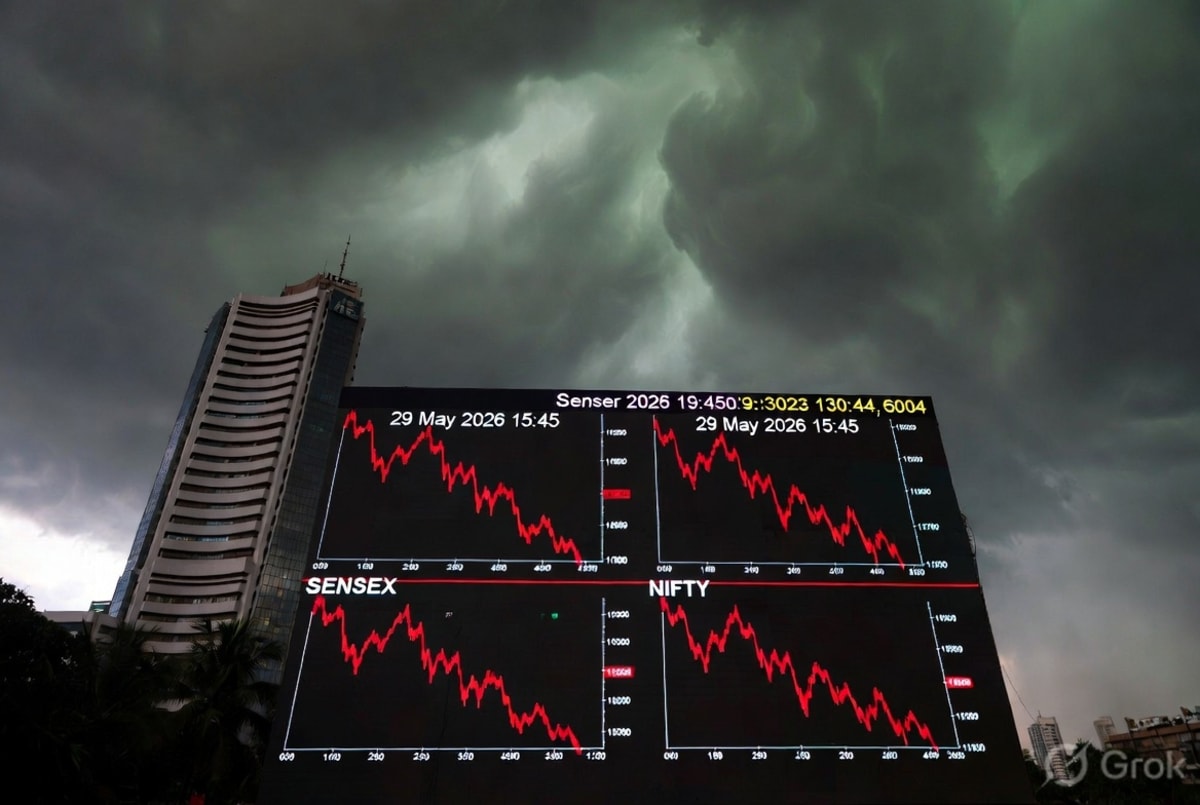
The Indian equity markets witnessed a substantial decline on Friday, May 29, 2026, as investors reacted to a combination of domestic and international concerns. The benchmark BSE Sensex plummeted by 1,092.06 points, or 1.44%, to close at 74,775.74. Similarly, the Nifty 50 index saw a significant drop, falling 359.40 points, or 1.50%, to end the trading session at 23,547.75.
Monsoon Worries Dampen Investor Sentiment
A primary driver of the market downturn was the India Meteorological Department's (IMD) forecast for a below-normal monsoon season. The IMD projected rainfall to be 90% of the long-period average (LPA) for the June-September period, with a model error of 4%. This forecast has heightened concerns among investors about potential impacts on agricultural output, rural demand, and the broader economy, potentially leading to elevated food inflation in the coming months. The prospect of a deficient monsoon, coupled with the increasing likelihood of an El Niño weather pattern, cast a shadow over market sentiment. Vinod Nair, Head of Research at Geojit Investments Limited, noted that while downside risks are partially mitigated by moderating crude oil prices and bond yields, the monsoon forecast remains a significant concern.
Geopolitical Tensions and MSCI Rebalancing Exacerbate Sell-off
Adding to the domestic concerns, geopolitical uncertainties, particularly surrounding the US-Iran peace talks, contributed to the market's decline. Investors adopted a cautious stance amid the ongoing developments, leading to profit-taking in the final trading hours. The market also experienced a sharp sell-off in the last 30 minutes of trading, largely attributed to the MSCI May 2026 index rebalancing. This event typically triggers passive institutional flows as funds adjust their portfolios, leading to increased volatility and sharp price movements. Several stocks experienced significant selling pressure due to their exclusion or trimming of weightages in MSCI indices, including companies like RVNL, Kalyan Jewellers, Jubilant FoodWorks, and Hyundai Motor India. According to IIFL Capital, India's weightage in the MSCI Emerging Markets Index saw a marginal decline following the rejig. The uncertainty surrounding a lasting peace arrangement between the United States and Iran was identified as a key trigger for the sell-off, prompting risk-averse investors to lock in profits. Arun Malhotra, founder and fund manager at CapGrow Capital, emphasized that a consistent rise in Indian stocks is unlikely without clarity on the US-Iran conflict.
Sectoral Performance and Investor Wealth Erosion
The broad-based selling pressure was evident across various sectoral indices. The Oil & Gas sector was among the major laggards, tumbling by 2.75%, followed by Metal (2.30%), Utilities (2.23%), Hospitals (2.16%), Energy (2.08%), Commodities (1.94%), Auto (1.90%), and Services (1.58%). Conversely, IT, Telecommunication, and Focused IT sectors managed to show gains. The significant market decline resulted in a substantial erosion of investor wealth, with the market capitalisation of BSE-listed companies decreasing by approximately Rs 5.77 lakh crore to Rs 4,64,97,814.78 crore. Foreign Institutional Investors (FIIs) continued their selling trend, offloading equities worth Rs 1,042.70 crore on May 27, 2026, reflecting cautious positioning amid global uncertainties. However, Domestic Institutional Investors (DIIs) provided some support by remaining net buyers. The market breadth was weak, with a larger number of stocks declining compared to those advancing.
Looking Ahead: Cautious Outlook Amid Multiple Headwinds
The Indian stock market faces a cautious outlook in the near term, grappling with a confluence of factors including monsoon uncertainty, ongoing geopolitical tensions, and potential shifts in global economic policies. The upcoming weeks will be closely watched for any significant developments in the US-Iran negotiations, as well as further clarity on the monsoon's progression. Investors are advised to focus on portfolio quality and maintain a disciplined investment strategy. The market will also be influenced by upcoming economic data releases and corporate earnings reports, which could provide further directional cues. The sustainability of any market recovery will likely depend on the resolution of geopolitical uncertainties and a clearer picture emerging on the monsoon front.