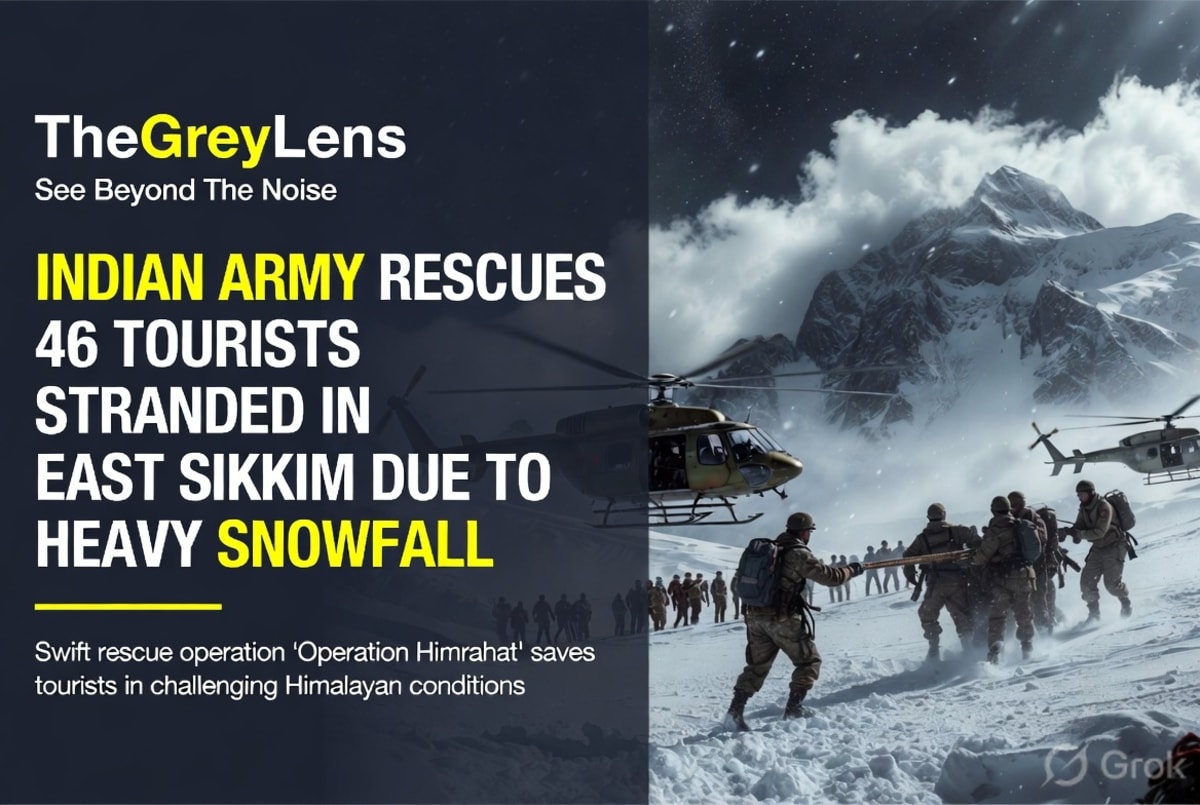
Operation Himrahat: Army's Swift Response in Sikkim's Winter Crisis
The Indian Army has once again demonstrated its commitment to civilian safety with a rapid and effective rescue operation in East Sikkim. Codenamed 'Operation Himrahat', the mission was launched on February 22, 2026, following a sudden and severe snowfall that blanketed the high-altitude areas, leaving 46 tourists stranded. The treacherous weather conditions, characterized by sub-zero temperatures and heavy snow, had brought normal movement to a standstill, endangering the lives of those caught in the adverse climate.
Defence officials reported that the intense snowfall on February 22 disrupted traffic on several vulnerable stretches of East Sikkim, leading to multiple tourist vehicles becoming immobilized. Civilians found themselves exposed to the harsh climatic conditions, prompting an immediate response from the Indian Army troops stationed in the region. The coordinated relief and rescue operation was initiated promptly to assist those affected by the sudden turn in weather. The rescued tourists were subsequently shifted to the nearest Army camp, where they received immediate medical examinations and necessary care, ensuring their well-being after the ordeal.
Stranded Tourists Receive Aid Amidst Challenging High-Altitude Conditions
Despite operating in challenging high-altitude conditions and freezing temperatures, the Army personnel exhibited full preparedness and responsiveness throughout the operation. The rescued tourists were provided with essential amenities, including warm shelter, hot meals, and heating facilities, to mitigate the effects of severe cold and altitude-related stress. This humanitarian assistance underscores the Indian Army's dedication to its role in Humanitarian Assistance and Disaster Response (HADR), particularly in remote and geographically difficult terrains that are prone to natural disruptions.
The prompt mobilization and round-the-clock preparedness of the Army troops were crucial in ensuring the safety of the stranded civilians. The operation highlighted the critical role the Army continues to play in safeguarding lives during emergencies in some of India's most challenging landscapes. The affected tourists, grateful for their timely rescue, lauded the efforts of the soldiers who braved the extreme weather to ensure their safety. Officials confirmed that all 46 individuals were brought to safety without any casualties, a testament to the efficiency and dedication of the rescue teams.
Broader Context: Army's Role in Himalayan Disaster Response
Operation Himrahat is the latest in a series of successful rescue and relief missions undertaken by the Indian Army in the Himalayan regions. In April 2026, 'Operation HimSetu' saw the evacuation of over 1,400 tourists and local residents from North Sikkim within 48 hours after landslides and heavy snowfall disrupted connectivity. This operation, conducted under the Trishakti Corps, involved overcoming challenges such as continuous bad weather and difficult terrain, including the construction of a temporary footbridge to restore movement. Such missions underscore the Indian Army's critical role in disaster response and emergency management, especially in remote and strategically sensitive areas like the India-China border region in Sikkim.
Furthermore, the Indian Air Force has also been actively involved in disaster response, as seen in May 2026 when Mi-17 helicopters were deployed for firefighting operations in Himachal Pradesh, Uttarakhand, and Jammu and Kashmir amidst massive forest fires. These operations, often conducted under challenging conditions, highlight the multi-faceted capabilities of India's defense forces in responding to a wide range of natural calamities. The recurring incidents of extreme weather events and natural disasters in the Himalayas emphasize the importance of such robust and well-coordinated rescue mechanisms. The Indian Army's continuous commitment to ensuring the safety of civilians, whether stranded by snow, landslides, or fires, remains a cornerstone of its service to the nation.