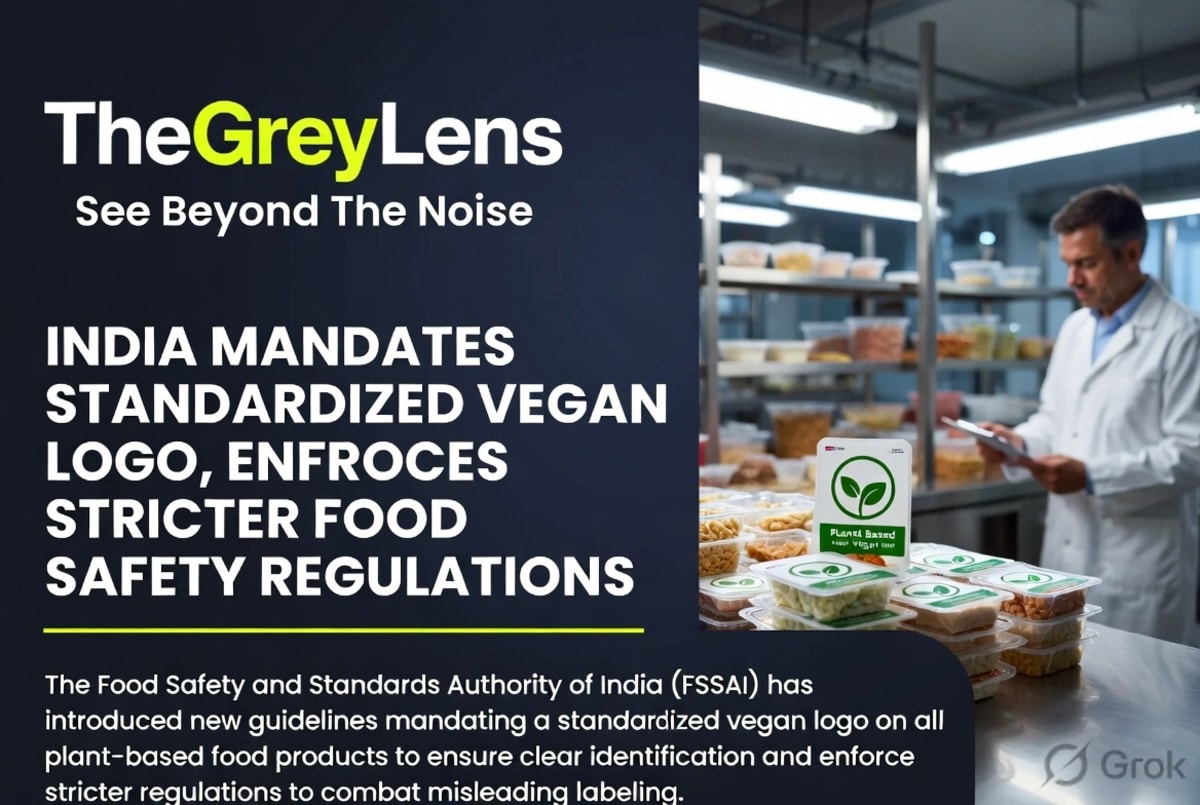
The Indian food industry is undergoing a significant transformation with the implementation of new regulations and standards by the Food Safety and Standards Authority of India (FSSAI). Recent notifications from the FSSAI have introduced a mandatory standardized 'Vegan' logo, updated standards for edible seeds, and revised contaminant limits, signaling a commitment to enhanced food safety and consumer transparency. These changes, many of which will come into effect in late 2026 and mid-2027, are poised to reshape product labeling, manufacturing practices, and market access for food businesses across the country.
Mandatory Vegan Logo to Enhance Consumer Trust
In a move to bolster consumer confidence and prevent misleading claims, the FSSAI has notified the Food Safety and Standards (Vegan Foods) Amendment Regulations, 2026. This amendment makes it compulsory for all approved vegan food packages to display a standardized green 'VEGAN' logo, featuring a stylized 'V' with a sprouting leaf. This new requirement, which becomes mandatory from July 1, 2027, aims to provide consumers with a clear, government-recognized mark of authenticity for vegan products. The detailed specifications for the logo's size, placement, and color have been provided to guide manufacturers. This initiative follows a thorough review of stakeholder feedback and aims to create a uniform national identity for vegan products, distinguishing them from conventional foods and ensuring that consumers can make informed dietary choices with greater certainty. The regulation revises the 2022 Vegan Foods Regulations, ensuring a proper definition, labeling, and regulation of vegan food products. Food businesses will be required to obtain approval before using the vegan label, ensuring only compliant products carry the designation.
Strengthening Food Safety Standards Across Categories
The FSSAI has also issued draft regulations that introduce standards for edible seeds, categorizing them into Edible Vegetable Seeds and Edible Oilseeds. These seeds can be sold raw, roasted, coated, or salted, with added ingredients like sweeteners and spices permitted. However, strict purity standards are mandated, prohibiting rancidity, molds, insects, and unauthorized coloring. Chemical and physical parameters, including moisture content (capped at 8.00%) and free fatty acids (maximum 1.25%), have been set to ensure freshness and quality. Additionally, the FSSAI has approved the use of 'Potassium polyaspartate (INS No. 456)' as a permitted food additive in grape wines, with a maximum recommended level of 100 mg/kg.
Further amendments to the Food Safety and Standards (Contaminants, Toxins and Residues) Regulations, 2026, have expanded the scope of lead and cadmium limits to include "pulses and pulse flours." New limits have also been set for inorganic arsenic in fish oil and total aflatoxins in oils, fats, and oilseeds. A maximum limit of 10 mg/kg has been established for safrole in foods and beverages containing nutmeg. In the realm of veterinary drug residues, maximum residue limits (MRLs) have been set for trimethoprim (0.05 mg/kg) and oxolinic acid (0.3 mg/kg) in shrimp, prawns, and other seafood products. These amendments, set to enter into force on December 1, 2026, will affect food manufacturers, seafood exporters, edible oil producers, and ingredient suppliers.
Regulatory Reforms and Industry Impact
In a broader effort to reduce compliance burdens, the Ministry of Health and Family Welfare, in alignment with FSSAI, has approved several regulatory and procedural reforms. These include perpetual validity for FSSAI registrations and licenses, replacing the previous renewal system. The turnover threshold for basic registration has been significantly increased to ₹1.5 crore (approximately $160,300 USD) from ₹12 lakh, effective April 1, 2026. Street vendors registered under the Street Vending Act 2014 are now automatically deemed FSSAI registered, and food trucks have been granted legal identity under the Petty Food Business Operator category. A technology-enabled, risk-based food safety inspection system has also been introduced, prioritizing inspections based on factors like food type, compliance history, and audit performance. These reforms aim to streamline processes, incentivize compliance, and improve regulatory oversight.
The National Restaurant Association of India (NRAI) has also been active, launching its Mangaluru & Western Karnataka Chapter on June 4, 2026. This initiative seeks to strengthen the region's food service ecosystem, promote culinary identity, and support entrepreneurs in this rapidly growing hospitality hub. The growth in Karnataka's food services sector is attributed to increasing tourism, urbanization, rising disposable incomes, and evolving consumer preferences, with Dakshina Kannada and Udupi alone attracting over 11 crore domestic tourists in recent years.
These comprehensive regulatory updates and industry-led initiatives underscore India's dynamic and evolving food landscape, emphasizing a concerted push towards enhanced safety, transparency, and growth within the sector.