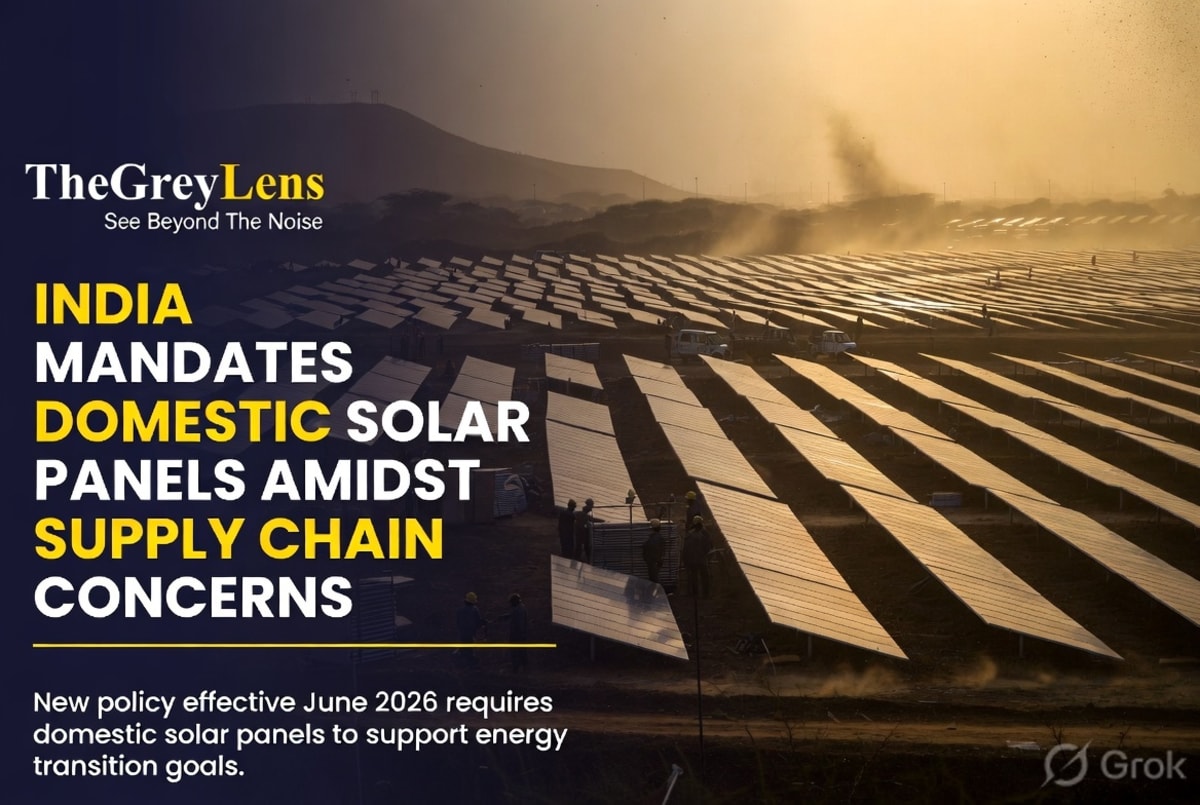
India is ushering in a new era for its renewable energy sector with the implementation of a significant policy mandating the use of domestically manufactured solar panels, effective from June 1, 2026. This directive, linked to the enforcement of the Approved List of Models and Manufacturers (ALMM) List-II, will apply to all residential, commercial, and industrial solar projects across the country. The policy necessitates that both solar cells and modules used in these projects must be produced within India, signaling a strategic pivot from rapid solar energy deployment towards the strengthening of indigenous industrial capabilities. This initiative is a key component of the broader 'Atmanirbhar Bharat' (self-reliant India) campaign, designed to curtail the nation's substantial reliance on imported solar equipment, particularly from China. Industry leaders have largely welcomed the policy's long-term vision of enhancing supply chain security and fostering energy independence, yet significant apprehension lingers regarding its immediate practical implications.
[H2]Domestic Manufacturing Capacity Under Scrutiny
[/H2]
A primary concern voiced by various stakeholders is the potential gap between India's current domestic solar manufacturing capacity and the burgeoning market demand. While the sector is experiencing expansion, experts suggest that local production of solar cells may not yet be fully equipped to meet the escalating needs of the rooftop, commercial, and industrial solar markets. Compounding this issue is the limited availability of upstream materials, such as silicon wafers, which are crucial for cell manufacturing. Developers and Engineering, Procurement, and Construction (EPC) companies are expressing worries that the mandatory shift to locally sourced components could lead to a short-term increase in project costs. Reports indicate that domestic solar panels are currently priced higher than their imported counterparts, a factor that could impact the financial viability of numerous solar ventures. Furthermore, companies are anticipating potential delays in procurement and project execution as manufacturers strive to scale up their operations to meet the policy's stringent requirements. Ankit Patidar, Managing Director of Shakti Irrigation Pvt. Ltd. and Chief Marketing Officer of Shakti Group, noted the impending shift, stating, “From 1 June 2026, India's solar energy landscape will enter a new era of self-reliance, with only domestically manufactured DCR solar panels permitted across residential, commercial, and industrial projects. This landmark policy will reduce dependence on imported cells and modules while strengthening India's manufacturing ecosystem. Developers and businesses will need to adapt supply chains to source from approved Indian manufacturers.”
[H2]Balancing Energy Transition with Industrial Growth
[/H2]
The policy underscores a strategic reorientation of India's renewable energy strategy. While the nation has made considerable strides in increasing its non-fossil fuel capacity, with targets for 60% non-fossil fuel-based installed power capacity by 2035, this new mandate places a strong emphasis on the manufacturing ecosystem. This is particularly relevant as India aims to achieve its ambitious renewable energy goals, such as the 500 GW non-fossil capacity target by 2030. However, the path to achieving these goals is not without its challenges. Data from early 2026 indicates that India's clean energy rollout is colliding with an underprepared grid, leading to significant curtailment of renewable energy due to transmission delays. In the first quarter of 2026 alone, approximately 300 GWh of renewable power was curtailed due to transmission constraints. This mismatch between renewable energy deployment and grid readiness is seen as a major obstacle to meeting long-term targets. The government's commitment to bolstering domestic manufacturing, as exemplified by the new solar panel policy, is intended to create a more resilient and self-sufficient energy sector. Rahul Das, AVP – Business Development at Oorjan Cleantech, commented on the policy's significance: “The Government of India's decision to permit only India-made DCR solar panels from 1 June 2026 marks a defining moment for the renewable energy ecosystem. This policy strongly supports Atmanirbhar Bharat by strengthening domestic manufacturing, improving supply chain resilience, and ensuring long-term energy security. For the solar industry, it creates opportunities to accelerate innovation, enhance quality standards, and build consumer trust.”
[H2]Navigating Cost and Supply Chain Dynamics
[/H2]
The immediate future of solar projects in India is likely to be shaped by the interplay between policy objectives and market realities. The higher cost of domestically produced solar panels, compared to imports, presents a direct challenge to project economics. Industry experts, such as those quoted by SolarQuarter, have highlighted that “higher project costs and limited DCR cell availability may create short-term challenges for consumers and developers.” The call for a “balanced transition approach, including possible timeline flexibility, can help align manufacturing readiness with policy goals while minimizing disruptions.” The success of this policy will hinge on the government's ability to effectively manage these transitional challenges, potentially through targeted support for domestic manufacturers, streamlining of upstream material supply chains, and a concerted effort to bridge the price differential between local and imported components. As India continues its ambitious energy transition, the effective implementation of this domestic manufacturing mandate for solar panels will be a critical test of its ability to balance environmental goals with industrial development and economic pragmatism. The coming months will reveal whether the domestic industry can scale up efficiently to meet demand and whether developers can absorb the initial cost implications, paving the way for a truly self-reliant renewable energy future for India. The nation's electricity demand continues to rise, with peak demand projected to reach around 270 gigawatts (GW) in 2026, underscoring the urgency of a robust and sustainable energy infrastructure.