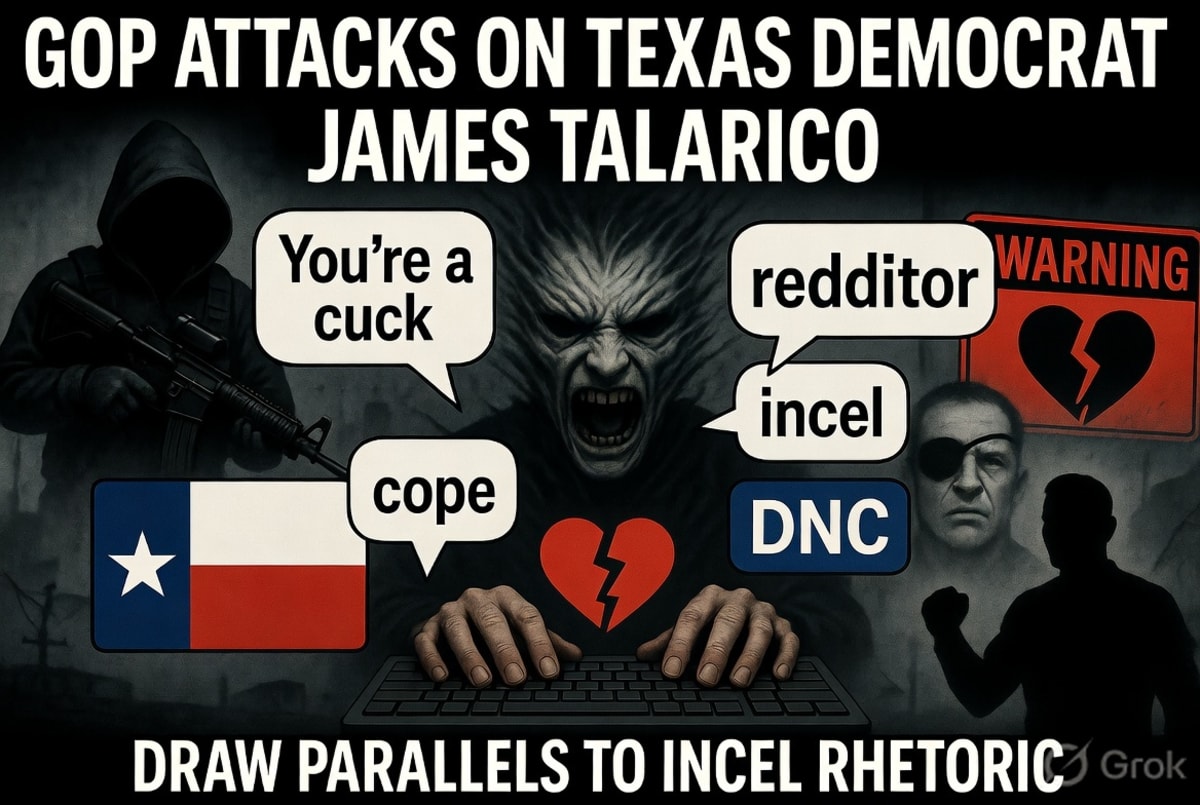
The political landscape in Texas is witnessing a sharp escalation in rhetoric targeting Democratic State Representative James Talarico, with Republican operatives drawing upon themes and language that bear a striking resemblance to the online discourse of incel communities. The attacks, which have been amplified through digital advertisements and social media campaigns, focus on Talarico's perceived lack of traditional masculinity, his veganism, and his theological interpretations, particularly a past statement that \"God is nonbinary.\"
Weaponizing Dietary Choices and Masculinity
Central to the GOP's strategy is the portrayal of Talarico as \"woke\" and \"radical,\" often by highlighting his dietary choices and questioning his masculinity. Nicknames such as \"Tofu Talarico\" and \"Sixth Gender Jimmy\" have been deployed by Republican figures, including Texas Attorney General Ken Paxton, who is Talarico's opponent in the upcoming Senate race. These monikers, along with comments questioning his \"unambiguous masculinity,\" tap into a narrative that seeks to delegitimize Talarico by associating him with perceived effeminacy and alternative lifestyles. The Washington Examiner reported that a GOP super PAC released an ad criticizing Talarico for fighting for \"6 genders and all species,\" further attempting to paint him as out of touch with mainstream Texas voters.
These attacks resonate with themes prevalent in incel (involuntary celibate) online forums, where discussions often revolve around perceived societal emasculation, perceived threats from progressive social movements, and a fixation on biological determinism. While the direct link to incel communities is an analytical observation rather than an explicit campaign strategy, the rhetorical parallels are notable. The focus on diet, particularly veganism, has been used as a proxy to question a candidate's perceived \"manliness,\" a tactic that has found traction within certain online subcultures.
Theological Provocations and AI-Generated Attacks
Another key element of the Republican offensive against Talarico involves his past theological statements, most notably his 2021 declaration that \"God is nonbinary.\" Talarico, a Presbyterian seminarian and former public school teacher, has defended the statement, explaining it was intended to be \"provocative\" and that his point was \"God is beyond gender.\" He has further elaborated that this theological perspective aligns with scriptural interpretations, referencing the Apostle Paul's writings in the letter to the Galatians, which suggest that \"in Christ, there is neither male nor female.\" However, Republicans have seized upon this comment, using it to characterize him as \"out of step with most Texans\" and a \"radical leftist.\"
The National Republican Senatorial Committee (NRSC) has deployed an artificial intelligence-generated video ad that depicts a simulated Talarico reciting his past social media posts, including the \"God is nonbinary\" comment and his office's efforts to add pronouns to staff business cards. This use of AI in political attacks adds a new layer of sophistication and potential for manipulation to the campaign. The NRSC's regional press secretary, Samantha Cantrell, stated that Talarico is \"the most radical, woke Democrat Texas voters have ever seen, and voters will reject his extreme statements praising transgenderism, twisting Christian beliefs and advocating for open borders.\"
Political Strategy and Election Impact
These attacks are part of a broader strategy by Republicans to define Talarico before he can define himself, a common tactic in Texas politics. Political science professor Brandon Rottinghaus noted that \"The Paxton campaign wants to highlight how Talarico is out of step with the values or culture of most Texans. Paxton will try to paint Talarico as 'weird.'\" The GOP aims to leverage Talarico's progressive stances on issues such as race, gender, and border security to portray him as an extremist candidate, thereby solidifying their hold on a traditionally Republican state.
Talarico has emerged as a formidable candidate, raising significant funds and narrowing the predicted margin in a race against Ken Paxton. The Cook Political Report has shifted the race's outlook from \"likely Republican\" to \"lean Republican,\" indicating a tightening contest. Talarico's campaign has suggested that these attacks are a predictable, albeit \"panicky,\" Republican response to his strong showing. His campaign has also accused Republicans of taking his comments out of context, pointing to his full quote on immigration which included the metaphor, \"Our southern border should be like our front porch. There should be a giant welcome mat out front and a lock on the door.\"
The campaign's strategy appears to be anticipating these attacks, with Talarico himself stating in his victory speech, \"They're going to throw everything they have at us.\" The effectiveness of these GOP strategies, particularly their reliance on rhetoric that draws parallels to incel discourse, remains to be seen as the election cycle progresses. Whether these tactics will resonate with a broader electorate or alienate moderate voters will be a key factor in determining the outcome of the Texas Senate race.
Looking Ahead: The Evolving Nature of Political Discourse
The current election cycle in Texas highlights a growing trend in political campaigning: the utilization of niche online subcultural language and themes, amplified by AI-generated content, to attack political opponents. The GOP's strategy against James Talarico, by focusing on his perceived lack of masculinity and unconventional theological views, demonstrates a willingness to engage with tactics that echo the grievances and rhetoric found in communities like incels. This approach, while potentially effective in energizing a specific base, carries the risk of alienating undecided voters and could lead to a broader discussion about the ethical boundaries of political discourse in the digital age.
As the election draws nearer, Talarico's campaign will likely continue to counter these narratives by emphasizing his policy positions and appealing to a wider range of voters. The Republican Party, on the other hand, will likely persist in attempting to define Talarico through these controversial characterizations. The broader implications for future political campaigns, particularly the increasing role of AI in shaping narratives and the potential for mainstreaming fringe online discourse, warrant close observation. The outcome of this race may well signal whether such polarizing and unconventional campaign tactics can lead to electoral success in the United States.