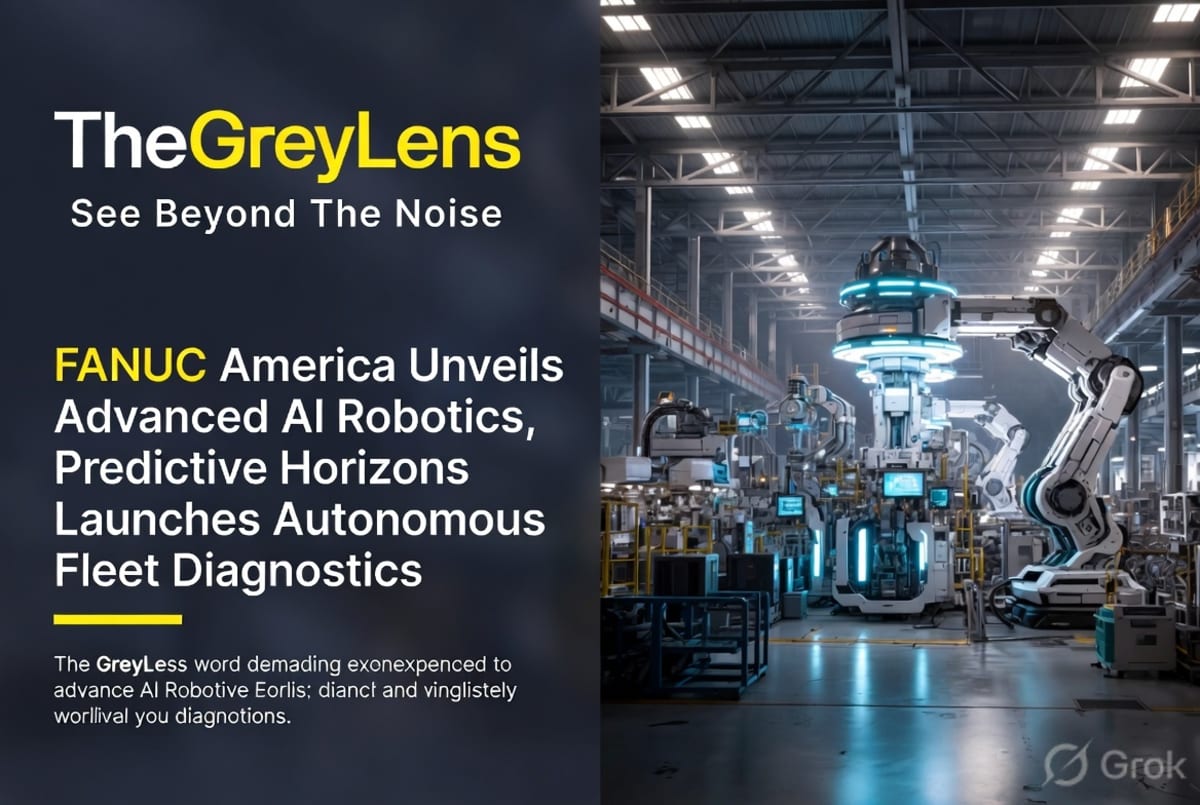
The landscape of artificial intelligence is rapidly evolving, with significant recent developments in both industrial automation and autonomous systems. FANUC America is at the forefront of this evolution, preparing to unveil its latest AI-enabled robotics and "Physical AI" technologies at Automate 2026 in Chicago, scheduled from June 22-26. The company's demonstrations will highlight advanced robotics, collaborative automation, and generative AI capabilities, aiming to enhance flexibility, precision, and scalability across various manufacturing sectors. These advancements are designed to allow robots to perceive their environment, make real-time decisions, and act with a new level of responsiveness.
AI-Driven Robotics and Manufacturing
At Automate 2026, FANUC America will present a range of AI-powered demonstrations. These include collaborative robots that exhibit human-aware motion control, dynamically adjusting their movements to ensure safety around human operators without interrupting production. The CRX-10iA/L collaborative robot, for instance, will demonstrate vision-guided box handling and barcode scanning, reacting intelligently to nearby personnel. Furthermore, FANUC will showcase AI-driven bolt tightening on moving engine blocks and the use of generative AI to control robot operations, illustrating the increasing sophistication of autonomous execution in industrial settings. The integration of advanced 3D vision and real-time adaptive robot motion underscores a commitment to bridging digital intelligence with physical action, offering manufacturers unprecedented control and efficiency. This focus on "Physical AI" represents a paradigm shift, enabling robots to not only perform tasks but to do so with a level of environmental awareness and decision-making previously unseen in industrial automation.
AI in Autonomous Fleets and Diagnostics
In parallel, the automotive sector is seeing crucial AI advancements for the future of autonomous vehicles. Predictive Horizons, a pioneer in next-generation vehicle diagnostics, has announced the launch of its Unified Fault Decomposition (UFD) model. This groundbreaking AI technology enables highly accurate vehicle diagnostics without any reliance on human symptom reporting. As the industry accelerates towards fully autonomous driving and the deployment of robotaxi fleets, traditional diagnostic methods that depend on a driver's observations are becoming a significant bottleneck. The UFD model directly processes vehicle faults, cross-references data, and generates comprehensive diagnoses autonomously. "In a world moving rapidly towards robotaxis and fully autonomous fleets, vehicles can no longer rely on a driver to report a funny noise or intermittent failures," stated Moe Yassine, CEO of Predictive Horizons. "With the Unified Fault Decomposition model, we are making symptom-based diagnostics a thing of the past." This innovation is vital for ensuring the safety, reliability, and proactive maintenance of autonomous vehicle fleets.
Advancements in AI Computing and Healthcare
Beyond robotics and autonomous systems, AI research continues to push the boundaries in computing and healthcare. Researchers at the University of Pennsylvania have developed a hybrid light-matter particle that promises to dramatically accelerate AI computing while significantly reducing energy consumption, potentially paving the way for more efficient, light-based computing processes. Concurrently, NASA is advancing its capabilities in space exploration with a new generation of space computer chips designed to grant spacecraft greater autonomy during deep space missions, exhibiting performance levels far exceeding current technology. In the healthcare domain, AI's impact is becoming increasingly pronounced. Diagnostic Imaging has been tracking numerous AI-related advancements in radiology, including expanded FDA clearance for AI software that aids in detecting joint effusions and dislocations. These developments, alongside ongoing research in medical imaging, diagnostics, and treatment planning, highlight AI's growing role in improving healthcare accuracy, efficiency, and patient outcomes.
The ongoing surge in AI innovation across these diverse fields underscores a transformative period. From the factory floor to the open road and the frontiers of scientific research, artificial intelligence is proving to be an indispensable tool for overcoming complex challenges and driving progress. The emphasis on autonomous decision-making, enhanced efficiency, and integrated systems points towards a future where AI is more deeply embedded in the fabric of our daily lives and industries.