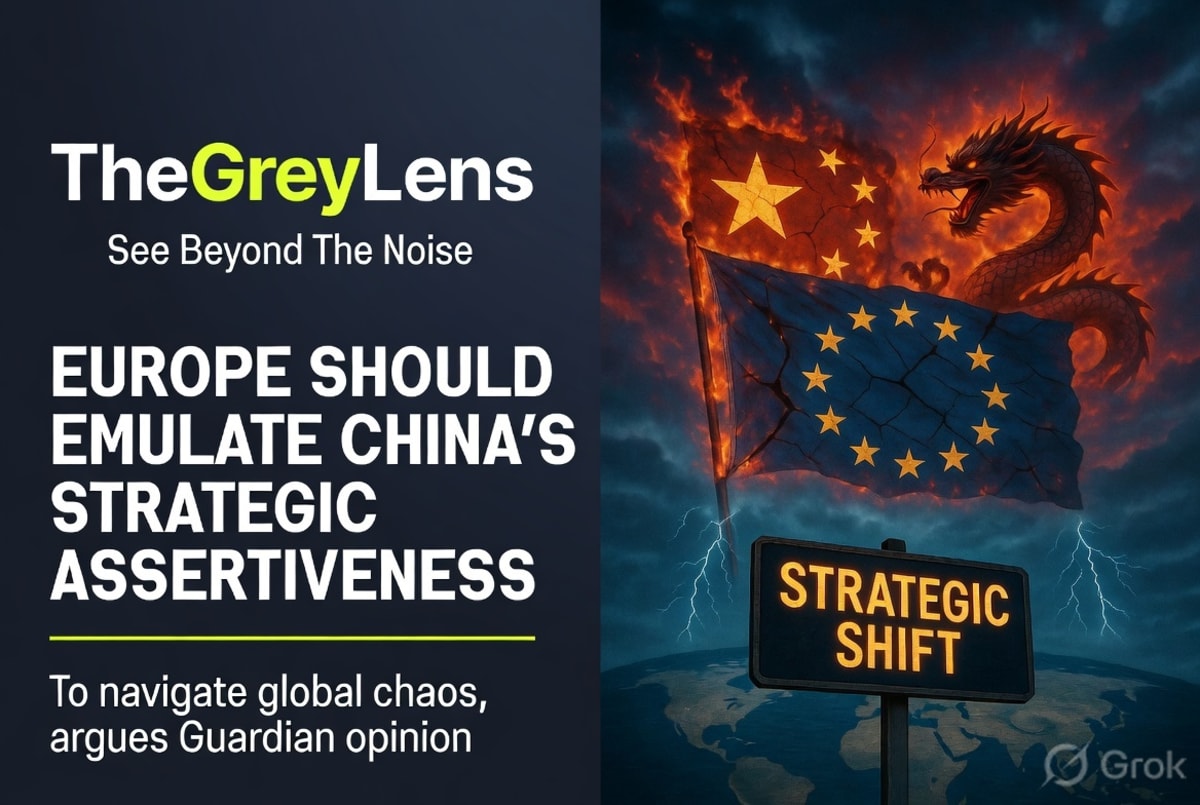
Europe must shed its hesitations and embrace a more proactive and assertive foreign policy, mirroring China's strategic pragmatism, to navigate the increasingly tumultuous global landscape, according to an opinion piece published in The Guardian on May 11, 2026. The author, Mark Leonard, argues that the continent's current approach, characterized by a reliance on established international norms and a reluctance to engage in power politics, leaves it vulnerable and ill-equipped to address the multifaceted crises emerging worldwide.
The Perils of European Hesitation
Leonard contends that while Europe has often prided itself on its commitment to multilateralism and the rule of law, this approach has become a liability in an era defined by great power competition and a disregard for international conventions by some actors. He suggests that Europe's efforts to promote its values and interests through diplomacy and soft power are increasingly being overshadowed by the more direct and often unilateral actions of other global players. The piece highlights the need for Europe to develop a clearer strategic vision and the willingness to act decisively to protect its interests, rather than waiting for consensus or for international institutions to provide solutions.
Learning from China's Strategic Calculus
Drawing a parallel with China's foreign policy, Leonard suggests that European nations could benefit from adopting a similar strategic calculus. He points to China's consistent pursuit of its national interests, its long-term planning, and its ability to exert influence through a combination of economic and diplomatic tools, even when facing international criticism. This is not to advocate for replicating China's political system, but rather to understand and adapt its pragmatic approach to statecraft in a competitive international environment. The author implies that Europe's current diplomatic toolkit is insufficient for the challenges ahead, and a more robust and strategically aligned foreign policy is urgently needed.
Navigating an Age of Chaos
The opinion piece emphasizes that the current global order is characterized by significant volatility, citing the ongoing conflicts, the rise of populism, and the challenges to democratic institutions as evidence of this chaotic environment. Leonard argues that Europe's current passive stance risks further marginalization and an inability to shape outcomes that directly affect its security and prosperity. He calls for a fundamental re-evaluation of Europe's role in the world, urging leaders to move beyond incremental adjustments and embrace a more ambitious and confident foreign policy that can effectively contend with the prevailing global disorder. The article suggests that without such a shift, Europe may find itself increasingly at the mercy of external forces, unable to safeguard its future in an unpredictable world. The commentary serves as a stark warning and a call to action for European policymakers to develop a more robust and assertive geopolitical strategy.