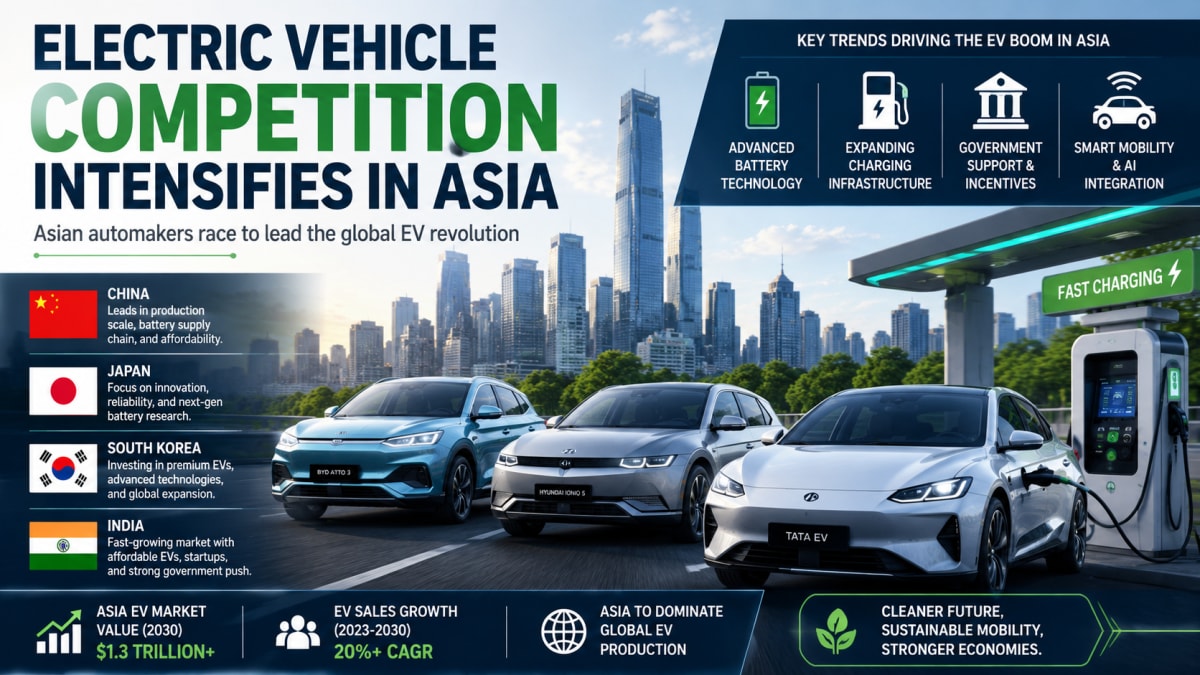
Asia is rapidly becoming the center of the global electric vehicle revolution, with governments, technology firms, and automobile manufacturers competing aggressively to dominate the next generation of transportation. What began as a gradual transition toward cleaner mobility has now evolved into a high-stakes industrial race involving billions of dollars in investments, large-scale battery manufacturing, artificial intelligence integration, and national economic strategies.
China currently remains the strongest force in the Asian EV ecosystem. The country has built a massive supply chain around battery production, rare earth processing, and electric vehicle assembly. Chinese manufacturers are pushing affordable EVs into domestic and international markets at unprecedented speed, creating pressure on traditional automakers worldwide. Their advantage lies not only in manufacturing scale but also in vertical integration, where battery production, software development, and vehicle assembly operate within interconnected ecosystems.
Meanwhile, Japanese and South Korean automotive companies are responding with a different strategy focused on reliability, premium engineering, and advanced battery research. Several firms are investing heavily in solid-state battery technology, which promises faster charging speeds, improved safety, and longer driving ranges compared to conventional lithium-ion systems. Analysts believe this technology could become the next major breakthrough in the EV sector if commercial production reaches scale within the next few years.
India is also emerging as an important player in the Asian EV landscape. Rising fuel prices, urban pollution concerns, and government incentives are accelerating local adoption of electric two-wheelers, compact cars, and public transportation fleets. Domestic manufacturers are increasingly focusing on cost-effective EV solutions tailored for middle-income consumers. At the same time, startups are entering the market with innovations in battery swapping, charging infrastructure, and smart mobility platforms.
The competition extends beyond vehicles themselves. Charging infrastructure has become a major battleground across Asia. Countries are racing to expand fast-charging networks in cities and highways to eliminate range anxiety among consumers. Governments are offering subsidies, tax reductions, and manufacturing incentives to attract both domestic and foreign investment into EV-related industries.
Another critical factor shaping the market is software integration. Modern EVs are no longer viewed purely as automobiles; they are increasingly treated as connected technology platforms. Artificial intelligence is being integrated into navigation systems, energy optimization, predictive maintenance, and autonomous driving features. Companies that succeed in combining software innovation with affordable hardware may ultimately dominate the future mobility market.
Despite rapid growth, challenges remain significant. Battery raw material shortages, charging infrastructure gaps, and pressure on power grids continue to create obstacles for long-term expansion. There are also concerns regarding recycling systems for used batteries and the environmental impact of large-scale mineral extraction.
Still, industry experts believe Asia’s momentum in electric mobility is unlikely to slow. Consumer demand continues to rise as EV prices gradually become more competitive with traditional fuel-powered vehicles. Governments are tightening emissions regulations, while investors increasingly view electric transportation as a long-term economic opportunity.
The outcome of this competition could reshape not only the automotive industry but also the global balance of technological and industrial power over the next decade.