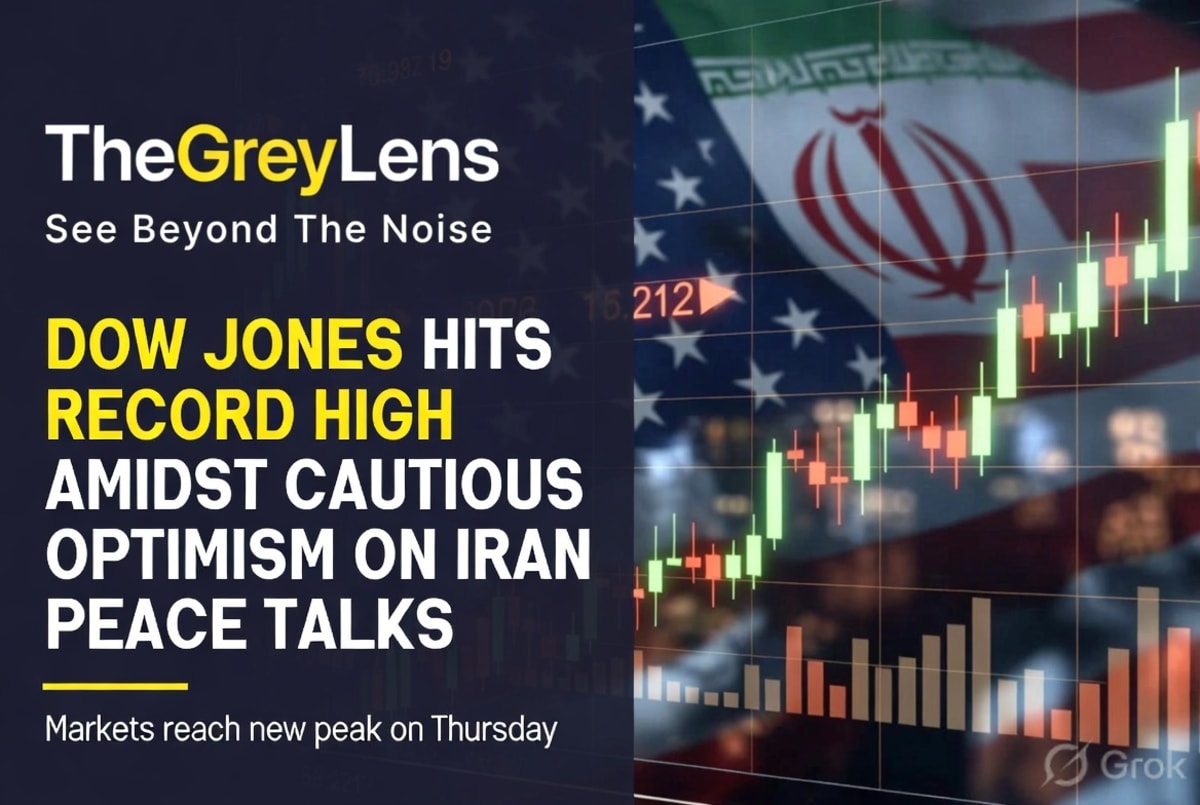
New York, NY – May 22, 2026 – The Dow Jones Industrial Average closed at a record high on Thursday, May 21, 2026, as investors navigated a complex landscape of geopolitical developments and economic indicators. While tentative progress in U.S.-Iran peace talks offered a degree of optimism, underlying concerns about inflation and the Federal Reserve's monetary policy kept market sentiment cautiously balanced.
Geopolitical Rapprochement and Market Jitters
U.S. Secretary of State Marco Rubio indicated on Thursday that there were “good signs” suggesting an agreement to end the ongoing conflict with Iran could be within reach. However, he tempered expectations by warning that any deal would be “unfeasible” if Iran pursued measures to permanently control shipping through the Strait of Hormuz. The ongoing tensions in the Middle East continue to influence global oil prices, which remain elevated, contributing to supply chain uncertainties. Despite these geopolitical undertones, stock futures showed an upward trend early Friday, reflecting a cautious hope for de-escalation. The S&P 500 and Nasdaq Composite also saw modest gains on Thursday, closing up 0.2% and 0.1% respectively.
Inflationary Pressures and Federal Reserve Scrutiny
Economic data released this week paints a mixed picture for the U.S. economy. The latest Consumer Price Index (CPI) data, released on May 12, indicated an annual inflation rate of 3.8% for the twelve months ending in April 2026, an increase from the previous month's 3.3%. Energy prices, in particular, saw a significant year-over-year jump of 17.87% for the April 2025 to April 2026 period, and a 3.81% increase from March to April 2026. This persistent inflationary pressure continues to be a key concern for the Federal Reserve. Minutes from the Federal Open Market Committee's (FOMC) April 28-29 meeting revealed a hawkishleaning sentiment, with several policymakers favoring the removal of language indicating an easing bias and suggesting a rate hike might be appropriate if inflation remains above target. Market participants are now pricing in a higher probability of interest rate hikes rather than cuts for the remainder of the year, a shift from earlier expectations.
Economic Resilience Amidst Uncertainty
Despite inflationary headwinds and geopolitical uncertainties, some sectors of the U.S. economy are demonstrating resilience. U.S. manufacturing activity has expanded at its fastest pace in four years, according to recent reports. This expansion suggests underlying economic strength, even as investors remain watchful of how persistently high energy prices might impact future inflation and interest rate policy. The Dow Jones Industrial Average has been a particular beneficiary, closing at a fresh record high on Thursday, indicating investor confidence in certain segments of the market. However, the broader market sentiment remains cautious, with a notable rotation observed away from growth sectors like technology, which have seen significant selling pressure, and towards more cyclical areas such as energy, materials, and industrials.
Looking ahead, investors will be closely monitoring upcoming economic data, including consumer confidence reports and capital goods orders, for further insights into the U.S. economic trajectory. The Federal Reserve's next move on interest rates, heavily influenced by inflation figures and geopolitical developments, will also be a critical factor shaping market performance in the coming weeks. The ongoing diplomatic efforts between the U.S. and Iran will continue to be a key focus, with any significant progress or setbacks potentially leading to notable market reactions.