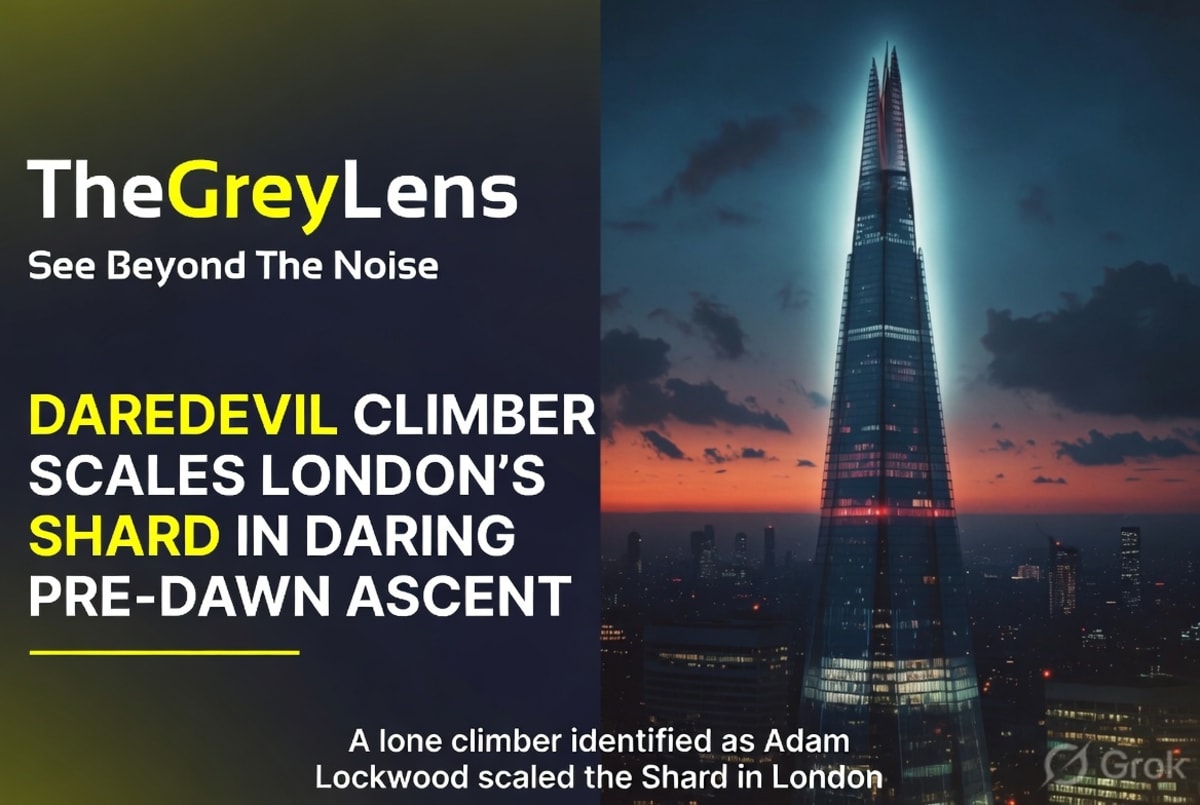
A breathtaking and audacious feat unfolded in the heart of London in the pre-dawn hours of Saturday, June 7, 2026, as Adam Lockwood, a renowned free-climber, ascended the Shard, Western Europe's tallest building. The daring climb, undertaken without ropes or safety equipment, saw Lockwood scale the iconic skyscraper's glass facade, reaching the pinnacle just as the first rays of sunlight began to illuminate the city.
The Vertiginous Ascent
The ascent, which began around 4:30 AM BST, was meticulously planned and executed with remarkable speed and precision. Lockwood, known for his previous high-profile climbs of structures like the Eiffel Tower and the Great Pyramid of Giza, navigated the sheer 310-meter (1,017 ft) structure with an agility that has astounded onlookers and experts alike. Security personnel at the Shard were alerted to his presence shortly after he began his climb, but by the time law enforcement and emergency services arrived, Lockwood had already reached the summit and was descending. Eyewitnesses, including early morning commuters and residents in nearby buildings, described a surreal scene as a lone figure moved with fluid grace against the backdrop of the awakening city. The entire climb reportedly took just under 40 minutes, a testament to Lockwood's extreme physical conditioning and mental fortitude. Footage captured by bystanders and subsequently shared widely on social media platforms shows Lockwood’s silhouette against the twilight sky, a stark and dramatic image that quickly captured global attention. The Metropolitan Police confirmed that they were in attendance and are currently investigating the incident. A spokesperson stated that Lockwood was met by officers upon his safe descent and taken into custody for questioning. The specific charges he may face are yet to be determined, but typically involve offenses such as criminal damage, trespass, and public nuisance.
Security Lapses and Public Reaction
The successful, albeit illegal, ascent of the Shard has inevitably raised serious questions about the building's security protocols. The Shard, a prominent tourist attraction and a symbol of modern London, is equipped with extensive surveillance systems and employs a dedicated security team. However, Lockwood's ability to bypass these measures and execute such a high-risk maneuver without immediate detection has sparked debate. Security analysts are expected to scrutinize the incident to identify potential vulnerabilities. The public's reaction has been divided. While many have expressed admiration for Lockwood's extraordinary skill and courage, a significant portion of the public and many officials have condemned his actions as reckless and irresponsible. Mayor of London, Sadiq Khan, issued a statement condemning the climb, emphasizing the inherent dangers involved and the potential risks to public safety. He further stressed that such actions could have diverted essential emergency services from genuine crises. Online forums and social media platforms buzzed with discussions, with hashtags like #ShardClimber and #AdamLockwood trending globally. Some lauded Lockwood as a modern-day daredevil pushing the boundaries of human capability, while others criticized him for putting himself and potentially others in harm's way, as well as for the significant cost incurred by the security response. Representatives for Real Estate Management, the company that manages the Shard, have stated that they are cooperating fully with the police investigation and are reviewing their security procedures to prevent any recurrence.
The Psychology of Extreme Climbing
Adam Lockwood's decision to scale the Shard is consistent with a pattern of behavior seen in a niche group of extreme athletes who seek to test their limits against monumental urban landscapes. Psychologists specializing in extreme sports suggest that such individuals are often driven by a complex interplay of factors, including a profound desire for achievement, a need for adrenaline, and a unique form of self-expression. Dr. Eleanor Vance, a sports psychologist, noted in a recent interview that "These climbers often describe a state of intense focus, a 'flow state,' where the external world fades away, and only the immediate task and their own physical and mental capabilities remain. It's about conquering not just the structure, but their own fears and limitations." She added that the public spectacle and the media attention that follows such feats also play a role, fulfilling a need for recognition and validation. Lockwood himself has previously spoken about his motivations, often citing a desire to inspire others to pursue their dreams and to challenge conventional boundaries. His climbs are not merely about personal risk but are often framed as artistic performances against the canvas of the urban environment. The planning involved in such ascents is immense, often taking months or even years, and includes detailed reconnaissance, understanding weather patterns, and developing highly specialized techniques for gripping and ascending smooth surfaces. The choice of the Shard, with its distinctive diagrid structure and glass exterior, presented a unique set of challenges, requiring specific knowledge of its architectural features.
Legal Repercussions and Future Implications
The legal consequences for Adam Lockwood are likely to be significant. Trespassing on such a high-profile and secure building, particularly in a manner that causes alarm and necessitates a large-scale police response, can lead to severe penalties. While the exact legal framework will depend on specific statutes in England and Wales, charges could include aggravated trespass, criminal damage (if any part of the building was harmed), and potentially offenses under the Public Order Act if his actions were deemed to have caused significant public distress or disruption. The financial implications could also be substantial, with Lockwood potentially liable for the costs incurred by the Shard's security and the police operation. Beyond the immediate legal ramifications, Lockwood's actions may prompt stricter regulations and enhanced security measures for tall buildings across the UK and potentially internationally. Building owners and operators will likely face increased pressure to fortify their structures against similar attempts. The debate also extends to the ethics of such stunts: while some view them as acts of individual freedom and daring, others argue they represent a dangerous disregard for law and safety. The Advisory Board on বিপজ্জনক Activities is expected to review the incident and may issue new guidelines for managing and preventing such urban climbs. Lockwood's future in extreme climbing may also be impacted, with potential bans from certain venues or increased scrutiny from authorities. Nevertheless, given his history, it is probable that Lockwood will continue to seek new challenges, albeit under even greater surveillance.
The incident at the Shard is a stark reminder of the enduring human fascination with pushing boundaries and the complex relationship between individual ambition, public safety, and the built environment. As the investigation unfolds, the world will be watching to see the full extent of the repercussions for Adam Lockwood and the potential changes in security strategies for iconic urban structures worldwide.