TSX Faces Headwinds Amidst Sectoral Weakness and Global Uncertainty
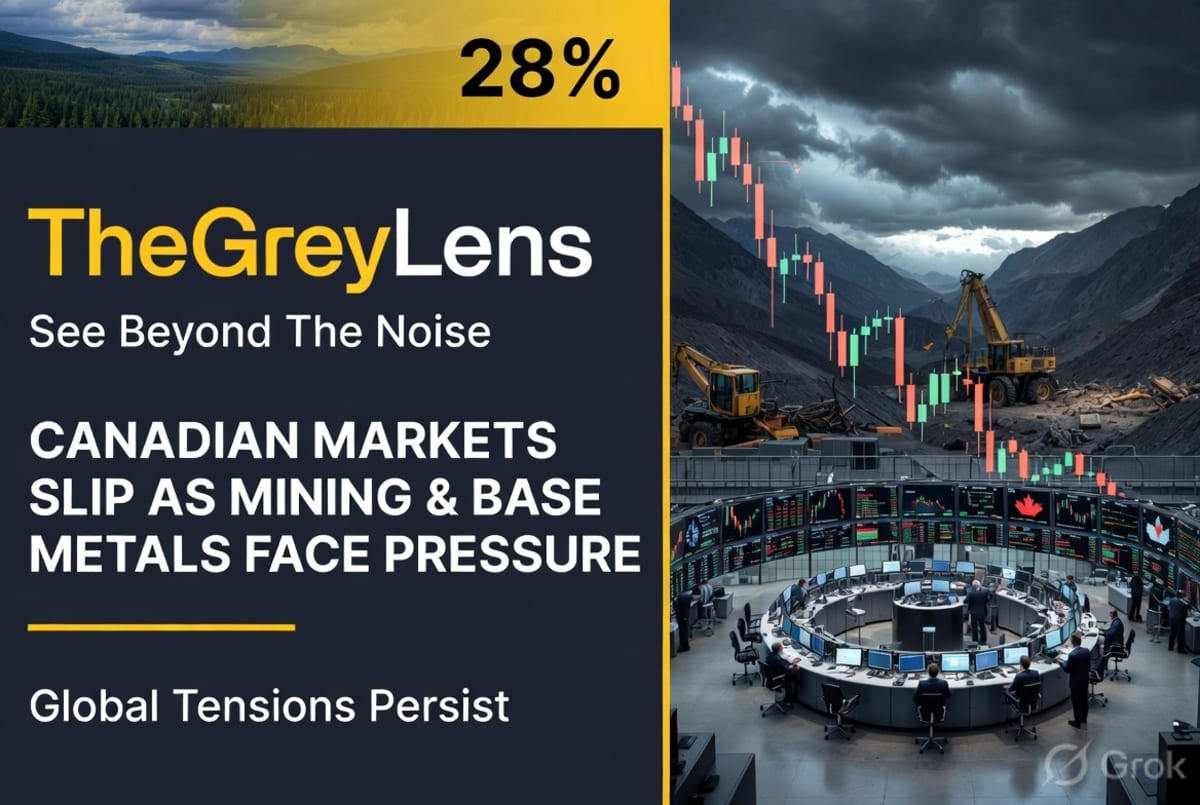
Canada's primary stock market index, the S&P/TSX Composite, experienced a downturn on Tuesday, May 19, 2026, closing down 92.11 points at 33,741.24. This decline was largely attributed to significant losses within the battery and base metals sectors, which weighed on the overall market performance. The movement mirrored a broader trend of weakness observed in U.S. stock markets, with the Dow Jones Industrial Average, the S&P 500, and the Nasdaq Composite all posting losses for the day. The S&P/TSX Composite has now been trading lower for two consecutive days, marking the largest two-day decline in percentage terms since late April 2026.
The prevailing market sentiment appears to be shaped by a confluence of factors, chief among them being the ongoing geopolitical tensions stemming from the closure of the Strait of Hormuz. This strategic waterway's shuttering by Iran in response to U.S. and Israeli attacks has led to a sustained spike in global oil prices since late February. Analysts note that the market's performance remains closely tethered to developments in this region, with continued uncertainty contributing to investor apprehension. The lack of significant de-escalation has led to a general market hesitancy, with investors appearing to "give back a little bit of what it's done in the last few weeks because there's nothing new coming up and nothing new means we're still in the same bad position," according to Sadiq Adatia, chief investment officer at BMO Global Asset Management.
Inflationary Pressures and Central Bank Dilemmas Add to Market Jitters
Adding to the market's concerns are rising inflation figures in Canada. Statistics Canada reported that the cost of gasoline was 28.6% higher year-over-year in April, a direct consequence of disrupted global oil shipments. This surge, coupled with the seasonal switch to more expensive summer gasoline blends, contributed to Canada's inflation rate climbing to 2.8% last month, the highest annual rate since May 2024. While this figure was slightly below economists' expectations, it still presents a challenge for the Bank of Canada. The central bank finds itself in a precarious position, needing to address inflation while also navigating a weaker Canadian economy and the looming renegotiation of the Canada-United States-Mexico Agreement. This economic backdrop is contributing to the overall negativity observed in the Canadian stock market.
In addition to the domestic inflation concerns, broader economic data from the U.S. also played a role. Hotter-than-expected April U.S. inflation data had previously pushed rate expectations higher, creating a ripple effect across North American markets. While corporate earnings in the U.S. have shown strength, with first-quarter earnings tracking a significant year-over-year growth rate, this has not been enough to counteract the geopolitical and inflation-related anxieties.
Commodity Markets and Currency Fluctuations
Commodity prices saw mixed movements. The July crude oil contract experienced a slight decline, trading down 23 cents U.S. at US$104.15 per barrel. Conversely, gold prices also dipped, with the June gold contract down US$46.80 at US$4,511.20 an ounce. These movements in key commodities can significantly impact Canadian market sectors, particularly those reliant on resource extraction. The Canadian dollar traded at 72.69 cents U.S. compared to 72.72 cents U.S. on Friday, indicating a slight weakening against its U.S. counterpart.
Looking ahead, market participants will be closely monitoring any developments regarding the Strait of Hormuz and further inflation data releases. The Bank of Canada's next policy decisions will also be under scrutiny as it balances the need to control inflation with supporting economic growth. The performance of the base metals and battery sectors will be crucial to watch, as their recent weakness has been a significant drag on the S&P/TSX Composite. The market's ability to find upward momentum will likely depend on a de-escalation of geopolitical tensions and clearer signals on the path of inflation and interest rates.