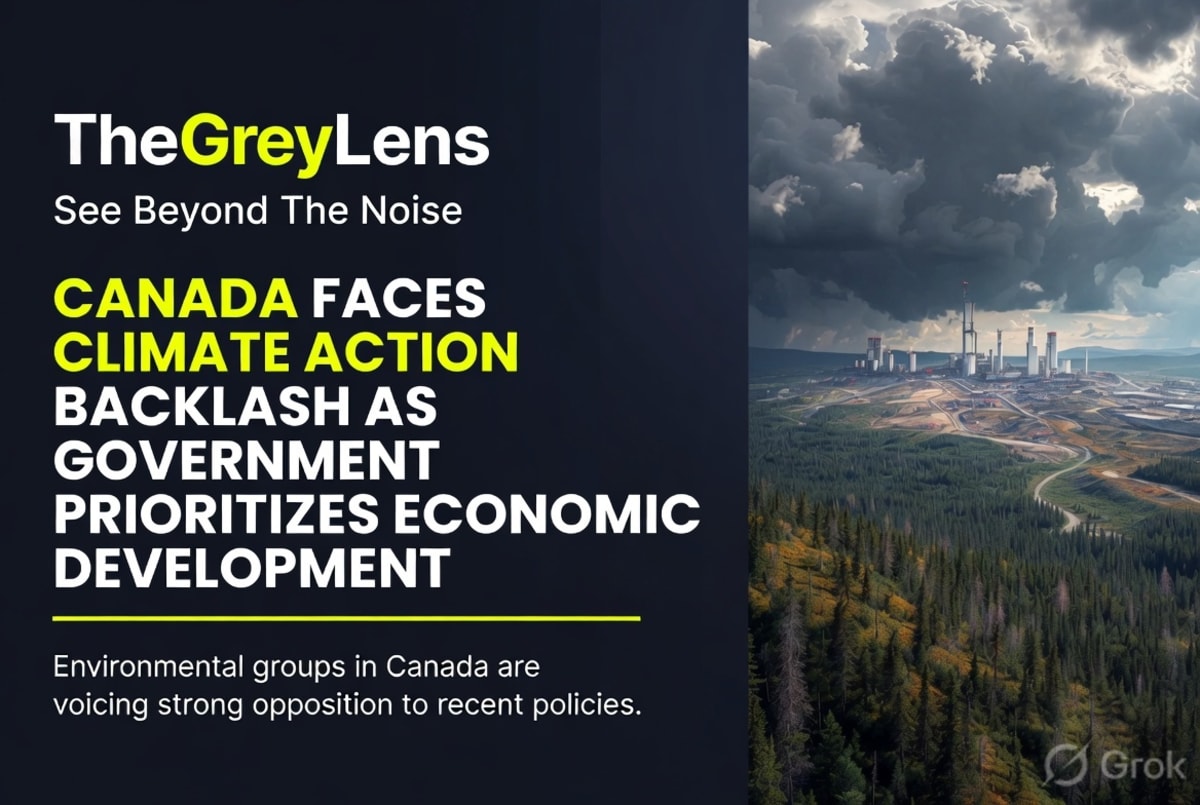
Canada is facing a significant backlash from environmental organizations and advocates who argue the government is prioritizing economic development at the expense of crucial climate action and environmental protection. The growing discontent stems from recent policy shifts and agreements that critics contend undermine decades of progress in safeguarding nature and meeting emission reduction targets.
Environmental Groups Decry Policy \"Rollbacks\"
On June 3, 2026, representatives from 14 environmental groups gathered on Parliament Hill to urge the Liberal government to reverse course on what they are calling \"rollbacks\" of environmental policy. These organizations expressed alarm that Ottawa has gone too far in undermining environmental and climate policy, particularly in light of recent agreements that appear to favor fossil fuel development. Sandra Schwartz, with the Canadian Parks and Wilderness Society, stated that the proposals ask Canadians to accept \"less protection for nature, fewer safeguards for communities, and more risk of extinction for iconic species, all in the name of moving faster.\" She emphasized that these actions are not conducive to nation-building but rather to \"nation-breaking.\"
The environmental leaders are particularly concerned about the memorandum of understanding (MOU) between Prime Minister Mark Carney and Alberta Premier Danielle Smith, which places fossil fuels at the center of Canada's economic and national security. This was further solidified with the recent signing of an implementation agreement for new pipelines. This direction is seen as a stark contrast to the urgent need for climate action, especially in the context of intensifying extreme weather events. Two of the past three years have seen the worst wildfire seasons on record, with unprecedented firestorms consuming vast areas and destruction in regions like West Kelowna leaving a significant mark. Climate warming is an observable scientific fact, and to mitigate its effects, Canadians need to reduce fossil fuel consumption. However, the current policy direction appears to be moving in the opposite direction.
Disappointment Over Climate Action and Reconciliation
Further fueling the disappointment is the perceived loss of ground on carbon pricing and reconciliation efforts. Environmental advocates note that the government's approach to Indigenous consultation and accommodation has shifted from free, prior, and informed consent to a more limited \"where appropriate.\" This is seen as a political concession that has also failed to appease separatist pressures, with Alberta's referendum plans forging ahead. The imminent departure of Steven Guilbeault, the Liberals' former environment minister, from Cabinet and his subsequent resignation from his seat entirely, following the implementation agreement for the MOU, is viewed by many as a damning indictment of the government's climate policy. Guilbeault's decision to resign from Cabinet six months prior, when the MOU debuted, and then his complete resignation after the implementation agreement, highlights the deep concerns within the government and among its environmental allies.
Prime Minister Mark Carney, speaking to The Canadian Press, stated that the government is \"absolutely not\" abandoning environmental protections and cited its new nature strategy. However, environmental groups remain unconvinced, arguing that the government's focus on fast-tracking project approvals undermines conservation efforts. They contend that the government's approach, which includes declaring federal economic zones as broadly undermining environmental rules and approving projects before impacts are studied, is \"destructive and it's dangerous.\"
Economic Pressures and Environmental Trade-offs
Canada's commitment to climate action is being tested as it grapples with economic pressures. The government's Climate Competitiveness Strategy aims to reduce emissions while catalyzing investment in clean technology and innovation. Minister of the Environment, Climate Change and Nature, Julie Dabrusin, emphasized on World Environment Day (June 5, 2026) that addressing climate change is essential for protecting communities, improving affordability by reducing climate damage costs, and building a resilient economy. She highlighted that Canada's plan is ambitious, pragmatic, and durable, guided by Indigenous Knowledge, informed by science, and strengthened through collaboration. However, critics argue that the practical implementation of these strategies is falling short, with a perceived shift towards prioritizing resource development. The Environmental Damages Fund, while supporting 12 new nature conservation and restoration projects with over $4 million in funding, is seen by some as insufficient to counteract the broader policy direction.
Environment Canada's seasonal outlook forecasts a hotter-than-normal summer across most of Canada, with a high probability for parts of southern British Columbia, including Metro Vancouver and Vancouver Island. This forecast, attributed to human-caused climate change and a strong El Niño, underscores the urgency of climate action. Yet, some energy providers, like B.C. Hydro, are cancelling plans to phase out gas-powered generation due to looming electricity shortfalls, further illustrating the complex trade-offs between environmental goals and energy security.
The current situation suggests a critical juncture for Canada's environmental policy. While the government reiterates its commitment to climate action and nature protection, a growing chorus of environmental advocates believes that recent policy decisions signal a significant backtrack. The coming months will likely see continued pressure on the government to reconcile its economic development agenda with its climate commitments, as the impacts of climate change become increasingly apparent across the country.