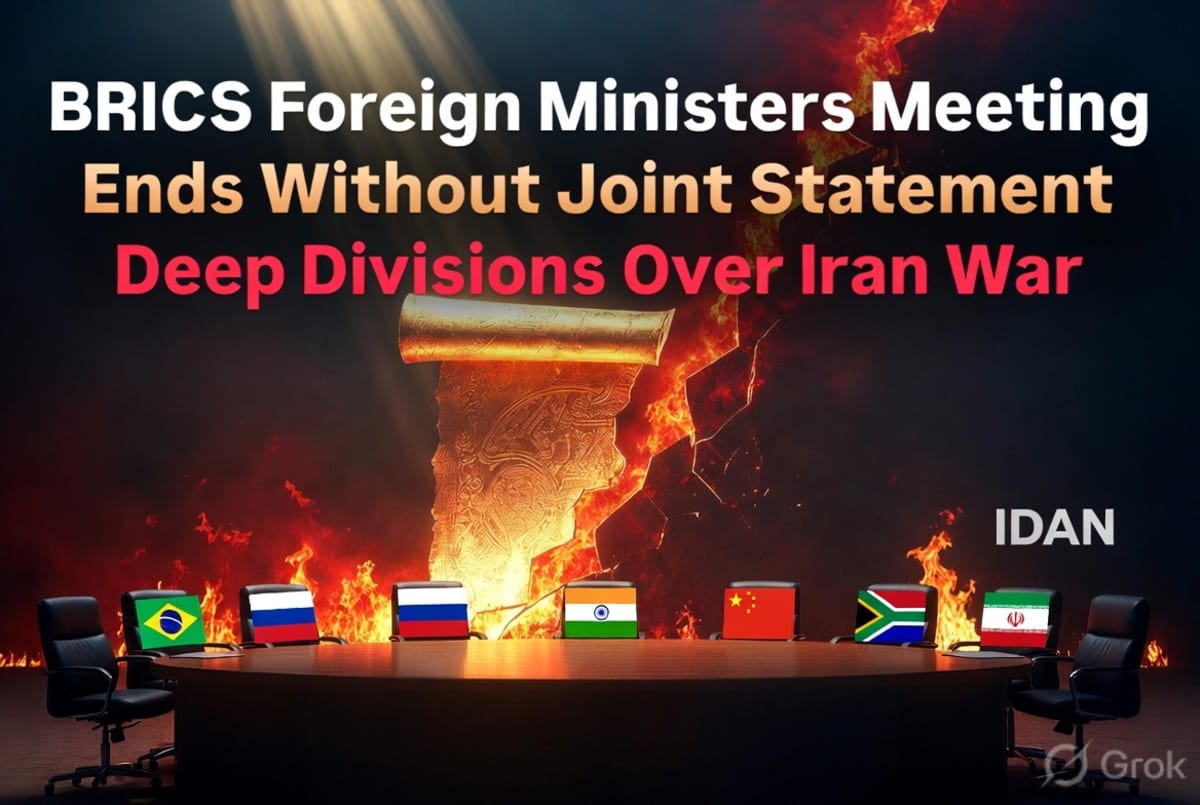
New Delhi, India – The BRICS foreign ministers' meeting, held in New Delhi on May 14-15, 2026, concluded without a joint statement, highlighting deep fissures within the bloc, particularly regarding the escalating conflict in West Asia involving Iran, the United States, and Israel. The inability of the member states to reach a consensus led India, the current chair, to issue a "Chair's Statement and Outcome Document" instead of a co-signed declaration.
Divergent Stances on the Iran Conflict
The most significant point of contention revolved around the ongoing conflict in West Asia. Sources indicate that the United Arab Emirates (UAE) pushed for an explicit condemnation of Iran, while Tehran advocated for a condemnation of the "violations of international law by the United States and Israel". This stark divergence in viewpoints underscored the challenge of managing the geopolitical interests of newly inducted members like Iran and the UAE, who are regional rivals. The chair's statement acknowledged that member countries held differing perspectives on the Middle East crisis.
India's Balancing Act and Diplomatic Strategy
For India, the situation underscored the complexity of its foreign policy, which seeks to balance relations with multiple global powers simultaneously. New Delhi maintains close ties with the United States and Gulf countries while also preserving strategic partnerships with Russia and China. Russian Foreign Minister Sergey Lavrov, speaking at a press briefing after the meeting, suggested that India could play a larger long-term diplomatic role in mediating the tensions involving the US and Iran, citing India's vast diplomatic experience and growing global standing. Lavrov indicated that Pakistan was currently facilitating immediate dialogue between the US and Iran.
India's approach to the conflict, as reflected in the chair's statement, called for diplomacy, respect for sovereignty, protection of civilian lives, and the importance of maintaining secure maritime trade routes. The statement also reiterated support for a two-state solution for Palestine, with East Jerusalem as its capital, and called for Palestine's full UN membership, a stance that India maintained was not a departure from its previous positions.
Economic Convergence Amidst Political Disagreements
Despite the significant political disagreements, the BRICS foreign ministers found greater convergence on economic issues. The outcome document condemned "unilateral coercive measures" such as economic and secondary sanctions not authorized by the UN Security Council, warning that such measures harm development, food security, and global supply chains. This sentiment is generally understood to refer to Western sanctions regimes, particularly those targeting Russia. The ministers also discussed concerns regarding unilateral measures and their disproportionate impact on developing countries, emphasizing a commitment to a rule-based, non-discriminatory, and inclusive multilateral trading system with the WTO at its core.
The meeting highlighted both the growing importance of the expanded BRICS bloc and its inherent structural limitations in achieving consensus on major international crises amidst deepening geopolitical rivalries. The bloc, which now includes Brazil, Russia, India, China, South Africa, Ethiopia, Egypt, Iran, and the UAE, faces the challenge of navigating diverse and often conflicting national interests.
Looking ahead, the BRICS bloc's ability to forge a unified stance on global security challenges will be a key determinant of its future influence. While economic cooperation may continue to provide a foundation for engagement, the unresolved geopolitical fault lines, particularly concerning the West Asian conflict, pose a significant hurdle for the bloc's aspirations to act as a unified voice for the Global South.