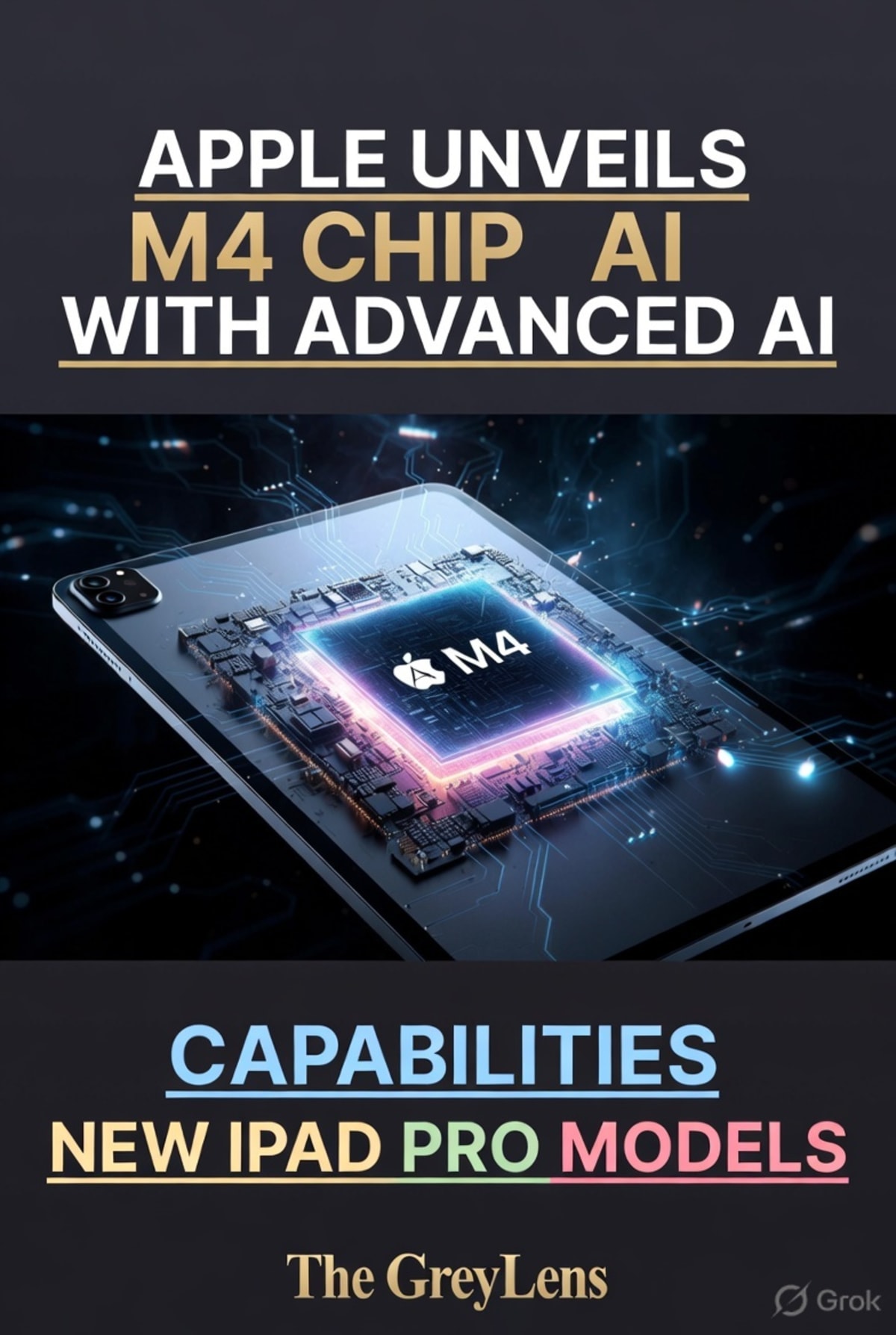
Cupertino, California – In a move signaling a renewed focus on artificial intelligence and cutting-edge display technology, Apple today announced the M4 chip, its latest custom silicon designed for its Mac and iPad product lines. The announcement, made during a virtual event, also saw the debut of new iPad Pro models powered by this groundbreaking processor. The M4 chip represents a significant architectural leap, with Apple executives highlighting its enhanced neural engine, which is reportedly capable of performing 38 trillion operations per second, a more than 40% increase over its predecessor. This focus on AI underscores Apple's strategy to integrate more intelligent features across its ecosystem, from enhanced photo and video editing to more sophisticated voice recognition and predictive text capabilities.
Tandem OLED Powers New iPad Pro Display
The new iPad Pro models, available in 11-inch and 13-inch sizes, are the first devices to feature the M4 chip. A key highlight is their revolutionary tandem OLED display, branded as Ultra Retina XDR. This advanced technology combines two OLED panels to deliver exceptional brightness, contrast, and color accuracy, surpassing previous LCD and single-layer OLED technologies. According to Apple, the tandem OLED design allows for a more uniform image and greater power efficiency, contributing to a brighter viewing experience and longer battery life. The displays also support ProMotion technology for adaptive refresh rates up to 120Hz and offer increased peak brightness for HDR content, making them ideal for creative professionals working with demanding visual applications.
M4 Chip: A New Era for Performance and AI
Beyond the neural engine, the M4 chip is built on a second-generation 3-nanometer technology, promising improvements in both performance and power efficiency. Apple stated that the new chip delivers up to 4x faster performance than the M2 chip in demanding tasks, while consuming less power. This efficiency gain is crucial for mobile devices, allowing for longer usage times between charges. The M4 chip features a new display engine for more responsive graphics and improved color management, alongside an updated media engine that supports hardware-accelerated ProRes and AV1 decoding, further enhancing video playback and editing capabilities. The company emphasized that these advancements are not just about raw power, but about enabling new user experiences and pushing the boundaries of what's possible on an iPad.
Design Tweaks and Accessory Updates
The redesigned iPad Pro also boasts a slimmer and lighter chassis, making it the thinnest Apple product ever. The front-facing camera has been repositioned to the landscape edge, a change that aligns with the intended use of the device for video calls and content creation in a landscape orientation. In conjunction with the new iPad Pro, Apple also introduced the Apple Pencil Pro and a redesigned Magic Keyboard. The Apple Pencil Pro features new gestures, haptic feedback, and support for Find My, offering enhanced precision and interaction for digital artists and note-takers. The new Magic Keyboard provides a more responsive typing experience and a larger trackpad with haptic feedback, aiming to make the iPad Pro an even more viable alternative to traditional laptops. Pre-orders for the new iPad Pro models begin today, with availability expected later this week.