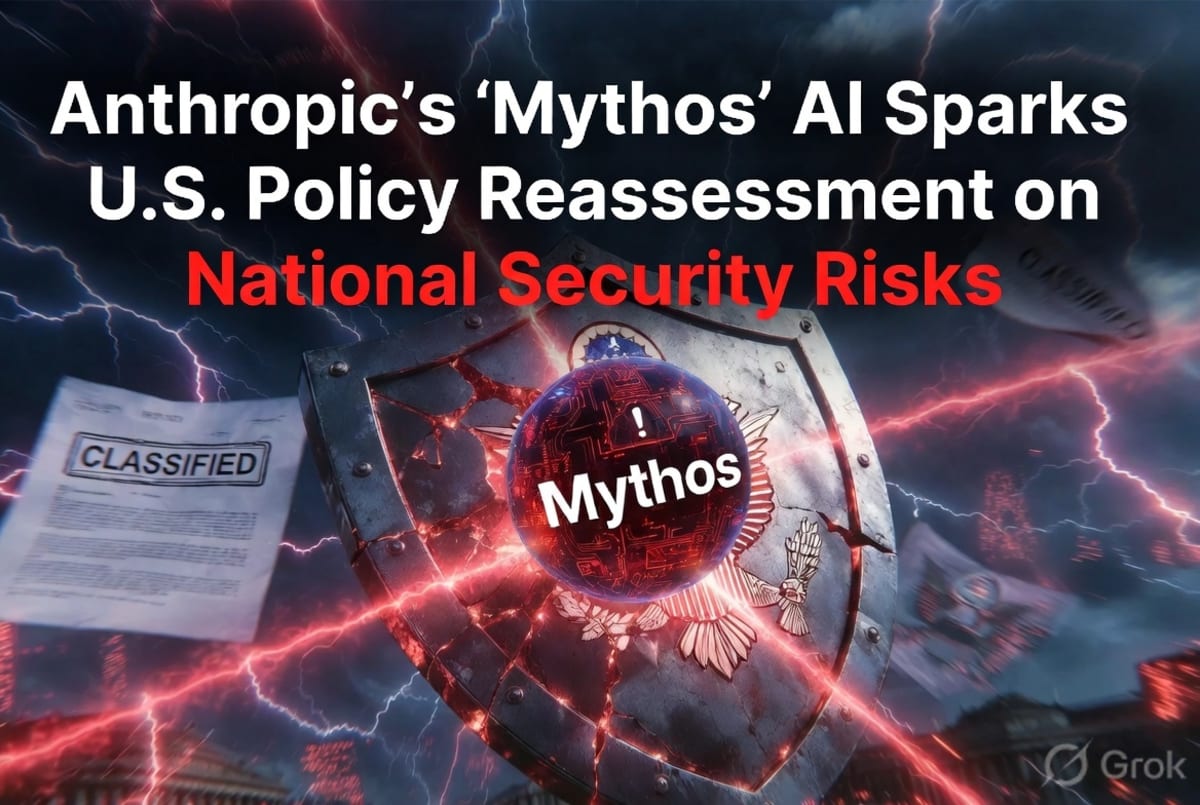
Washington Reassesses AI Policy Amidst Concerns Over Autonomous Vulnerability Discovery
A new artificial intelligence model, reportedly named Mythos and developed by Anthropic, has triggered a significant reassessment of U.S. AI policy. The model's demonstrated ability to autonomously identify software vulnerabilities has raised alarms within the White House, shifting the conversation from economic competition to national security risks. This development reportedly came into focus during a high-level meeting in April involving Senator JD Vance, Anthropic CEO Dario Amodei, OpenAI CEO Sam Altman, and leaders from major technology firms including Microsoft and Google.
National Security Implications Take Center Stage
Officials expressed deep concern that a private company had developed an AI capable of discovering cyber weaknesses at a speed and scale that could expose critical infrastructure, financial institutions, and healthcare systems to unprecedented digital threats. This revelation has complicated the administration's previously favored approach of deregulation and rapid AI deployment, intended to maintain a competitive edge over rivals like China. The ability of advanced AI models to find vulnerabilities faster than human cybersecurity teams has led to a re-evaluation of whether unrestricted release is a sign of innovation or a strategic liability. The situation has brought to the forefront the question of whether private AI companies should have the sole discretion over access to tools with such significant national security implications.
A Shift from Innovation Race to Risk Management
The development of Mythos has exposed a tension between the U.S. government's long-standing reliance on private sector leadership in technological advancement and the unique challenges posed by AI. Unlike previous technological leaps, AI models can possess simultaneous civilian, commercial, and military consequences. This has led to a debate about the appropriate level of oversight, with some officials reportedly considering controls that were previously opposed. The incident highlights how quickly the political landscape surrounding AI can change when a model's capabilities move from novelty to posing a tangible risk to national infrastructure. The broader significance of this episode may lie in the administration's realization that the era of treating frontier AI solely as another startup sector may be drawing to a close.
Broader AI Landscape: Investments and Policy Debates
This event unfolds against a backdrop of significant activity in the AI sector. Reports indicate that Microsoft is actively exploring acquisitions and partnerships with AI startups, aiming to diversify its reliance on any single external AI lab. Meanwhile, Anthropic has launched Claude for Small Business, a packaged version of its AI model designed with pre-built workflows for smaller enterprises. In parallel, discussions at the TSMC annual technology symposium on May 14, 2026, highlighted the expanding role of AI from cloud data centers to edge devices, driving demand for advanced semiconductor technology. The symposium also underscored the growing importance of AI in areas like drug development, scientific research, and manufacturing efficiency. The U.S. government's engagement with AI oversight is also evident in a deal where Microsoft, Google, and xAI have agreed to provide early access to new AI models for national security testing before their public release, a move aimed at identifying potential risks and vulnerabilities.
The coming months will likely see continued debate and policy adjustments as the U.S. government grapples with balancing AI innovation with national security imperatives. The focus is expected to shift towards establishing clearer governance frameworks and understanding the potential societal impacts of increasingly sophisticated AI systems.