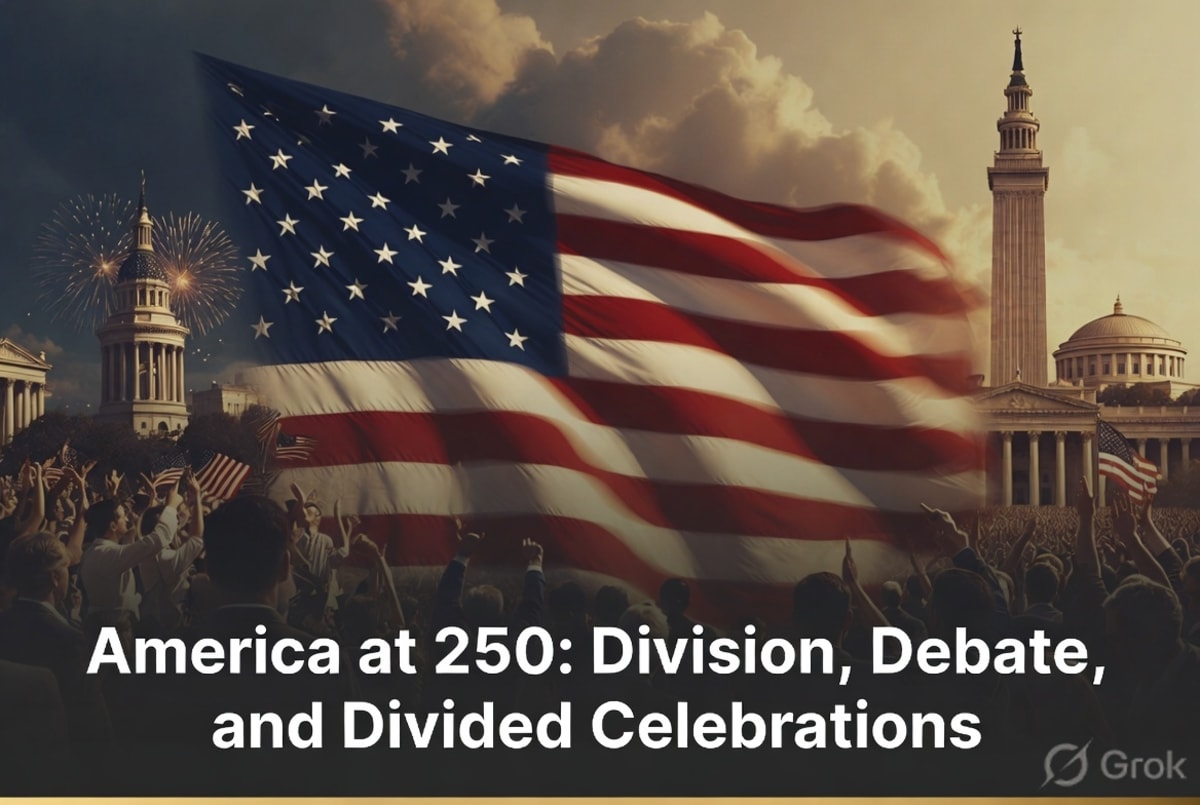
The United States is commemorating its 250th anniversary on July 4, 2026, a milestone marked by a complex tapestry of official events, grassroots initiatives, and significant political contention. Celebrations are being spearheaded by two main federal entities: the congressionally established, non-partisan America250 Commission and the White House-aligned Freedom 250 task force, chaired by President Donald Trump. This dual approach has led to a fragmented and often politicized commemoration, with accusations of financial impropriety and attempts to hijack the narrative. While official events include a "Great American State Fair" on the National Mall, a Times Square ball drop, and extensive fireworks displays, numerous local and community-led events are also taking place across the country, aiming to reflect diverse American experiences. The anniversary is not just a look back at history but also a focal point for contemporary debates about American identity, values, and the nation's future direction, particularly in an era of deep political polarization.
The Full Picture: Where We Actually Are
As of July 4, 2026, the United States is in the midst of its semiquincentennial celebrations, a period marked by both widespread public engagement and significant political division. Official festivities, heavily influenced by the Freedom 250 initiative, aim for a grand spectacle, including a massive fireworks display over the National Mall and a "Great American State Fair." Simultaneously, the America250 Commission continues its programming, focusing on educational and civic engagement initiatives. However, the celebrations are overshadowed by controversy. Accusations of financial impropriety, political favoritism, and a deliberate downplaying of historical complexities like slavery plague the Freedom 250 effort. Many state and local organizations are forging their own paths, seeking to create more inclusive and less partisan commemorations. The narrative surrounding the anniversary is fractured, reflecting the deep societal divisions that characterize contemporary America. Many Americans express pride in the nation's founding principles, yet a significant portion also voice concern about the country's direction and its deviation from those ideals. The celebrations, therefore, serve as a microcosm of the nation's current state—a blend of patriotic fervor, historical reflection, and profound societal introspection.
How We Got Here
The path to the current semiquincentennial celebrations began in 2016 with the establishment of the America250 Commission by Congress, intended to plan a non-partisan commemoration of the nation's 250th anniversary. This commission spent years developing programming aimed at unifying Americans and celebrating the nation's history. However, the landscape shifted dramatically in 2025 when President Donald Trump, shortly after beginning his second term, issued an executive order creating the White House Task Force on Celebrating America's 250th Birthday, which evolved into Freedom 250. This new entity, with significant backing from the private sector and taxpayer funds, began to overshadow America250, leading to accusations of a political power grab and a redirection of resources. Congressional Democrats have criticized the Trump administration's approach, alleging a deliberate attempt to politicize the anniversary and sideline the bipartisan commission. This dual-track approach, marked by competing visions and contested funding, has defined the lead-up to July 4, 2026, transforming what was intended as a unifying national moment into a focal point for political battles over history and national identity.
The Players And Their Interests
At the center of the semiquincentennial celebrations are two primary organizations with divergent interests: the congressionally chartered America250 Commission and the White House-backed Freedom 250. America250, supported by a nonprofit and a bipartisan congressional caucus, aims for inclusive, educational, and unifying events, seeking to engage all Americans in reflecting on the nation's full history. Their interest lies in a historically comprehensive and broadly representative commemoration. In contrast, Freedom 250, led by President Trump, appears to prioritize a more nationalistic and politically aligned celebration. This group, funded by private donors and taxpayer money, has been accused of favoring certain political narratives and downplaying difficult aspects of American history, such as slavery. Corporations like Amazon, JPMorgan Chase, Oracle, Walmart, ExxonMobil, and Mastercard have significant interests as sponsors, potentially seeking influence and favorable access. Government contractors like Lockheed Martin and Northrop Grumman have also contributed, suggesting an interest in maintaining relationships with powerful political figures. The National Park Service and the Department of the Interior are also key players, navigating directives that have favored Freedom 250.
The Data People Are Not Talking About
While official celebrations draw headlines, crucial data points reveal deeper complexities and disparities. Despite extensive planning, a recent poll indicates that nearly half of Americans (49%) do not know what the nation's 250th anniversary is celebrating. Furthermore, while 76% of Americans view the nation's founding favorably, only 70% believe its founding principles remain relevant today, with 57% stating the country has moved away from them. The America250 Commission aims to engage all 350 million Americans, a goal of "350 for 250," though current engagement metrics are not widely publicized. Freedom 250's "Freedom Trucks" aim to reach 20 million Americans, a target that, if met, would still represent less than 7% of the population. Critically, while Freedom 250 received $68 million in taxpayer funds in 2026, the bipartisan America250 commission reported a $100 million funding shortfall. This disparity in funding and reach highlights the uneven distribution of resources and attention in the semiquincentennial commemorations.
The India Dimension
India's engagement with the United States' 250th anniversary underscores the deep and evolving bilateral relationship. Prime Minister Narendra Modi extended warm congratulations to President Trump and the American people, emphasizing that the India-US partnership is a "force for global good" rooted in shared democratic values and the potential of their people. He expressed hope for enhanced prosperity, peace, and progress for America and a strengthening of India-US ties over the next 250 years. India's prominent figures, including political leaders, sports stars, and artists, participated in a cinematic tribute organized by the US Embassy, lauding America's spirit of innovation, meritocracy, and global influence. Figures like Shashi Tharoor highlighted the "united democratic spirit," while others, such as former PepsiCo CEO Indra Nooyi, praised the US as a "true meritocracy." American Spaces across India have also been engaging young Indians in exploring US history, culture, and values through various programs, aiming to foster understanding and connection ahead of the 2026 milestone. This multifaceted engagement reflects India's strategic alignment with the US and its recognition of America's enduring global impact.
What Happens Next
The immediate focus is on the July 4th celebrations, which are poised to be the crescendo of the semiquincentennial commemoration. President Trump is scheduled to deliver a major address on the National Mall preceding what is billed as the "world's largest fireworks display." Simultaneously, numerous community-led events and counter-programming by progressive activists will occur, reflecting the ongoing tension between official and grassroots commemorations. Beyond the immediate holiday, the America250 Commission's programming will continue through the year, with initiatives like the "America's Block Party" aiming for broad engagement. The Freedom 250 initiative also has events scheduled through the end of 2026. The long-term implications hinge on how the controversies surrounding funding, transparency, and historical representation are addressed, and whether the nation can find common ground in its collective memory as it looks toward its next 250 years. The enduring question of American identity and the nation's role in the world will continue to be debated, informed by the divergent narratives presented during this anniversary year.
America's 250th anniversary is less a celebration of unity and more a stark reflection of its deep-seated divisions. The politicization of this milestone, driven by the Freedom 250 initiative and President Trump's personal branding, has fractured the intended national moment into competing partisan spectacles. This is not merely a disagreement over event planning; it is a contest for the very soul of American identity, a struggle over whose history is remembered and whose values are prioritized. While America250 attempts a more inclusive approach, its struggles with funding and political headwinds leave it at a disadvantage. The data reveals a populace that, while proud of its founding, is deeply concerned about the nation's present trajectory and its fidelity to core principles. The true legacy of this anniversary will not be the fireworks or the rallies, but the extent to which these divisions are acknowledged and addressed, or further entrenched. As a nation, America is at a crossroads, and this anniversary is less a triumphant march forward and more a critical, and often contentious, reckoning with its past and future. The challenge for Americans is to move beyond the noise and find a shared narrative that honors the complexities of their history and fosters a truly inclusive vision for the next 250 years.
- The 250th anniversary is marked by a political split between the bipartisan America250 Commission and the White House-backed Freedom 250 initiative.
- Significant controversy surrounds Freedom 250, including accusations of political favoritism, lack of transparency, and downplaying historical issues like slavery.
- Data shows a disconnect between pride in the nation's founding and concern about its current direction, with many Americans feeling the country has strayed from its original principles.
- India's engagement highlights the strong US-India relationship, with leaders expressing hopes for continued bilateral growth and shared democratic values.
- The celebrations serve as a critical juncture for national introspection, forcing a confrontation with America's complex history and its future identity in an era of deep polarization.