What's Happening
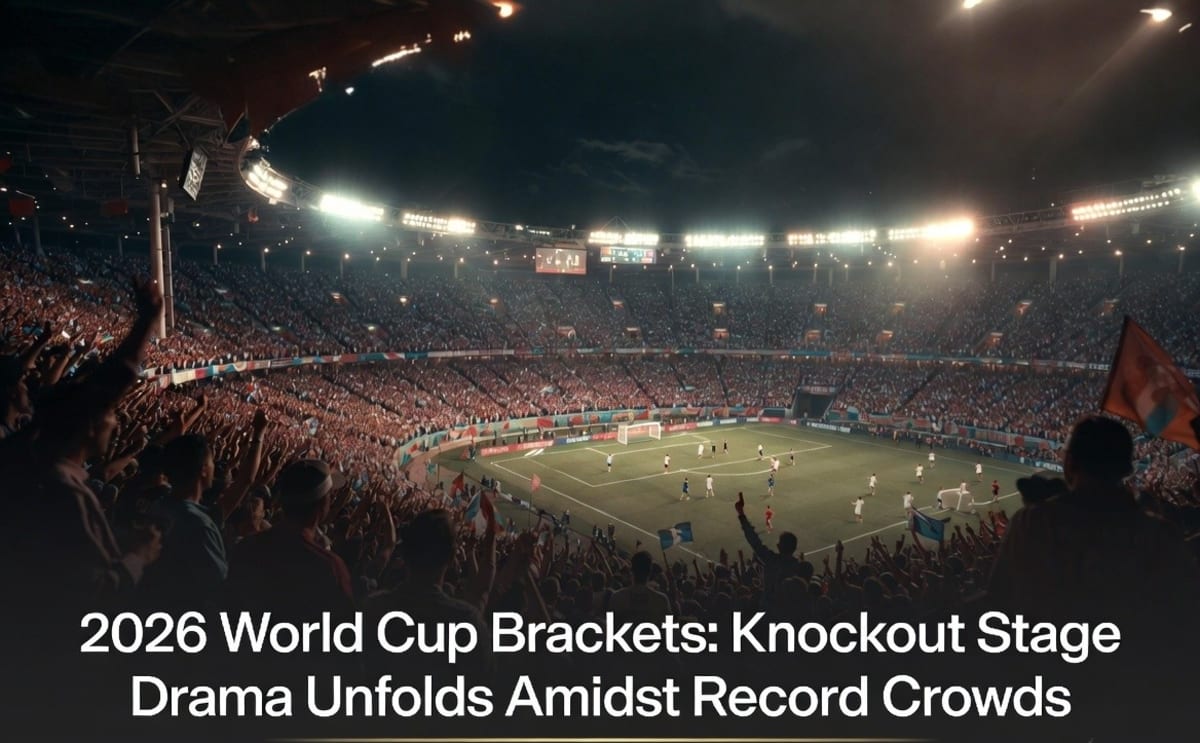
The FIFA World Cup 2026 is currently in its electrifying knockout phase, a testament to the expanded 48-team format that has captivated the globe. The tournament, co-hosted by Canada, Mexico, and the United States, commenced on June 11, 2026, and will culminate on July 19, 2026. A staggering 104 matches are being played across 16 cities. The Round of 32 has concluded, with the Round of 16 currently underway, showcasing intense battles as teams vie for a spot in the quarterfinals. The group stage alone saw a record-breaking 4,644,549 spectators attend the initial 72 matches, with an average crowd of 64,508 per game and a 99.7% seat occupancy rate. The highest single-day attendance in FIFA history was recorded on June 25, with 426,834 fans. Broadcast figures are equally impressive, with over 50 million viewers tuning in across the host nations during the opening stages, and the Mexico vs. South Africa opener becoming the most-watched FIFA Men's World Cup opening match ever broadcast in English in the United States, drawing 7.2 million viewers.
The Full Picture
This year's FIFA World Cup 2026 marks a significant departure from previous editions, most notably with its expansion to 48 teams, an increase of 16 from the 32-team format that had been in place since 1998. This has led to a revamped structure featuring 12 groups of four teams, with the top two from each group and the eight best third-placed teams advancing to a new Round of 32. The tournament is being jointly hosted by three nations for the first time, with Canada, Mexico, and the United States sharing hosting duties across 16 cities. This co-hosting arrangement is historic, with Mexico having previously hosted in 1970 and 1986, making it the first country to host or co-host three times, and the United States hosting in 1994. The tournament has also returned to its traditional June-July schedule. The FIFA Club World Cup 2025™ and FIFA World Cup 2026™ are projected to add $62 billion to global GDP.
Why This Is Exploding Right Now
The current trending status of "fifa world cup brackets" is directly tied to the ongoing, high-stakes knockout stage of the tournament. As the matches progress into the Round of 16 and beyond, the elimination format intensifies the drama and uncertainty, making the bracket a focal point for fans and analysts alike. The expanded 48-team format, with its new group stage dynamics and the advancement of third-place teams, has added layers of complexity and potential for unexpected outcomes, fueling discussions about potential upsets and underdog stories. Furthermore, the unprecedented attendance and broadcast figures demonstrate a heightened level of global engagement, with fans actively tracking the tournament's progression through the bracket. Social media is abuzz with real-time updates, fan reactions, and expert analyses of the bracket's evolving landscape, making it the central narrative of the tournament's current phase.
The Real-World Impact
The FIFA World Cup 2026 is a significant economic driver, with FIFA projecting it will generate up to $40.9 billion in additional global GDP and create approximately 824,000 jobs. For the host nations, the economic impact is substantial, though concentrated. U.S. host cities are expected to see between $160–$620 million in incremental economic activity per city. Seattle, for instance, projects a minimum of $929 million for King County from its six matches, including over $100 million in direct tax revenue. Mexico is estimated to benefit around $3 billion, while Canada anticipates CAD 3.8 billion in economic benefits. Beyond direct economic gains, the tournament serves as a platform for tourism, investment, and infrastructure development. For fans, particularly younger demographics, the tournament presents a generational opportunity for engagement and national pride, especially with the U.S. hosting. The tournament's global audience of 5 billion is expected to showcase the host cities' hospitality and infrastructure, driving long-term tourism and investment.
What Most Coverage Gets Wrong
Much of the current coverage, while highlighting the excitement of the knockout stages, often overlooks the subtle yet significant impact of the expanded 48-team format on the *quality* of the tournament bracket itself. Critics initially feared a dilution of quality, but the reality has been a more nuanced competitive landscape. The new dynamic where eight third-place teams advance creates a 'tournament within a tournament,' making third-place finishes strategically crucial and adding an unforeseen layer of complexity to bracket predictions. Furthermore, while economic projections are widely reported, the critical analysis of these figures, noting that they often represent a redistribution of spending rather than net new value creation and can suffer from cost overruns, is frequently downplayed. The focus remains on the aggregate numbers, rather than the granular distribution and potential long-term sustainability of these economic impacts.
What Comes Next
The FIFA World Cup 2026 is now firmly in its knockout stages. The Round of 16 matches are currently underway, with the quarter-finals scheduled to take place between July 9 and July 11. Following the quarter-finals, the semi-finals will determine the finalists, with the ultimate championship match set for July 19 at MetLife Stadium in East Rutherford. The tournament's conclusion will mark the end of an unprecedented 39-day event. The immediate focus remains on the unfolding matches and how the bracket will continue to evolve, with fans eagerly anticipating which teams will advance and who will ultimately lift the trophy.
The FIFA World Cup 2026 bracket, while a product of an expanded format, has proven to be a crucible of compelling narratives, defying early predictions of diminished competition. The introduction of the third-place advancement has injected an unexpected strategic element, turning every group stage match into a potential knockout tie. While giants like France and Argentina are demonstrating their pedigree, the resilience shown by nations like Cape Verde and Morocco in the group stages, and their subsequent progression, highlights the increasing global competitiveness. Our analysis suggests that the tournament's unique format, combined with the sheer scale of fan engagement, has created a more unpredictable and ultimately more enthralling spectacle than many anticipated. We predict that a European team will ultimately triumph, with France narrowly edging out Argentina in a fiercely contested final, driven by their consistent knockout stage performance and the individual brilliance of Kylian Mbappé. The true story of this World Cup, however, is not just about who wins, but how the expanded bracket has democratized the dream, offering more nations a genuine shot at glory and captivating a new generation of fans.
- 48-team expansion leading to 104 matches and a Round of 32 knockout stage
- Record-breaking attendance and broadcast figures highlighting global engagement
- Co-hosting by Canada, Mexico, and USA marks a historic first
- Third-place teams advancing adds strategic complexity and potential for upsets
- Economic projections indicate significant GDP growth and job creation across North America