High-stakes trade negotiations between India and the United States began on April 20, 2026, in Washington D.C., with a delegation of approximately a dozen Indian officials meeting their U.S. counterparts over three days. This resumption of talks, as reported by Business Standard and The Federal, comes after a deferral from February and is driven by significant shifts in the U.S. tariff policy. A key development prompting this recalibration is the U.S. Supreme Court's ruling on February 20, which invalidated sweeping reciprocal tariffs previously imposed under the International Emergency Economic Powers Act by President Donald Trump. In response, the U.S. administration implemented a flat 10% tariff on all countries for a period of 150 days, effective February 24. This new tariff landscape has forced both nations to revisit the draft framework of their proposed Bilateral Trade Agreement (BTA), which was initially released on February 7. Darpan Jain, India's chief negotiator and additional secretary in the department of commerce, is leading the Indian delegation, which includes officials from the customs and external affairs ministries. The talks are also occurring in the context of a significant realignment in global trade, with China having overtaken the U.S. to become India's largest trading partner in the 2025-26 fiscal year, a position the U.S. held for the preceding four years. The Federal notes that India's exports to the U.S. saw a marginal increase of 0.92% to USD 87.3 billion in the last fiscal year, while imports rose by 15.95% to USD 52.9 billion, resulting in a narrowed trade surplus. Under the original BTA framework, India had expressed its willingness to reduce or eliminate tariffs on a wide range of U.S. industrial goods and agricultural products, including items like dried distillers' grains, red sorghum, tree nuts, fruits, soybean oil, wine, and spirits. Furthermore, India had indicated plans to import approximately USD 500 billion worth of U.S. goods over five years, encompassing energy products, aircraft and parts, precious metals, technology products, and coking coal. These proposed concessions and import plans are now subject to review in light of the altered tariff environment. Additionally, two investigations by the U.S. Trade Representative (USTR) under Section 301 are expected to be discussed, with India having rejected the allegations and requested their termination, as per The Federal. The outcome of these negotiations is poised to significantly influence the future of trade relations between India and the United States, especially as global economic dynamics continue to evolve.
General
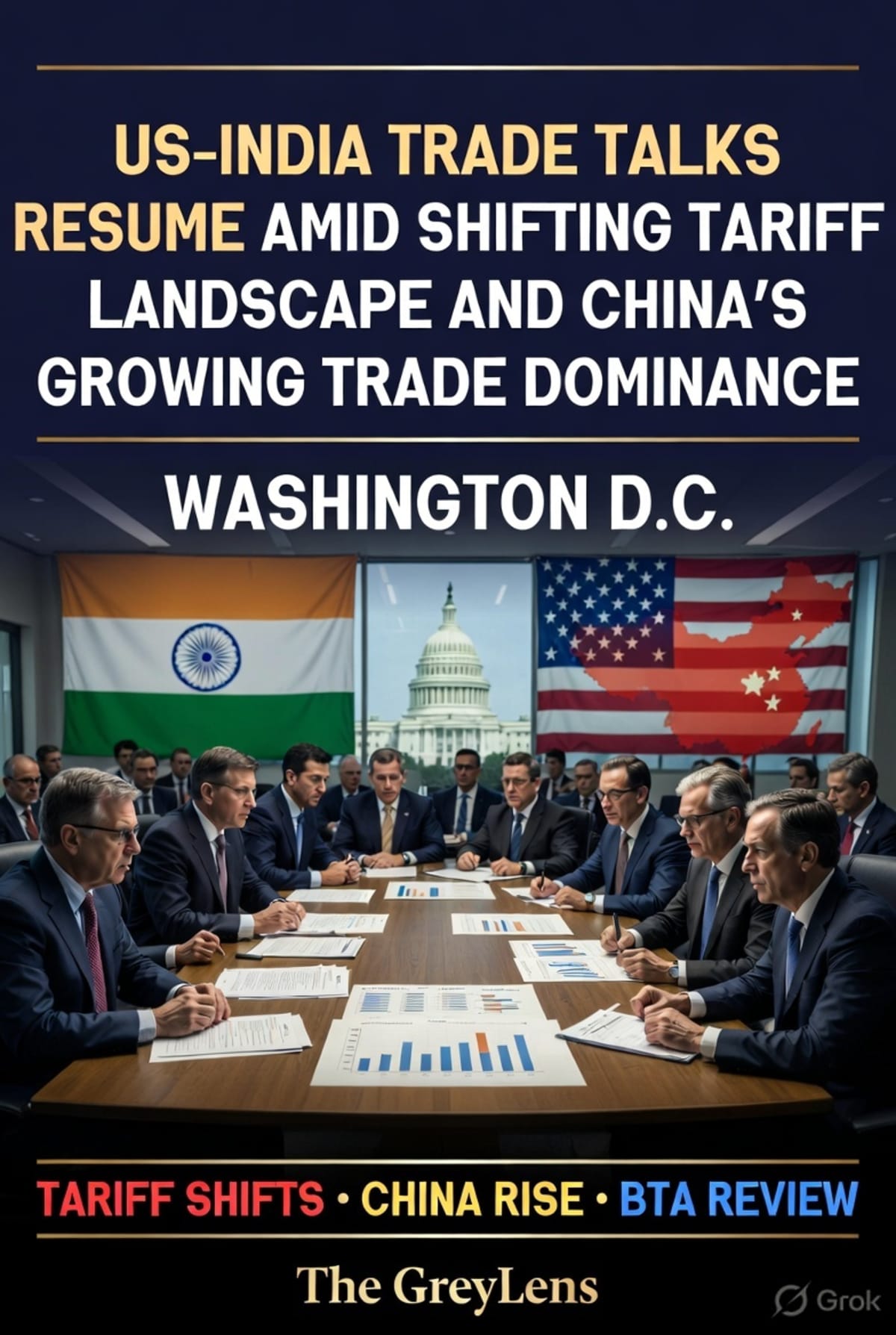
US-India Trade Talks Resume Amid Shifting Tariff Landscape and China's Growing Trade Dominance
High-stakes trade negotiations between India and the United States commenced today in Washington D.C., as both nations work to recalibrate their proposed Bilateral Trade Agreement (BTA). The talks, set to continue for three days, are taking place against a backdrop of significant changes in U.S. tariff policy and China's recent ascent to become India's largest trading partner. A delegation of approximately a dozen Indian officials, led by chief negotiator Darpan Jain, is engaging with their U.S. counterparts to address the implications of a U.S. Supreme Court ruling that struck down previous tariffs, prompting a new uniform tariff structure. This recalibration is crucial as China has now surpassed the U.S. as India's leading trading partner for the 2025-26 fiscal year, a significant shift from the previous four years. According to The Federal, the revised trade environment necessitates a thorough review of the BTA's framework, originally released on February 7. The U.S. administration's imposition of a flat 10% tariff on all countries for 150 days, effective February 24, has fundamentally altered the negotiating dynamics. Both sides are now tasked with adapting the agreement to these new realities, which could impact previously agreed-upon tariff reductions and import plans. The Business Standard reports that India had proposed significant tariff reductions on U.S. industrial goods and agricultural products, alongside plans for substantial energy and aircraft component purchases, which will now undergo review. The outcome of these talks will be closely watched for its potential to reshape trade relations between the two major economies.
Report an error/suggestion: news@thegreylens.com