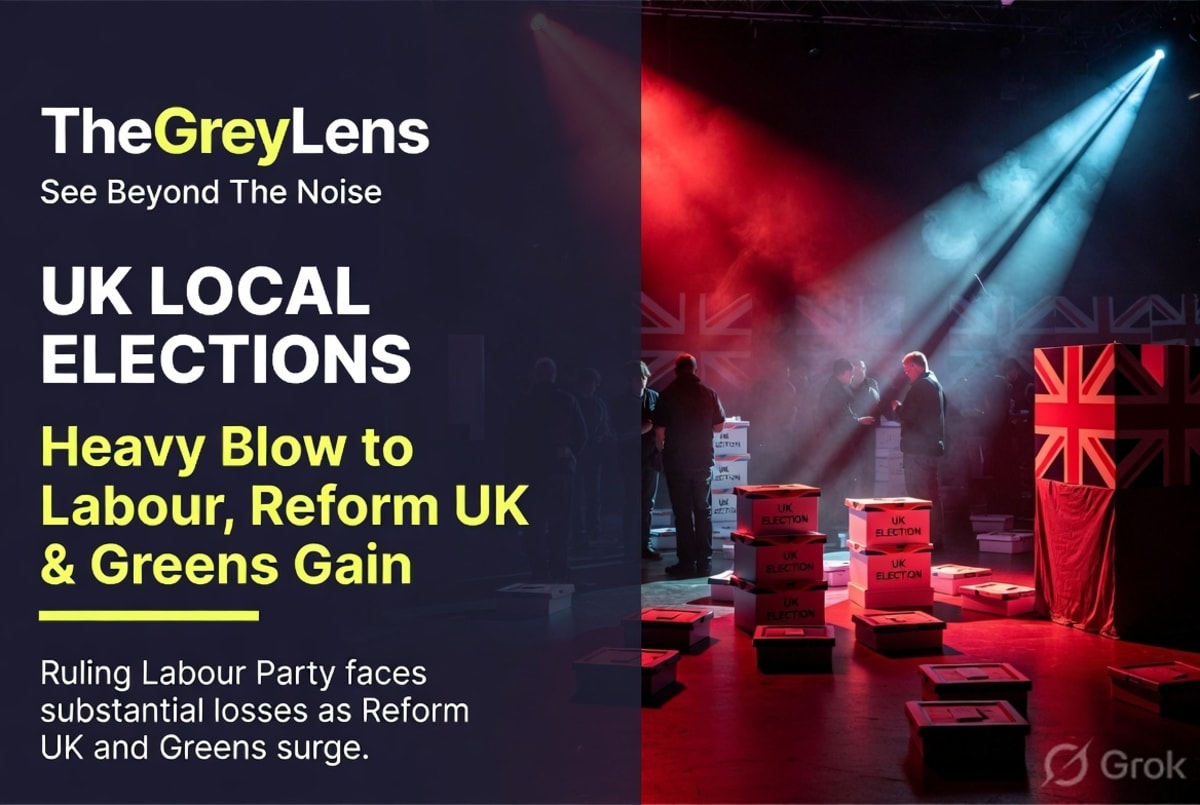
LONDON – The United Kingdom is witnessing a significant political shake-up following local elections held on Thursday, May 7, 2026. Early results indicate a bruising night for Prime Minister Keir Starmer's Labour Party, with substantial seat losses across England, Scotland, and Wales. In contrast, Nigel Farage's Reform UK party has made sweeping gains, securing over 250 council seats in England alone, marking a historic victory and the first Reform-run council in Greater London with the capture of Havering. The Green Party has also capitalized on voter dissatisfaction, making significant inroads, particularly in urban areas, and squeezing Labour from the left.
The devolved elections for the Scottish Parliament and the Senedd in Wales have also seen major shifts. Reports from the BBC and Reuters suggest that the Labour Party has conceded defeat in Wales, with Plaid Cymru and Reform UK making considerable gains. Welsh Labour leader and First Minister of Wales, Eluned Morgan, has resigned after losing her seat. In Scotland, the Scottish National Party (SNP) has claimed victory, consolidating its support. These election outcomes are being viewed as a critical test for all major political parties, with some suggesting the results could be existential for Starmer's leadership.
A 'Soul-Destroying Night' for Labour
Early projections and declarations paint a grim picture for Labour. With counts completed in a significant portion of English councils, Reform UK had posted a net gain of 275 seats, while Labour's tally was down by over 200 seats, losing almost half of the seats they were defending. This performance falls short of some of the most dire predictions but is still a significant blow to the party's standing. Former shadow chancellor John McDonnell, speaking to BBC radio, suggested that the party needed to have a "conversation" about Starmer's future. Rebecca Long-Bailey, who was a contender in the 2020 leadership race, described the night as "really soul-destroying," noting the party's squeeze from both Reform UK and the Greens. Despite the pressure, Deputy Prime Minister David Lammy defended Starmer, stating, "you don't change the pilot during the flight."
Economic Headwinds and Political Instability
These election results come amidst a challenging economic backdrop for the UK. Inflation remains a significant concern, with the annual rate rising to 3.3% in March 2026, driven largely by increased transport and energy costs, exacerbated by the ongoing conflict in the Middle East. The Bank of England has maintained interest rates at 3.75%, balancing the need to curb inflation with concerns about economic growth. The conflict in Iran has also led to heightened geopolitical tensions, with the US striking military targets in Iran after an attack on its Navy destroyers in the Strait of Hormuz. This escalation threatened to fracture a fragile ceasefire and reignite hostilities, impacting global energy prices.
Long-dated UK government bonds saw a slight increase in value following Starmer's comments about remaining leader, with the 30-year yield falling three basis points to 5.61%. Sterling also held its ground against the euro. However, concerns linger among investors about potential shifts towards looser fiscal policies, which could impact the UK's long-term borrowing costs. The political instability suggested by these election results adds another layer of uncertainty to the economic outlook.